At some point, many people find themselves thinking the same thing: I have no friends.
Maybe you moved to a new city and never rebuilt your circle. Maybe a relationship ended and the shared social life disappeared along with it. Or maybe the friends you once had slowly started drifting away as university, careers, and life changes took over.
However it happens, the result can feel the same — too much time spent without real conversation, spontaneous plans, or someone to text when something good (or difficult) happens.
If you’re feeling this way, you’re far from alone. Having no friends as an adult is much more common than most people realize. In many cases, it’s just what happens when life changes faster than our social lives can keep up.
The encouraging part? Friendships can be rebuilt. This guide will walk through why adult friendships often disappear and, more importantly, how to start rebuilding your social life from scratch.
You don’t need to become a totally different person. You just need a place to start — we’ve got you.
First, know this: having no friends is more common than you think
If you’re sitting there wondering, “What’s wrong with me? Why do I have no friends as an adult?”, it’s worth pausing for a moment to consider the bigger picture.
According to the Survey Center of American life, the number of US adults without close friendships has quadrupled to 12% since 1990. In other words, the number of people with no close friends has roughly quadrupled in one generation, giving way to a phenomenon that has become widely known as “the Friendship Recession”.
And that’s only the most extreme category. Many more adults report having just one or two close friends, or say their social circles have shrunk significantly over time.
This matters because it reframes something important: having no friends as an adult is not a rare personal failure. It’s become a normal part of life.
While the pandemic certainly had a role to play in recent times, life transitions are often the real reason. People move cities, change careers, end relationships, become parents, or simply grow in different directions. The social environments that once made friendships easy (like school, college, shared housing, and early-career workplaces) gradually disappear.
Which is why the most common advice people give — “just be yourself and your people will find you” — can feel frustratingly useless. As adults, friendships rarely happen automatically. They require new environments, repeat interactions, and a lot of effort
Why adults lose friends (it’s not what you think)
It’s easy to assume the answer must be something about you. But, for most adults, friendships fade for structural reasons, not personal ones.
Earlier in life, friendships are supported by what researchers sometimes call “built-in social environments.” School, university, shared housing, and early jobs create constant proximity. You see the same people every day, spend time together without having to plan it, and friendships form almost by accident.
As adulthood progresses, that structure disappears. People move cities, change careers, start families, or simply grow in different directions. Psychologists note that many adults are surprised when the friendships that once felt effortless become harder to maintain as life paths diverge. Never mind the fact that, with the rise of convenience culture, these structures have become even more rare.
But there’s another factor that often makes things worse: the isolation spiral.
When someone goes a long time without social interaction, even small steps like reaching out via text or going to an event can start to feel unusually difficult. The longer the gap, the more intimidating it can feel to start again.
As psychologist Mark Travers explains in Psychologist Today, many adults report feeling unexpectedly lonely later in life and miss the supportive social circles that once came easily.
None of this means friendship is out of reach. It simply means that adult friendships rarely happen automatically anymore. They usually require one thing that used to come built-in: intentional time spent with new people.
Let’s get into how to make that happen.
How to rebuild your social life from zero
Sure, the idea of rebuilding your social life can feel overwhelming, but the key is not trying to fix everything at once.
Instead, think of it as starting a rhythm again — small moments of interaction that gradually add up to real connection.
Week 1: Take one tiny step
The first step is simply creating one opportunity for interaction. It doesn’t have to be perfect. It just has to exist.
That might mean downloading a social app designed for meeting new people, like Timeleft or Bumble BFF. It could mean booking a structured event where everyone shows up alone, like a Timeleft dinner where strangers are matched in groups of six for a shared meal.
Timeleft connects strangers for weekly dinners, drinks, coffees, and runs in more than 200 cities and 52 countries worldwide. Over 3 million people have attended Timeleft experiences, and the format is intentionally simple: groups of six people, personality matching, conversation cards to break the ice, and a two-hour dinner that gives everyone enough time to actually talk.
"If you're new to a city or looking to make new friends, it can be REALLY hard to start from zero. This was my first time in this situation in my mid 30s: Like yes, you can go to events and join clubs and stuff, but it's daunting to go alone and approach strangers, especially since they're often in groups already. I'm generally an outgoing person, but still find it terrifying to make the first move in the wild. I also realized making new friends is kind of like applying for jobs — easier if you're already employed, since it takes the desperation out of your vibe lol. Timeleft takes all the sting out of that first step by grouping you with other people who WANT to meet people.”
tnxw333 (5★, US)
Or, your tiny step could be even smaller. Consider spending an intentional hour in a “third space” like a café, library, or park where being around other people happens naturally.
The goal this week isn’t to make a best friend. It’s simply to re-enter social space.
Week 2–4: Build consistency
Friendship rarely forms from one interaction alone. It’s all about repeated contact.
Choose one or two environments and keep showing up, whether it’s a weekly event like book club, a regular café, or a recurring group activity. Familiarity builds comfort, and that comfort is what makes conversations easier.
A helpful “challenge” for yourself during this stage? Try to have one conversation each time you go somewhere social. It doesn’t need to be long or meaningful, you just need to practise.
It can also help to say yes to opportunities that feel slightly outside your comfort zone. You never know what could happen.
Month 2–3: Deepen connections
Once you start seeing familiar faces, the next step is turning those casual interactions into something more intentional.
If you enjoy talking with someone, suggest something specific: grabbing a coffee, going for a walk, or attending another event together. Be intentional about setting the time and place, and make sure to show up. Better yet, make it something recurring.
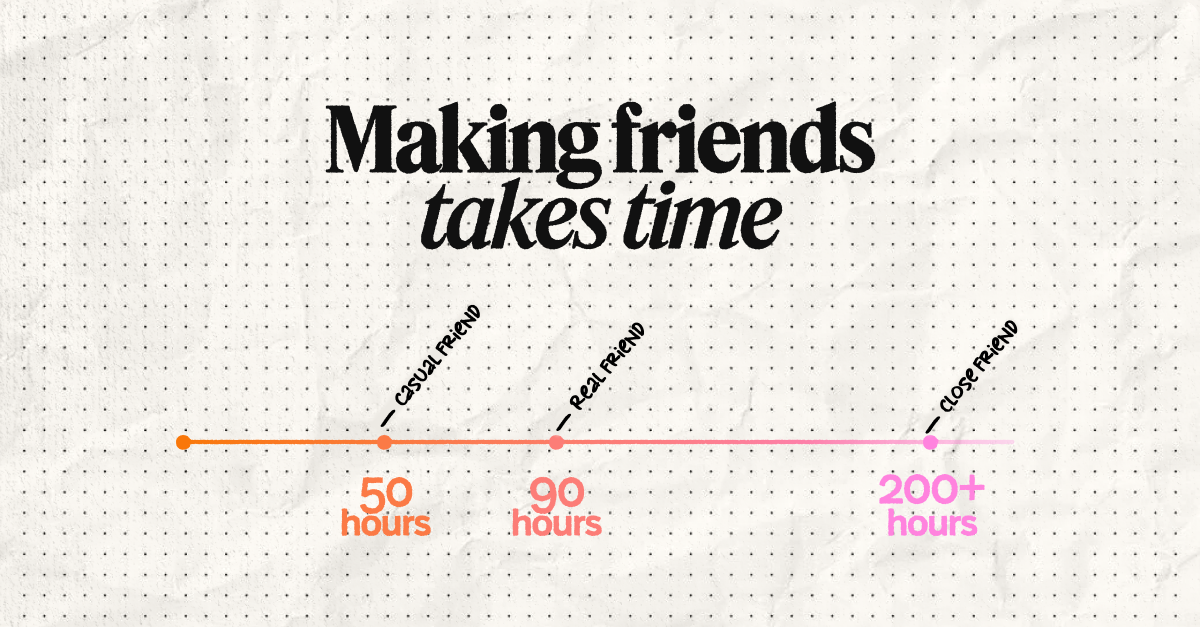
Remember, friendship grows through time spent together. Studies suggest it takes roughly 50 hours of interaction for a casual friendship to form, and much longer for close friendships.
In other words, nothing is “wrong” if a strong connection doesn’t appear immediately. What matters most is continuing to create opportunities for shared time, the ingredient every budding friendship needs to thrive.
"I'm an introvert and I'm surprised at how easily I opened up to everyone at the [Timeleft] dinners I've attended. It's been a great way to meet people and get to know the city."Simone G. (4★, US)
What if you have social anxiety?
For many people, feeling like you have no friends isn’t just about life circumstances. Social anxiety can make the process of meeting new people feel extra intimidating. Even small interactions can feel high-stakes, and the thought of attending events alone or starting conversations can be overwhelming.
The good news is that there are ways to lower the pressure while still making meaningful connections. Structured social experiences, like Timeleft dinners, remove most of the hard parts: you don’t need to plan anything, you come alone (as do most other guests!), and the small group setting of six people creates a safe, manageable environment. Conversation cards help break the ice, so you never have to worry about what to say.
These small, low-pressure steps are important as they can help you start to rebuild confidence over time.
That said, if anxiety feels overwhelming or prevents you from taking even tiny steps toward socializing, it can be helpful to seek professional guidance. A therapist or counselor can provide strategies tailored to your situation and help you break the isolation cycle safely.
The key takeaway? Social anxiety doesn’t have to stop you from making friends, and there are structured ways to make connecting easier while you build confidence.
Tools and resources for making friends from scratch
Starting from zero doesn’t mean starting alone. There are a handful of tools designed to help adults create social opportunities without pressure:
- Timeleft — The Friendship App connecting strangers over weekly dinners, drinks, coffees, and runs in 200+ cities. Groups of six, personality matching, conversation cards, and a two-hour format make it easy to meet new people even if you have no existing friends. Over 3 million users have attended Timeleft experiences, and many first-time solo attendees form lasting connections.
- Bumble BFF — Meet local people with similar interests through the app’s friendship mode.
- Meetup and local interest groups — Join recurring clubs, classes, or casual meetups that fit your hobbies or lifestyle. Think pottery, book club, run clubs, dog training, and so much more.
Pick one or two that feel achievable and commit to showing up consistently.
FAQ
Q: Is it normal to have no friends as an adult?Absolutely. Life changes, relocations, and busy schedules make it common.
Q: How do I make friends when I have none?Start small: create opportunities to be around people, attend structured social events, and practice one-on-one conversations. Over time, these repeated interactions naturally lead to friendships.
Q: Why do I have no friends?Friendships often fade due to life transitions, moving, career changes, family commitments, or the simple drift of adult life. It’s rarely about personal failure.
Q: How long does it take to make friends as an adult?Research suggests it takes roughly 50 hours of interaction to form a casual friendship and up to 200 hours for a close friendship. Patience and consistency are key.
Ready to take one tiny step?
Friendship doesn’t happen instantly, but your first step could be as simple as booking a Timeleft dinner this week. No planning, swiping, or bios. Just a shared meal and a chance to meet your people in a small, supportive group.
Book your Timeleft experience and start rebuilding your social life today.