TL;DR: For introverts, the exhaustion of socializing does not come from people. It comes from the executive function cost of navigating unstructured formats: where to stand, when to leave, how to start a conversation. Timeleft removes this cognitive load by providing a fixed table, a pre-booked venue, and a predictable end time. By replacing social improvisation with clear logistics, the format lets you enjoy real conversations without draining your social battery before the main course arrives. Take the personality quiz to see how the format works.
If you have ever spent 20 minutes in your car outside a social event calculating your exit strategy, you do not have a people problem. It's just not the right social format.
Most introverts genuinely like people. What they dislike is the mental overhead of figuring out where to stand, how to start a conversation, and when it is acceptable to leave. That cognitive cost runs on the same finite mental resource as every other complex task in a day, and it burns through that resource fast. This article explains what is actually happening inside that drain and why the specific structure of a Timeleft dinner changes the energy math in a way that open-ended formats cannot.
Why unstructured socializing drains your energy
Understanding where the drain comes from is the first step to designing around it. The mechanism is neurological, not a personality flaw.
The "social battery" is not a soft metaphor. It maps directly onto something neurological: cortical arousal and the executive function budget your brain allocates to any situation. Hans Eysenck's arousal theory proposed that introverts have higher sensitivity in the ascending reticular activating system (ARAS) and are consequently more cortically aroused than extroverts, a hypothesis that has since been refined but remains a foundational frame for understanding introversion.
How structure saves your social energy
Susan Cain, author of "Quiet," argues that introverts are more sensitive to incoming stimulation and do their best work when the volume of external input is lower. As Cain puts it: "If you're feeling drained, as though your internal battery is on its last dregs, you might be an introvert."
Less input, more bandwidth. When a social setting removes the real-time decisions about logistics and social protocol, you stop spending mental energy managing the format and start actually being present in the room.
How built-in end times reduce anxiety
Knowing the exit point changes everything. Uncertainty reduction theory shows that individuals find uncertainty uncomfortable and actively seek to reduce it. An undefined end time adds a layer of uncertainty that doesn't disappear until the event is over, keeping part of your attention occupied all evening: "is it okay to leave now, or will it look rude?" A dinner that concludes naturally at a fixed, known time shuts that question off before the evening starts. When the plates are cleared and the bill is settled, the evening is over. Nobody suggests one more round. You don't need a cover story or a fake 10:30 pm commitment to get out the door. It just ends. A clear conclusion is neurologically restful in a way that open-ended formats are not.
The hidden labor of social chaos
At an open networking event or unstructured party, you make dozens of micro-decisions before you have said a word: where to stand, who to approach, whether a group is open to being interrupted, and how to exit a conversation that has run its course. Sustained decision-making is mentally costly, drawing on the same limited attention and self-control resources that Sweller's cognitive load theory describes. Attention, working memory, and executive control are finite resources that degrade with sustained use, all drawing from the same pool as self-presentation and planning. In an open format, you burn through that pool before the conversation worth having has begun.
Removing the guesswork from social events
Timeleft addresses each of these drains directly. You take a personality quiz, choose a format and date, and the algorithm handles everything else. Timeleft hosts dinners regularly in more than 200 cities across 52 countries, with 96% of diners reporting compatibility with their matched group. That figure matters because it means the algorithm is doing the relational work that would otherwise fall to you.
Skip the stress of finding your table
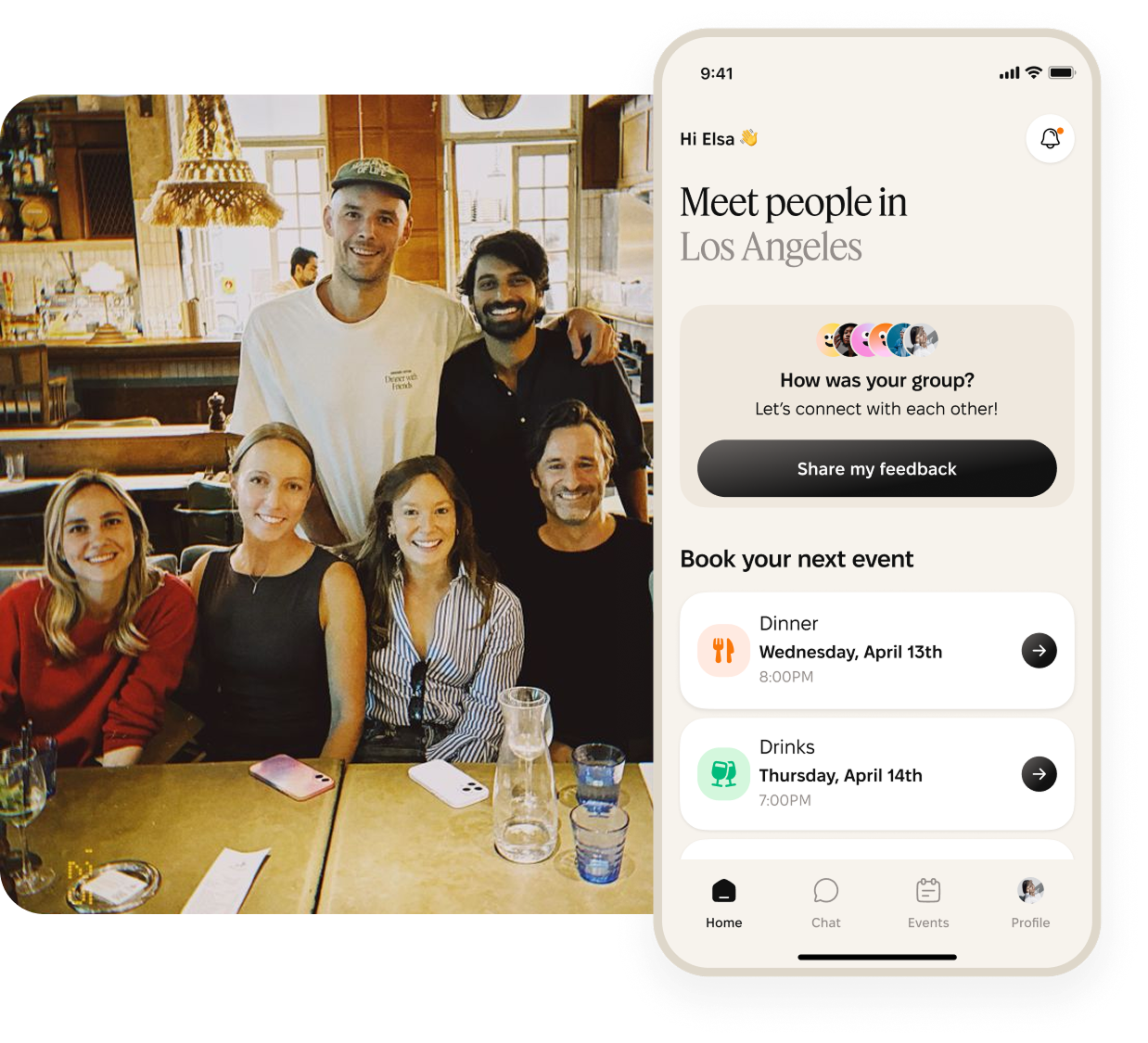
Timeleft assigns you to a fixed group of 4–6 people, and your place at it is already part of the booking. You don't have to scan the room or work out who looks approachable. Your spot is already there. How Timeleft matches you with a group is handled by an algorithm drawing on your personality quiz to build a compatible group. You do not browse other attendees beforehand. You walk in, find your table, and sit down.
Pre-selected venue: zero planning required
By removing the restaurant choice from your hands, Timeleft eliminates the pre-event research spiral with a venue reveal within 24 hours. You will not spend Tuesday afternoon reading reviews of five different places, second-guessing your choice, and arriving already tired from the planning. The decision is already made, leaving nothing left to overthink.
How structure protects your social battery
An assigned table, a pre-booked venue, and a known end time work together as an external nervous system. Instead of your brain running constant background calculations about logistics, timing, and social protocol, the format runs them for you. This is why Timeleft costs less for introverts than open formats: not just because the experience is pleasant, but because the cognitive overhead is structurally lower from the moment you book. The background process that monitors social risk in unstructured settings goes quiet because there is nothing to monitor.
Predictable logistics and contained duration
Operational logistics are fixed and repeatable. You take the personality quiz once, book a date, and receive your venue details within 24 hours before the event. You arrive at your scheduled time, your table is already assigned, and in-app conversation prompts help the group get started without requiring anyone to carry the opening minutes alone. A fixed, known duration is a quantity you can plan around and pace yourself within. Open-ended formats do not offer this: when you do not know how long an event will run, your brain cannot allocate energy efficiently, and it either hoards defensively or spends without knowing the limit. You can review current plan options on the pricing page, and food and drinks are paid directly to the venue at the end of the evening.
Reduced recovery time after dinner
How drained you feel the next morning has a lot to do with how much your brain had to resolve on the way home. The post-event processing load is lower than after an open party where the social rules were unclear and the exit had to be negotiated.
Predictable timing for introvert dinners
Timeleft dinners run in one sitting, at one table, with the same group of 4–6 people from start to finish. The group stays together at the same table from start to finish. There's no room-switching, and the conversation never resets. That consistency is a structural advantage for anyone whose energy responds badly to context-switching. Knowing the window in advance is the difference between a shift you can pace yourself through and one where you have no idea how long is left; the latter is what turns one difficult evening into a week of not wanting to try again.
| Venue type | Seating style | Energy drain mechanism |
|---|---|---|
| Timeleft partner restaurant | Fixed table (assigned) | Low: group, table, and end time are fixed before you arrive; no real-time logistics decisions required |
| Open networking event | Unstructured, no assigned place | High: repeated self-introduction, continuous room-reading, no defined exit point |
| Traditional bar or pub | Unstructured, no assigned place | High: self-directed socializing throughout, open-ended duration, no structural anchor |
| Interest-based group event | Depends on activity and organizer | Medium: activity provides partial structure, but cognitive cost varies significantly by organizer and format |
"I've had great experiencies in timeleft dinners, and found great friend, with whom I am creating memories! I truly recomend Timeleft" - Cristal on Trustpilot
Preserving your social battery
Users who attend regularly often describe a pattern worth noting: the format becomes more comfortable over time, not because they have become more extroverted, but because the known structure reduces the anticipatory cost with each booking. The app is also designed to help you stay in contact with people you meet, turning one structured evening into the start of something that does not require event infrastructure to continue, as Timeleft's guide to scheduling follow-up meetups covers.
Why structure fuels better interactions
In-app conversation prompts give the group a shared starting point without requiring anyone to perform. The format supplies the first few minutes. From there, conversation moves on its own, and you can participate at the level your energy allows without generating the entire social structure yourself.
Designing social events for introverts
The following checklist captures the structural features that determine whether a social event is genuinely low-energy or just marketed as one. Timeleft builds every item into its dinners by default.
Social battery audit checklist
- Fixed start time, so you know exactly when to arrive
- Fixed end time, so you know exactly when you can leave
- Table number shared before you arrive, so there is no room-scanning decision on arrival
- Small group size (4–6 people), so no single person has to carry the room
- Pre-booked venue, so there is no restaurant research before the event
- Venue announced within 24 hours, so there is no open-ended anticipation spiral
- Structured conversation openers, so the first five minutes are not your problem to solve
- No networking pitch expected, so you can focus on conversation rather than performing
- No swiping, no pre-event texting, no logistics negotiation with people you have not met
- Clear behavioral norms, so you are not guessing the social rules of the room
Timeleft offers this format across dinner, drinks, coffee, runs, and walks, with dinner being the highest-volume format and the one most optimized for the structure above. You can also book events in other cities when you travel, so the same predictable format travels with you.
Can I leave the dinner early?
Yes, but you rarely need a plan for it. The dinner runs for a fixed, known length, and the natural rhythm of a meal creates built-in transition points that make leaving feel socially normal rather than abrupt.
Managing your social battery duration
Practical preparation that helps most involves keeping the afternoon before your dinner low-stimulation. The format itself will not drain you before you arrive, but arriving already depleted from a high-demand day raises the cost of the evening regardless of structure.
Managing talk in a structured setting
Timeleft seats you with a group of 4–6 people, and that size is intentional: enough people to sustain interesting conversation, few enough that everyone at the table actually gets to speak.
At a small, fixed table, you do not have to fill silence to avoid it becoming awkward. Someone else is already talking. Compare that to a two-person Bumble BFF meetup, where conversations routinely fizzle before anyone suggests actually meeting up. Timeleft removes that coordination and chemistry burden entirely: the algorithm seats you and the evening runs itself. Timeleft's algorithmic matching removes the organizer dependency entirely, so every dinner delivers the same structured format regardless of city or host. Timeleft runs a structured format across 52 countries and 200+ cities, so the format is consistent wherever you are.
See which formats are available in your city, or take the personality quiz to book your first event. The quiz takes a few minutes, the dinner has a clear end time, and the planning takes none.
FAQs
Is Timeleft good for introverts?
Yes. Timeleft assigns your table and pre-books the venue, removing the real-time decisions that drain most introverts before a word is spoken. You're matched with a group of 4–6 people and the dinner concludes at a fixed, known time. These structural features eliminate the micro-decisions that drain an introvert's social battery in open-ended formats.
How do you manage social anxiety at events?
Timeleft removes the main sources of pre-event anxiety by assigning your table, pre-booking the venue, and revealing the location within 24 hours before. In-app conversation prompts handle the opening few minutes so no single attendee has to carry the social start alone.
What happens if not everyone shows up to the dinner?
Timeleft uses a no-show penalty to discourage last-minute cancellations and keep tables as full as possible. For the exact amount, see the no-show penalty entry in the glossary below.
How long does a Timeleft dinner last?
Timeleft dinners run for approximately three hours. The natural rhythm of a dinner service creates a clear end point without requiring anyone to negotiate when to leave. Some cities also offer a Last Drink after dinner if the table wants to keep the evening going, but there's no pressure to stay.
Can I attend a Timeleft dinner in a different city?
Yes. Your plan covers events across Timeleft's full city footprint. The help article on booking events in another city covers the specifics.
How big is the dinner group?
Groups run at 4–6 people: enough to keep conversation going, few enough that everyone at the table actually gets to speak.
Do I have to talk the whole time?
No. A fixed group of 4–6 people distributes the conversational load naturally, so you participate when you want to without being responsible for filling silence. The format supports genuine presence rather than constant performance.
Key terms glossary
Social battery: The finite mental resource introverts draw on during social situations, which depletes with sustained interaction and requires recovery time to recharge.
Cortical arousal: The baseline level of stimulation in the brain's cortex. Introverts have chronically higher cortical arousal than extroverts, meaning their nervous systems respond to more stimuli from the same environment.
Executive function: The set of mental processes that manage complex tasks, including planning, decision-making, self-regulation, and working memory. Social situations that require navigating unstructured formats draw heavily on this finite resource.
Decision fatigue: The degradation of decision-making quality that occurs after sustained periods of making choices. Each micro-decision at a social event (where to stand, when to leave, how to start a conversation) depletes the same cognitive budget.
Cognitive load: The total amount of mental effort being used in working memory. High cognitive load from managing social logistics leaves less bandwidth available for actual conversation and connection.
Uncertainty reduction theory: A communication theory showing that people find uncertainty uncomfortable and actively seek information to reduce it. In social contexts, not knowing when an event will end creates persistent low-level anxiety throughout the evening.
Within-24-hour venue reveal: Timeleft's practice of announcing the restaurant location within 24 hours of your dinner, eliminating the pre-event research spiral and removing the opportunity to overthink the decision.
Personality quiz: The short assessment Timeleft users complete during onboarding, which the algorithm uses to build compatible groups without requiring users to browse profiles or coordinate with strangers beforehand.
Matched group: The group of 4–6 people Timeleft assigns you to based on your personality quiz responses, designed to be compatible without being identical, removing the need to self-select who to approach.
No-show penalty: The accountability mechanism Timeleft uses to discourage last-minute cancellations. Currently 35% for some plan types, with the exact amount varying by model and shown in your plan's terms. Helps to keep tables full and the format reliable for everyone who does show up.