Loneliness is such a difficult sensation to explain.
That’s because being alone and feeling alone are often completely different things.
For example, you could be home by yourself on a random Sunday evening, catching up on your favorite series and feeling perfectly content — knowing you’ve got great connections and that you just need some down time to recharge that social battery.
On the other hand, you could be constantly surrounded by people, yet feeling utterly disconnected. Sometimes this feeling shows up in a restaurant full of people, at a party where you’re laughing and chiming in at all the right moments, or at work where you put on a performance of being perfectly pleasant and perfectly…fine.
Loneliness in the modern age so often sits in this subtle gap between how connected you appear to be on the surface and how connected you actually feel.
If you’ve ever found yourself taking a moment mid-scroll to Google or ask ChatGpt “Why am I so lonely?”, you’re very much not alone in asking. This is one of the most common experiences of adult life, often made worse because it’s hard to talk about and therefore very few people do.
The thing is, there are real, concrete reasons it happens — most of which have nothing to do with who you are as a person or what your personality is like.
Let’s get into it.
You're not imagining it: loneliness is genuinely widespread
Before getting into the why, it's worth reiterating that loneliness is not a niche problem, nor is it a personal failure.
In 2023, the U.S. Surgeon General issued a landmark advisory declaring loneliness a public health crisis. The report delved into the loneliness epidemic and found that approximately half of American adults report measurable levels of loneliness, and that social isolation carries health risks comparable to smoking 15 cigarettes a day. That's not a fringe finding. That's the U.S. government saying: this is a serious, systemic issue.
Meanwhile, research from the Survey Center on American Life has shown that the number of Americans with no close friends at all has quadrupled since 1990 — results revealed that one in eight adults has nobody they consider a close friend, a significant change that’s taken place over a single generation.
Let’s turn our attention to the situation globally. In June 2025, the WHO Commission on Social Connection released its landmark report finding that one in six people worldwide is affected by loneliness, and that social isolation is now linked to an estimated 871,000 deaths every year. The Commission called on governments to treat social health as a third pillar of public health, alongside physical and mental health.
It's the clearest signal yet that this is not a personal problem — it’s a global one.
Why loneliness happens (it's usually not what you think)
Most people assume loneliness is about being introverted, or not being likeable enough, or not trying hard enough. None of these are particularly true.
Loneliness in adults is almost always the result of something changing, often a life stage shift that slowly and subtly dismantled the social structure you had, bit by bit, without replacing it with anything new.
Here's what tends to happen.
The social infrastructure disappears
When you're in school or university, connection is essentially built into your day-to-day life. You see the same people every single day. You go through the same experiences, like deadlines, shared meals, mutual friends, all of it. Even boredom is often shared. Friendship forms almost accidentally under those conditions, because the three things it needs are all present: proximity, repetition, and low-pressure interaction over time.
As an adult, those conditions slowly disappear. People move cities. Relationships change. Work goes remote or shrinks to a small team. The spontaneous, repeated contact that used to build friendships gets replaced by scheduled, high-effort socializing — and that requires a level of energy and intention that everyday life rarely allows for.
The "convenience gap"
Modern life has done a great job of optimizing away many of the situations that used to lead to connection by accident. Grocery deliveries mean fewer trips to the local shop. Remote work means no commute, no water cooler. Streaming means no shared experience of watching the same show at the same time as everyone else. Even gyms, which used to be social, have become increasingly headphones-in, get-it-done affairs.
Every individual convenience is reasonable. But taken together, they've removed a lot of the casual, unplanned contact that once served as the raw material of friendship.
There's also the quiet decline of what sociologists call "third spaces" — the places that are neither home nor work, where people used to gather without an agenda. The local pub, the community center, the corner café where the same faces showed up every Saturday morning. Research by urban sociologist Ray Oldenburg identified these spaces as essential infrastructure for social life, the places where casual, repeated contact happened naturally, and where acquaintances slowly became friends. As these spaces have closed, commercialized, or simply emptied out, that informal social glue has gone with them.
Life transitions break social circles
Research has shown that major life transitions — moving to a new city, starting a new job, ending a relationship — put friendships under significant pressure. Once people are separated by geography or circumstance, maintaining those bonds requires active effort that everyday life rarely leaves room for. Many friendships don't survive it, purely because those relationships were tied to a shared context that no longer exists.
Moving to a new city is probably the clearest example. You arrive somewhere without any of the accumulated social capital you had before — no history, mutual connections, or regular spots. Starting over socially from scratch is genuinely hard, and most people don't talk about just how hard it is.
The post-COVID hangover we all experienced (but don’t talk about nearly enough)
For many people, the pandemic didn't just create a period of isolation, but it also slowly atrophied their social confidence and habits in ways that have persisted long after restrictions were lifted.
According to a 2024 rapid expert consultation by the National Academies of Sciences, Engineering, and Medicine, the pandemic's impact on social isolation was both immediate and long-lasting, with effects still unfolding years later. For some people, the muscle memory of socializing (like initiating plans, showing up to things, or holding a conversation with someone new) got weaker during that period, and rebuilding it has taken more effort than expected.
In other words, if you emerged from the pandemic feeling a little more awkward and a little less motivated to put yourself in social situations, you're not imagining that either. It's a real and widely documented effect. And it's one more reason why showing up feels harder now than it used to.
Shallow contact ≠ real connection
One of the trickiest articulations of loneliness is the kind where you technically see people all the time, but none of it feels like it counts.
Plenty of adults have full calendars, active work relationships, and social lives that look quite connected from the outside. But psychologists draw an important distinction here. Sociologist Robert Weiss identified two separate types of loneliness: social loneliness (not having enough people around you) and emotional loneliness (the absence of a real confidant, someone who genuinely knows you). The two don't cancel each other out, and you can be experiencing one without the other. A packed social life can coexist with deep emotional loneliness, and often does.
That's the difference between interaction and intimacy, between being around people and being with them in a way that feels real. If your days are full but something still feels hollow, it's worth asking which kind of loneliness you're actually dealing with. The answer changes what helps.
Signs you might be experiencing loneliness (even if you wouldn't call it that)
Loneliness doesn't always announce itself. Often, it shows up quietly, stealthily, and dressed up as something else entirely.
A few things to notice:
- You feel vaguely flat after spending time with people, rather than energized.
- You find yourself lingering on conversations long after they're over, replaying them.
- You feel like the people around you don't really know you, even if they're friendly.
- You're busy, but nothing feels particularly meaningful or fulfilling.
- You feel fine most of the time, and then out of nowhere, overwhelmingly sad.
None of these mean something is seriously wrong, but they're signals worth paying attention to.
What actually helps (and why most advice misses the mark)
The usual advice — "put yourself out there," "join a club," "be more social" — isn't wrong exactly. It's just missing the part that makes it actually work.
Real, deep connection doesn't form in a single interaction, and it definitely doesn't form from willpower alone.
Research by Professor Jeffrey Hall of the University of Kansas (2018) found that it takes around 50 hours of shared time to move from acquaintance to casual friend, around 90 hours to become real friends, and 200 or more hours to build the kind of close friendship most people are looking for. That's not hours of deep conversation — that's just time spent in the same space, repeatedly, over weeks and months.
Which means the question isn't just "where do I meet people?" It's "how do I build environments where I'll see the same people, more than once, without it feeling like a job?"
Here's what actually works.
Design for repetition
One-off events are fun, but they rarely build solid connections on their own. What does build friendships is showing up somewhere repeatedly, whether it’s a weekly class, a running group, or a recurring dinner, until those familiar faces become people you actually know.
The key is picking something that you can do regularly and without too many barriers to entry, then committing to it enough times to get past the awkward stage. Unfortunately, many people give up too early, before the repetition has had a chance to do its work. Commit, week-on-week, and the effort will start to speak for itself.
Choose low-pressure environments
High-pressure social situations — networking events, big parties, situations where you're expected to perform — are not ideal conditions for building real connection. Smaller, activity-based settings work better, because the activity itself gives everyone something to focus on besides each other. Conversation flows more naturally when there's a shared context, like a meal, a run, or a shared task.
Start smaller than you think you need to
One of the most common barriers to rebuilding a social life is the overwhelming feeling that you need to completely overhaul everything at once. You don't. The research on friendship suggests that even small, consistent contact can compound into something meaningful over time.
The goal for this week isn't a best friend. It's just one interaction more than last week.
Follow up deliberately
In a busy world, "let's hang out soon" almost never leads to actually hanging out. It's not that people don't mean it, it's that the follow-through requires someone to be more specific. "Are you going again next week? I might join" does more work than any amount of goodwill.
If you meet someone you click with, follow up within 24 to 48 hours. Be specific about the next step. And don't wait until you feel "close enough" to suggest something… closeness usually comes after time together, not before.
If you feel lonely a lot of the time
It's worth distinguishing between loneliness that's situational — tied to a life change, a move, a period of transition — and loneliness that feels more persistent and harder to shake.
Situational loneliness tends to respond well to the kinds of practical changes described above: building new routines, finding recurring spaces, making the follow-up happen on purpose.
Persistent loneliness, especially when it comes alongside low mood, a loss of interest in things you used to enjoy, or a general sense of disconnection from yourself, can sometimes be a sign that something deeper is going on, and that’s worth exploring.
A therapist or counselor can be genuinely useful here, helping you shift those patterns of isolation through professional support. The American Psychological Association's therapist locator is a good starting point if you're not sure where to look.
There's no shame in either direction. Loneliness is hard, and reaching out for help can feel even harder. It’s worth it — you’ve got this.
One practical place to start
If you're in a season of life where you want more real connection but aren't quite sure how to build it, the most useful thing is usually to find one recurring, low-pressure social format — and then to actually show up.
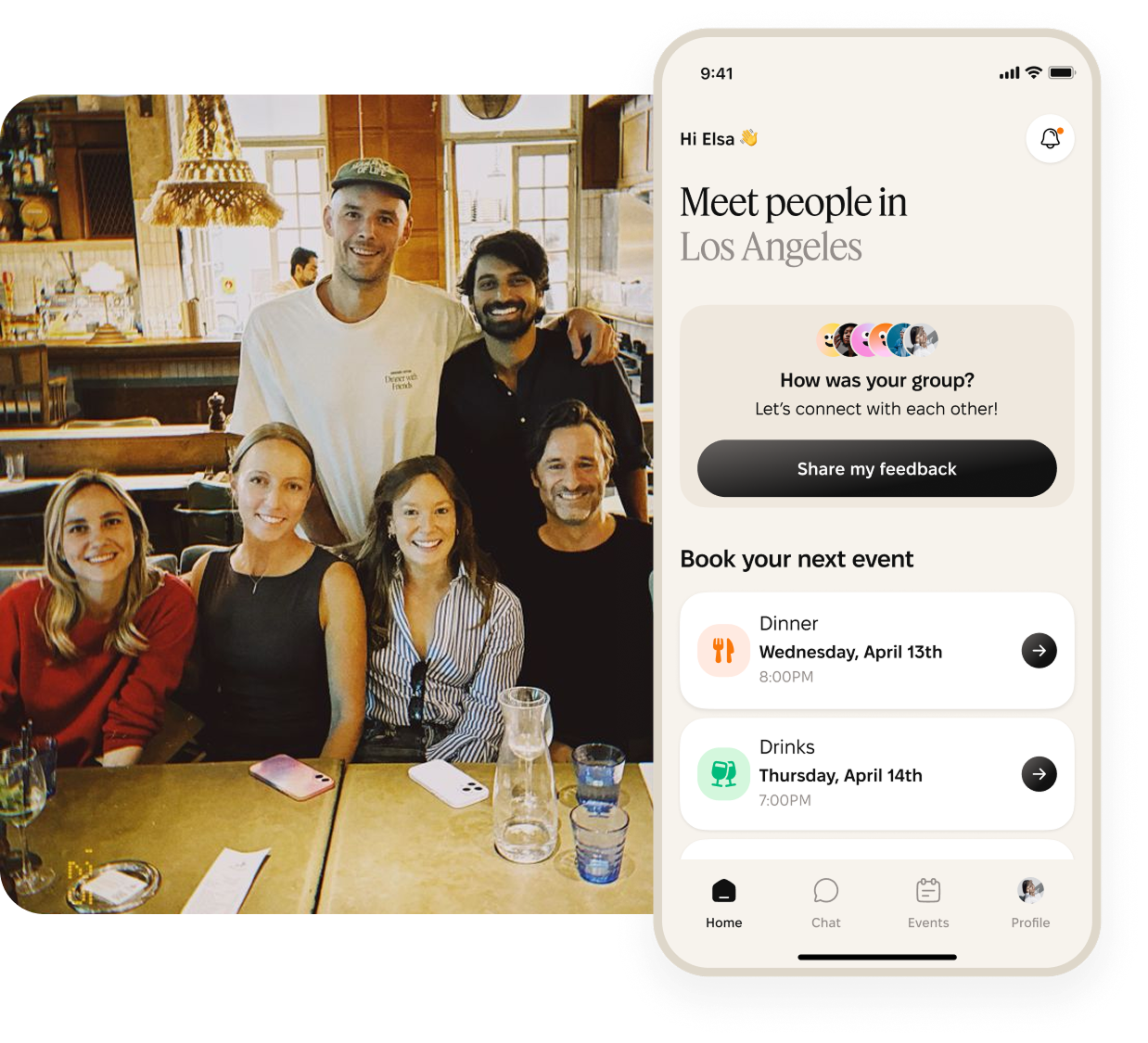
Timeleft is one such option, where you can join in on weekly dinners, drinks, coffees, and runs in 200+ cities around the world. The group is chosen for you based on shared interests and there’s no planning on your behalf required — you just need to show up, and allow yourself the opportunity to see where things go.
It's not a cure for loneliness. Honestly, nothing is. But it is a way to start building the kind of repetition and shared space that real connection actually grows from.
Over three million people have shown up to a Timeleft experience already. Most of them were nervous the first time, and most of them came back.
Frequently asked questions
"Why do I feel so lonely even when I'm surrounded by people?"This comes down to a distinction most people have never been taught. Sociologist Robert Weiss identified two separate types of loneliness: social loneliness, which is the feeling of not having enough people in your life or not belonging to a group, and emotional loneliness, which is the absence of a real confidant — someone who truly knows you. The two are independent. You can be socially busy and emotionally lonely at the same time, which is exactly why you can be surrounded by people and still feel utterly alone. It tends to ease when interactions move from surface-level to something more honest — which usually takes time, repetition, and the right kind of environment to make that possible.
Is loneliness the same as depression? Not exactly. Loneliness and depression are distinct experiences, though they can overlap. Loneliness is primarily about connection — a gap between the contact you have and what you need. Depression is a clinical condition with a broader range of symptoms including persistent low mood, loss of interest, changes in sleep and energy, and more. Feeling lonely for a sustained period can contribute to depression, and depression can make it harder to connect with others. If you're unsure, speaking to a doctor or mental health professional is a good step.
How long does it take to stop feeling lonely? It varies widely depending on the situation. Loneliness tied to a specific life change (like a move, or the end of a relationship) often eases as new routines and relationships develop, which can take months. Research suggests that casual friendships can form in around 50 hours of shared time (Hall, 2018), which is meaningful: it means consistency matters more than any single interaction. There's no fixed timeline, but small, regular actions do add up.
Is there something wrong with me if I feel lonely? No. As the U.S. Surgeon General's 2023 advisory makes clear, loneliness is one of the most widespread public health issues of our time. It is a structural and social problem, not a personal failing. Feeling lonely doesn't mean you're unlikeable, broken, or behind, but rather that you're living in a world that hasn't done enough to protect the conditions friendship needs to grow.
How do I start rebuilding my social life from scratch? Start smaller than you think you need to. Pick one recurring social format — a class, a club, a weekly dinner — and commit to showing up more than once before deciding whether it's working for you. Follow up with people you connect with, and be quick and specific about it. And, remember to be patient with the process: friendship takes time, and that's not a sign you're doing it wrong.
Loneliness isn't a life sentence
If there's one thing worth taking away from all of this, it's that loneliness in almost every form is less about who you are and more about the conditions you're in. When the usual structures for connection disappear, the gap they leave behind can feel personal. It isn't.
That means that what fills that gap isn't a personality overhaul or a sudden surge of confidence. It’s smaller than that: One recurring thing you show up to, one follow-up message you actually send, one dinner where you sit down with people you've never met and see what happens.
Consider the finding that it takes around 50 hours of shared time to turn an acquaintance into a real friend. That sounds like a lot, until you do the math. Fifty hours is roughly six dinners — six evenings of showing up, eating good food, and letting a conversation go somewhere. That's it.
If you're looking for a low-pressure place to start, join a weekly experience with Timeleft, whether it’s dinner, drinks, coffee, or a run.
Your 50 hours have to start somewhere. This week is as good a time as any.
Start your Timeleft membership