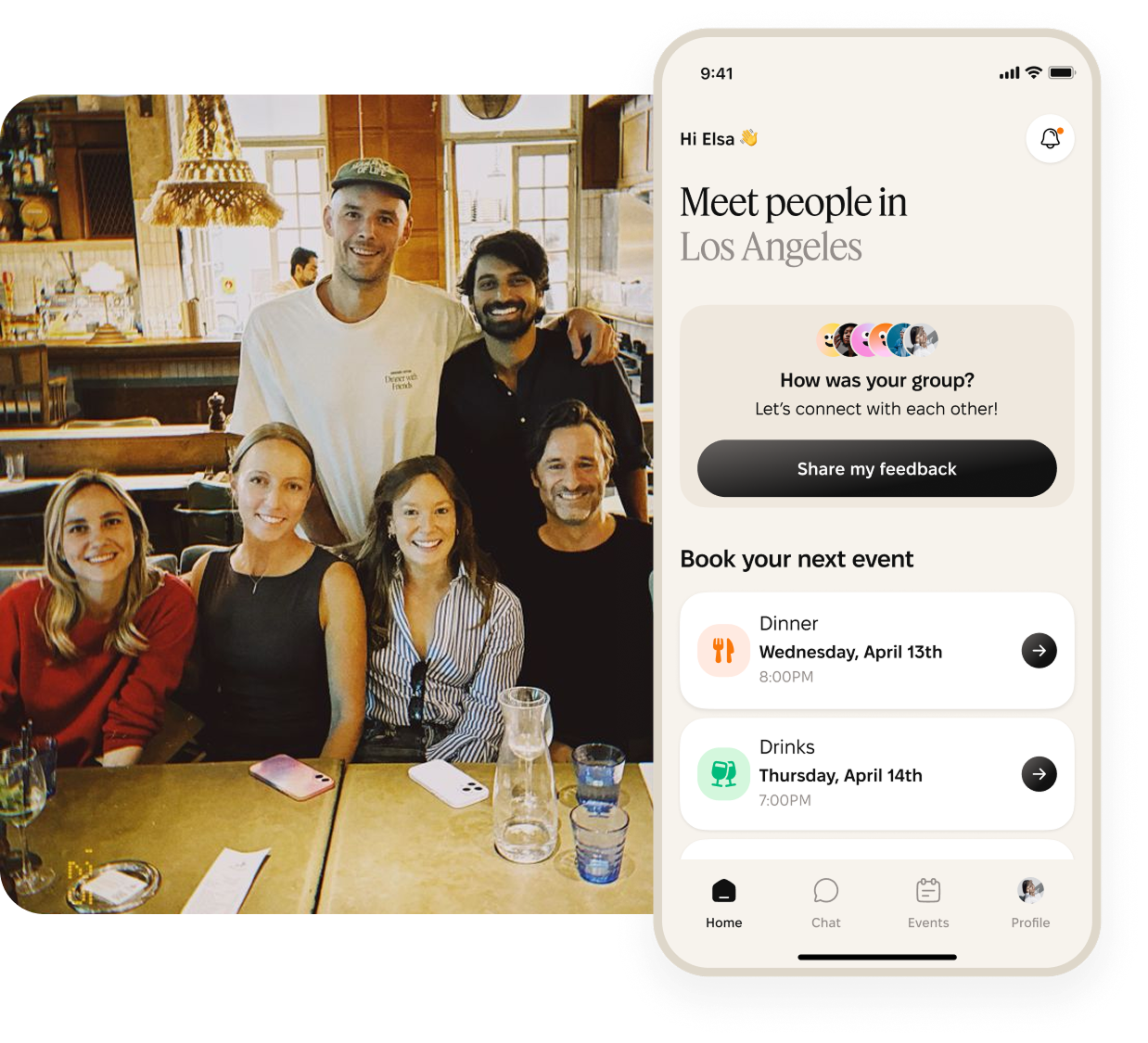
TL;DR: Timeleft is built for adults who find unstructured social events exhausting, not because they dislike people, but because the standard social format places every decision on them. If you prefer a fixed group, a pre-booked venue, and a clear end time over open-ended mingling, this self-assessment will tell you whether the structure fits your social capacity. If you need to know who you're meeting before you commit, or you're primarily looking for dates, it probably isn't. Timeleft offers dinner, drinks, coffee, runs, and walks across 200+ cities in 52 countries. Check current city availability before you book. Your only job is to show up.
Most social events extract a toll before you even leave the house: you negotiate a time, research a venue, plan your exit, and walk in already depleted. For a significant portion of adults, that coordination cost alone is enough to keep them home. The problem isn't wanting to meet people. It's the format.
This guide walks you through Timeleft's structure against your actual social capacity, including the honest trade-offs, so you can decide whether to book before spending time on the quiz.
Timeleft self-assessment: does it match your capacity?
The following two factors are the most reliable indicators. If both apply to you, the format is likely within your social range.
Structural support for lower social drain
The core of the Timeleft format is the removal of real-time decisions. The algorithm matches your group based on a personality quiz, prioritizing personality fit rather than shared demographics. The full detail is in the help center. You don't browse other attendees beforehand. You take the quiz, pick a date, choose your plan, and Timeleft handles the group composition, the venue booking, and the confirmation.
The reason it matters is that many people describe every unmanaged decision during a social event as pulling from the same mental energy that powers the actual conversation. When the venue is pre-booked, the group is pre-matched, and the format has a clear end point, that energy stays available for showing up as yourself rather than managing the logistics around you. 96% of diners report feeling compatible with their matched group, which reflects the design intent: the algorithm prioritizes psychological fit, not just shared postcode or age bracket.
Structural support removes specific barriers
If you want a quick answer, the scored checklist in the "Signs Timeleft is right for you" section below covers each of these indicators with more detail.
Why predictable logistics matter for you
The case for structure isn't abstract. There's research behind it, and a direct comparison between Timeleft and standard unstructured formats that makes the difference concrete.
How structure reduces social exhaustion
Research by Associate Professor Jeffrey Hall, published in the Journal of Social and Personal Relationships, found that it takes somewhere between 40 and 60 hours of shared time to move from acquaintance to casual friend. Time spent together, particularly in leisure and shared-experience contexts, is what drives that transition.
The cognitive cost of reading the room, finding conversational openings, and timing your exit often outweighs the benefit, and that's a format problem, not a motivation problem. Making friends as an adult is genuinely harder when the infrastructure to do so places all the organizing weight on you.
Why fixed formats reduce social cost
Compare the standard unstructured event against what Timeleft provides across the variables that matter most to people with limited social bandwidth.
| Variable | Unstructured (party, bar) | Semi-structured (Meetup, Bumble BFF) | Timeleft dinner |
|---|---|---|---|
| Coordination effort | High: you plan it or accept chaos | Medium: you browse, RSVP, hope it runs | None: algorithm and venue are pre-handled |
| Masking energy required | High: no rules, constant improvisation | Medium: organiser-dependent | Low: structured table, fixed start, conversation starters provided |
| Exit predictability | None: you decide and manage alone | Low: varies by event | High: dinner has a natural end built in |
| Group size | Large and unpredictable | Varies by organiser | Small, pre-matched group |
| Pre-event decision load | High: venue, time, company | Medium: browsing, RSVPing | Low: quiz, date, done |
For people who normally spend significant mental energy calculating when and how to leave a social event, a built-in endpoint removes that calculation entirely. Dinner ends. You're not managing a departure. Everyone goes home at roughly the same time, and that's not a small detail. It's often the difference between attending and cancelling.
That removal of the exit calculation also matters for building the kind of recurring habit that actually produces new friendships. A monthly dinner you don't have to organize is a more sustainable source of shared hours than waiting for a spontaneous plan to materialize, and building and following through on friendships gets easier when the format does the scheduling for you.
A fixed seat means you're not spending the first ten minutes working out where to stand. The compatibility work is already done before you arrive. And when dinner ends, it ends. No one is managing anyone else's expectations about staying longer.
Meetup's open, organiser-dependent format means group sizes and structure vary wildly from event to event. Timeleft places you at a small, pre-matched table, removing the anxiety of entering a crowded room. Exploring what Timeleft got wrong about connection makes clear that proximity alone doesn't produce friendship. The format has to do more of the work.
Concrete benefits of the set structure
The operational details are the actual value here. Here's what the format delivers in practice:
- 24-hour venue reveal: You find out which restaurant you're going to the night before, so the decision is already made. You can read about the full range of event types in the help center.
- In-app conversation starters: Timeleft provides icebreaker questions so nobody at the table has to carry the opening moment alone.
- Fixed table size: Group sizes are kept small, keeping the immediate conversation manageable regardless of the broader restaurant environment.
- Post-event connection: After dinner, you choose who to stay in touch with through the app, with no pressure to exchange numbers during the evening.
Evaluating your readiness for a structured dinner
Before you book, it helps to check two things: whether the format fits your energy on a typical evening, and what the full cost actually looks like.
Determining your personal energy budget
A Timeleft dinner has a fixed, predictable length. You travel to a pre-booked restaurant, sit at a small, matched table, and the evening has a natural close when dinner ends. For a significant share of adults, the real barrier to a social evening isn't wanting to go. It's the format: the unmanaged decisions, the unclear endpoint, the cognitive overhead that starts before you leave the house. Format design, not desire, is often the real constraint.
The practical question becomes: do you have the capacity for a structured, low-decision dinner at a small pre-booked table with a clear end time? If yes, Timeleft is likely within your range.
Calculating the true price of socializing
| Cost type | Doing it yourself | Using Timeleft |
|---|---|---|
| Planning effort | High: texts, venue research, chasing confirmations, managing dropouts | Low: quiz, pick a date, done |
| Mental energy before the event | High: managing dropouts, route, expectations | Low: venue confirmed, group matched |
| Financial cost | Variable: often higher due to spontaneous choices | Plan cost (varies by model) plus your meal at the venue |
| Exit management | You decide and own the exit alone | Dinner ends naturally, no negotiation required |
Your personal checklist for social safety
Safety at a Timeleft dinner operates on two levels: knowing the rules before you arrive, and knowing what happens if something goes wrong.
Why structure matters for social ease
Physical and psychological safety in a social setting isn't just about the absence of threat. It's about knowing the rules before you arrive. Timeleft's safety infrastructure includes block and report tools, proactive screening before matching, and a three-stage enforcement system: educational warning, formal warning, and permanent ban. As Timeleft's own safety messaging states: "a report button is a last resort, not a strategy." You can read the full framework in the staying safe at meetups guide. Timeleft requires real names and real photos, is 18+ globally (21+ in UAE), and maintains a zero-tolerance policy for any behavior involving the sexual exploitation or abuse of minors.
Socializing without the performance tax
Timeleft is not a dating app. This is worth stating directly, because it changes what you're asked to perform at the table. There's no profile to optimize, no opener to craft, and no romantic subtext built into the format. Timeleft is explicitly platonic, with a zero-tolerance policy for continued romantic pursuit after rejection written into Timeleft's Community Guidelines. For LGBTQ+ diners specifically, this matters.
The algorithm builds each group on personality compatibility, not age bracket or background. You're matched to a table, not a potential partner.
What Timeleft can and can't guarantee
Being honest here is more useful than being reassuring.
What Timeleft guarantees:
- A vetted venue from a network of 20,000+ hand-selected venues
- A group matched by algorithm across personality parameters
- In-app safety tools, proactive screening, and a clear enforcement system
- A 24-hour venue reveal so you're never walking in blind
What Timeleft cannot guarantee:
- A low-sensory environment: restaurants vary in noise level, and a busy evening at some venues will be loud. A small, matched table helps keep the immediate conversation manageable, but the broader environment is not controlled.
- That everyone at your table will become a long-term friend. That depends on the people and the evening.
- That no one will cancel. No-shows do happen, and a smaller table than expected is a real possibility. The cancellation penalty exists specifically to protect the other people at your table, and Timeleft openly acknowledges this as an ongoing friction point.
What to expect from the evening's structure
The practical shape of the evening is straightforward. Here's what the first few minutes look like, and how the rest of it tends to go.
What the first 10 minutes of the dinner look like
The evening starts with a practical advantage: nobody at the table is the host. The in-app conversation starters give everyone a shared starting point, so the first few minutes have structure built in rather than relying on whoever arrived most extroverted. Most first-timers describe the first 10 minutes as the hardest part, and the rest of the evening as easier than they expected.
Once the table settles, the format allows for conversation, quiet moments, and no obligation to be "on" for the full evening. As the Timeleft blog on scheduling follow-up meetups notes, the structure is designed to lower the barrier to actual conversation, not just proximity.
Removing the guesswork from social plans
When dinner ends, you have three options. You can leave, which requires no explanation. In select cities, you can opt into Last Drinks through the app. Or you can use Timeleft's Stay Connected feature to signal to specific people that you'd like to stay in touch. The post-dinner step is entirely opt-in, with no social pressure built in. If you book through a city with availability, these features work the same way regardless of which city you're in.
Signs Timeleft is right for you
Two factors consistently separate people who find Timeleft a fit from people who don't. Both come down to how you relate to structure, not to people.
Assessing if Timeleft suits your needs
Score yourself on the following checklist. Give yourself one point for each statement that applies.
Your Timeleft fit checklist:
I prefer small groups (under eight people) over large social gatherings.
I find open-ended social events more draining than energizing.
Knowing a clear end time before I commit makes it easier to say yes.
I've tried social apps but found the DM-to-meeting conversion rate too low.
I want to meet people in person, but I don't want to organize anything myself.
I'd rather show up to a structured evening than browse profiles and plan a meetup.
I'm comfortable being in a room with a small group of strangers if the context is clear.
I want a format that's explicitly platonic, with no dating subtext.
Your score:
- 6-8: Timeleft is built for exactly how you socialize. Take the personality quiz and book your first event.
- 4-5: You're a likely fit. Read the "When it isn't a good fit" section below to check the edge cases.
- 0-3: The format may not match your current preferences. The section below will confirm.
When the Timeleft format isn't a good fit
Three situations come up consistently where the format works against rather than for the person attending. Each is worth checking before you book.
Why you require clear social boundaries
If you need to know who you're meeting before you agree to show up, this format will cause you anxiety rather than reduce it. Timeleft's design deliberately withholds profile browsing before the event. That's a feature for most users, but it's a genuine barrier if pre-approval of the group is a firm requirement for your comfort. The three-stage enforcement system and Timeleft's safety protocols mean the group is screened, not anonymous, but you won't have seen their profiles in advance.
Why the standard format isn't built around dating
Timeleft is built around real, in-person connection. What those connections become after you show up is open. Business partners, travel companions, close friends, life partners; people have found all of it here. If you're primarily looking for dates, the format will feel limiting. The algorithm doesn't match on romantic compatibility, Timeleft's Community Guidelines explicitly prohibit continued romantic pursuit after rejection, and the experience is designed around a shared table. The platonic design is what makes Timeleft safe for people specifically looking to avoid dating-app dynamics. That's not a compromise. It's the point.
Signs that rigid schedules hinder you
The format requires a commitment to a specific date and time, so if you prefer genuinely spontaneous or last-minute social plans, the fixed schedule will feel restrictive rather than helpful. You can explore the full range of formats, including coffee, runs, and walks, which carry the same algorithmic matching on a lighter schedule, but the core design principle remains: you commit to a date and show up. If you'd like to check city availability first before making any decision, the help center has current information.
Three things to check before you commit
These are the practical details most people want confirmed before they book.
The cancellation policy and what it means for you
The no-show penalty exists because a missing seat affects everyone else's evening, not just yours. The cancellation window varies by booking and is shown on the platform at the time of reservation. Cancel within that window and there's no charge. Cancel late or don't show up, and Timeleft charges a no-show penalty. The current figure is 35% for some plan types; the exact amount varies by model and is shown in your plan's terms. Three or more late cancellations within a two-month period may result in suspension or a permanent ban. EU, EEA, and UK residents have a statutory 14-day withdrawal right from the date of subscribing. The policy is worth reading before you book, not after.
Timing is fixed, and that matters before you commit
Start times vary by city and are listed in the app when you book. The venue is expecting the group, and the group is expecting each other. Arriving significantly late changes the dynamic for everyone already at the table. This format works well for people who can commit to a specific time on a specific evening. If your schedule rarely allows that, it's worth factoring in before you take the quiz.
Smaller tables and the no-show reality
No-shows happen, and it means some tables end up smaller than planned. The cancellation penalty exists specifically to reduce that gap, and Timeleft names the problem openly rather than implying it's solved. A smaller table tends to produce more focused conversation rather than a worse evening. It's worth knowing before you book, not a reason to avoid booking.
Take the personality quiz and book your first event. Or read about how the matching algorithm works before you decide.
FAQs
Is Timeleft sensory-friendly?
Restaurant noise levels vary by venue and time of day, and Timeleft draws from a wide network of restaurants that are not selected specifically for sensory environment. Small group sizes help keep the immediate conversation more manageable compared to large gatherings. Checking the specific venue, revealed within 24 hours of your dinner, can help you prepare for the environment.
What is the penalty for a late cancellation?
Cancelling late or failing to show up results in a no-show penalty. The current figure is 35% for some plan types; the exact amount varies by model and is shown in your plan's terms. The cancellation window itself varies by booking and is shown on the platform when you reserve. Three or more late cancellations within a two-month period may also result in suspension or a ban from the platform.
Is the standard Timeleft format a dating app?
No. Timeleft is built around real, in-person connection, and what those connections become is up to the people at the table. What the format is not is a dating app. The algorithm doesn't match on romantic compatibility, and Timeleft's Community Guidelines carry a zero-tolerance policy for unwanted romantic pursuit, backed by proactive safety screening. The matching algorithm and Community Guidelines are built around connection, not romantic targeting.
How does the algorithm match my group?
Timeleft matches small groups based on personality quiz responses across backgrounds, ages, and personality inputs. You don't browse other attendees before the dinner. Read more about the matching process in the help center.
Can I attend a Timeleft event in a different city?
Yes, your plan works across Timeleft's full city footprint of 52 countries and 200+ cities. Check the app for available dates and formats in your destination city before you travel.
Key terms glossary
Venue reveal: The release of the restaurant name and location to matched diners within 24 hours of the dinner beginning.
No-show penalty: A fee charged to users who cancel late or fail to attend, designed to keep tables full. See the FAQ above for current figures.
Format-dependent: A reader who requires structured social parameters (fixed times, clear rules, and set end points) to prevent social exhaustion.