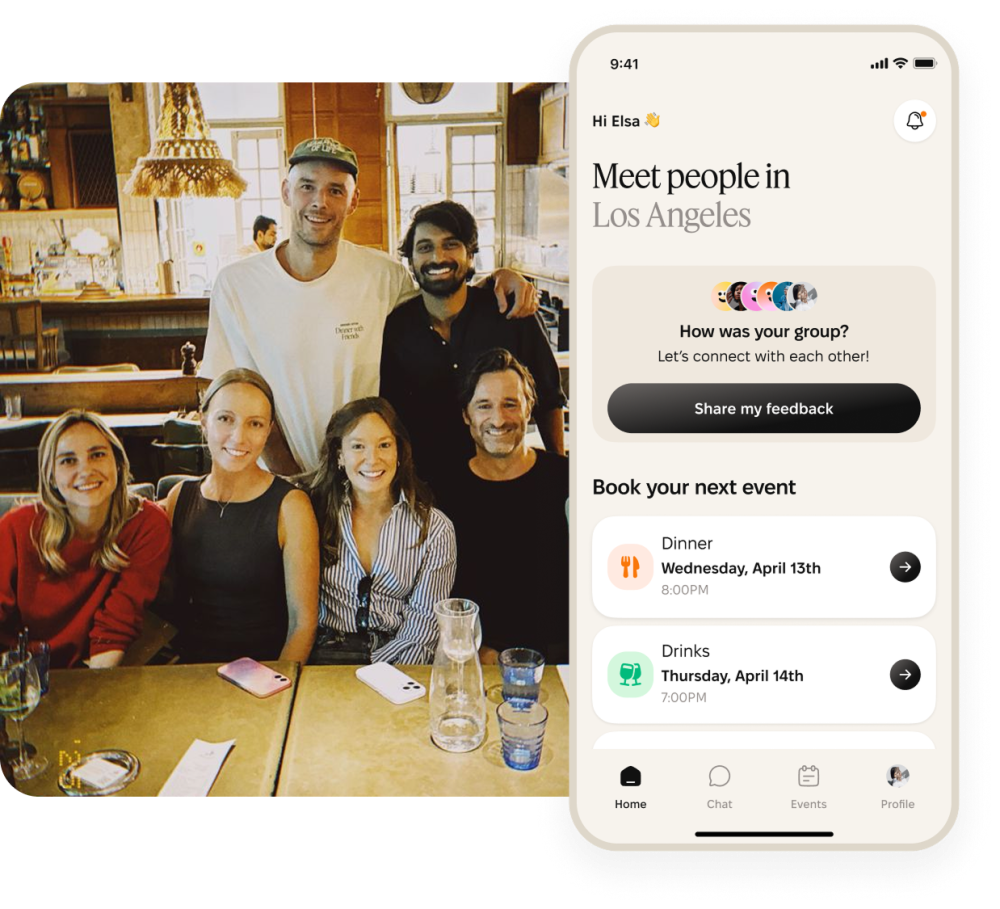
Every Timeleft event starts the same way: six strangers, a venue, no shared history, and a bet that everyone will show up in good faith. Most of the time, that bet pays off. But when we're asked how we protect guests on the days it doesn't, the instinctive answer across social platforms, online marketplaces, dating apps, and real-world meeting services, is almost identical: "If you see something, report it." Tucked into a menu corner, a small flag or three-dot icon sits on standby.
We have that button too. We're glad we do, and we've built it to be fast and frictionless. But if it were our main answer to "how do you keep people safe," it would be the wrong one, because a report is something a guest files after a dinner has already gone wrong. Our job is to make sure fewer dinners ever get there in the first place.
It's easy to understand why the industry defaults to reporting. It's visible to users. It gives Trust & Safety teams a clean policy reference. And it produces clear internal metrics that are easy to report up. Compared to the harder work of preventing harm before it happens, reviewing what users flag after the fact is the simpler system to build and to explain. It's also, on its own, not a safety strategy. It's a last line of defense.
The report button is a symptom, not a system
A platform that leans entirely on reporting has, by definition, decided that harm has to happen and be flagged by the affected party before any protective action occurs. Picture one of our guests at a dinner: they have to recognize, in the moment, that something crossed a line. They have to have the energy to act on it, often right after an uncomfortable experience they didn't choose.
Even when every step is completed, reporting remains inherently backwards-looking. While it can prevent an offender from harming others in the future, it cannot undo the negative experience that has already taken place.
None of this means reporting is unimportant. A fast, frictionless, one-tap report is genuinely good product design, and we've built ours that way deliberately. But treating the report button as the safety strategy, rather than one input into it, puts the entire burden of detection on the person who was harmed. That's backwards. Our job is to reduce how often someone ends up needing to press it.
What upstream investment actually looks like at Timeleft
At Timeleft, we can't afford to treat safety as something that switches on only after someone reports a problem, because by the time a report lands, the event has already happened. So a meaningful share of what we build is designed to act before that point, not after.
Concretely, our Community Guidelines aren't a legal disclaimer. They're an enforceable framework that sets expectations before anyone shows up, and they carry real consequences when violated. Venue vetting happens before a single guest arrives; where an event takes place is treated as a safety decision, not just a logistics one.
Even who you're grouped with is a proactive decision. Before you're ever matched with your six strangers, our systems are already working behind the scenes: once someone is reported, they're never placed with that person again: automatically, permanently, and quietly enough that most people never notice it happened
Likewise, most of what catches harm in our chats doesn't wait for anyone to press ‘report’. Every message sent in a Timeleft chat is screened automatically as it's sent, not after someone flags it. One layer catches outright red flags on the spot; another watches for harmful or spammy patterns across messages, including ones no single guest would think to report on their own. If the same account keeps tripping those flags, the case reaches one of our team members automatically, before a single report has been filed.
The evidence that this is working isn't that we have a report button. It's that most experiences never generate a report: 94% of our group chats are never flagged at all, and 99% of Timeleft experiences happen without any safety incident. Those numbers aren't a measure of how well we handle reports. They're a measure of how much harm never reaches that stage.
Why this matters more for an IRL event than for a post
Report-first is a fine model when what you're moderating is reversible: a post, a comment, a listing. Timeleft operates in the real world. We're putting strangers in a room together, in person, with no easy undo. A bad dinner can't be taken down the way a bad post can because the harm already happened by the time anyone could report it.
That's the standard we think is worth holding ourselves to: measuring safety less by how well we process reports, and more by how much we've reduced the need for them. Report handling should be the last layer of Timeleft's safety system, not the whole thing; the layer that catches what our upstream design couldn't prevent.
This is still a work in progress for us. Things still go wrong, and when they do, our job is to respond well, and that's a real and necessary part of the system we'll keep investing in. But we'd rather be judged on how rarely that layer gets used than on how advanced it looks when it does.
Nolwenn, Trust & Safety Manager at Timeleft