Timeleft logo Timeleft logo
  • About
  • Brand Partnerships
  • Newsroom
  • Essays
  • Careers
  • Affiliate
  • Locations
Log inSign up
  • About
  • Brand Partnerships
  • Newsroom
  • Essays
  • Careers
  • Affiliate
  • Locations
Log inSign up

Human connection
is healthcare

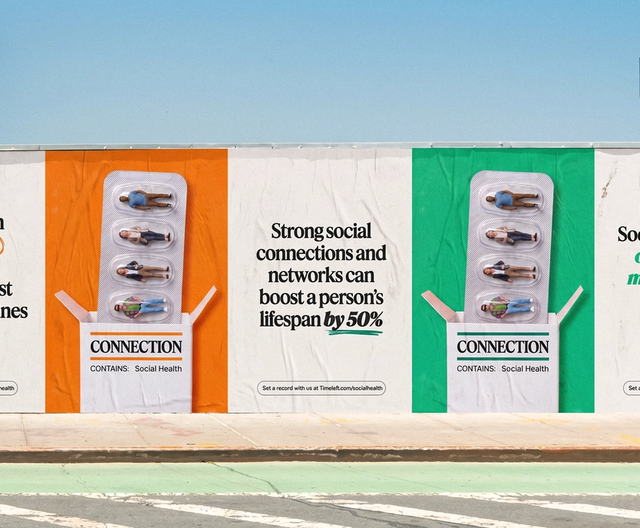
People with strong social connections have 50% better odds of survival.3

Social health is one of the biggest predictors of longevity.

So for six weeks, we’re following four people as they prescribe themselves more human connection. Follow the experiment: watch their journeys unfold every week, then get The Human Connection Report, built on our learnings.
Get the episodes + report
Why we're doing this
0:00
Join the experiment
let’s talk about social healthlet’s talk about social healthlet’s talk about social healthlet’s talk about social health
let’s talk about social health

WHY social health matters

Here’s a first look at our social health survey results.

What is social health?

Social health is the part of your wellbeing shaped by your relationships and sense of connection. It includes having people you can turn to, feeling that you belong, and finding time for relationships that matter to you. The connections you need can change as your life changes.7

58%

had never heard the term “social health.” Have you?

32%

know loneliness harms their physical health. 91% know it harms their mental health.

72%

Of people can’t remember their doctor ever asking about their social life.

Timeleft social health survey, 2026, nearly 900 respondents. Self-reported.6

Follow four strangers for six weeks

Different cities, different lives, all seeking to care for their social health. Twice a week they will show up to meet strangers and see what happens to their social lives and confidence.

A new episode every week

Errol, a social health campaign participant in New York Coming Soon

Errol, 50s

NEW YORK

He’s rebuilding his social life and putting himself back out there after losing a partner this year.

Nataly, a social health campaign participant traveling in Asia Coming Soon

Nataly, 30s

TRAVELLING ASIA

She left her job and is looking for a big change, so she’s meeting new people as she travels Asia.

Chris, a social health campaign participant in Berlin Coming Soon

Chris, 30s

BERLIN

He has stayed in his comfort zone too long and is ready to push himself to have new social experiences.

Kerabania, a social health campaign participant in Paris Coming Soon

Kerabania, 20s

PARIS

After feeling some social isolation, she wants to make new connections in her twenties.

Get the episodes + report
real datareal storiesreal people

The Human
Connection Report

At the end of this campaign, we’ll summarize everything we learn about human connection in a magazine. Insights, stories, and expert advice on social health turned into something you can use.

04 · THE SURVEY

How’s your social life, really?

58%

had never heard the term “social health.”

Issue 01December 2026 · Free

The Human
Connection Report

Timeleft connection campaign posters on a city street

Five strangers. Six weeks.

The prescription nobody writes

900 people on their social lives

Inside issue 01

How’s your social life, really?

Nearly 900 people answered honestly. The full findings, including the ones that surprised us.

Five strangers, six weeks

Four participants in our weekly series and a fifth documenting her own journey. From the first awkward hello to what changed.

The prescription

What our pre-registered pilot found. The good, the bad and the unexpected.

The health nobody talks about

The science of why connection belongs next to sleep, movement and diet.

Letters from the table

Members on the night something shifted.

Get the episodes + report

Follow the experiment and receive

Every week · Oct – Dec

Weekly episodes, in your inbox

New episodes, findings from our survey, and tips on how to improve your social health.

December

The Human Connection Report

A magazine with insights, stories and expert advice on social health, built from everything we learn. Delivered to your inbox in December.

By signing up you agree to receive the episodes and report. See our Privacy Policy.

No spam. Unsubscribe anytime. We will never sell your data.

You're on the list. We'll email you new episodes, survey findings and social health tips, followed by the Human Connection Report in December.

Who’s behind this

Timeleft

Timeleft is a social discovery platform for adults who want to grow more, connect more and experience more. Pick dinner, drinks, coffee or a run. We match you with a group and book a venue worth going to.
All you have to do is show up.

200+

cities

20K+

venue partners

96%

of diners feel compatible with their group

Timeleft Human connection is healthcare campaign posters on a city street

How to improve your social health

  • Make a little room for connection in your week. A walk, a coffee, or a regular call can give you time together.
  • Reach out to someone you already know. Ask how they are doing, and give yourself time to listen.
  • Try an activity you enjoy with other people. A class, a local group, or volunteering can make starting a conversation easier.
  • Keep showing up when a connection feels worth continuing. Relationships can grow through repeated time together.8

Social health questions

What are examples of social health?
Having someone you can ask for support, feeling welcome in a group, keeping in touch with people you care about, and making time for conversation are examples of social health. The number of people you know is only one part of the picture. The quality of those connections matters too.
How is social health different from mental health?
Social health concerns your relationships and connection with others. Mental health concerns your emotional and psychological wellbeing. The two can affect each other, while describing different parts of health.
What will I receive when I sign up?
You’ll receive weekly campaign episodes, survey findings, and tips by email, followed by the Human Connection Report in December. You can unsubscribe at any time.
Is this medical treatment?
This campaign explores human connection and social health. Timeleft experiences are social activities. They do not replace medical care or mental health support.

Sources

  1. World Health Organization. Constitution of the World Health Organization, 1948.
  2. WHO Commission on Social Connection. From loneliness to social connection: charting a path to healthier societies, June 2025.
  3. Holt-Lunstad J, Smith TB, Layton JB. Social relationships and mortality risk: a meta-analytic review. PLOS Medicine, 2010.
  4. AARP Public Policy Institute. Medicare spends more on socially isolated older adults, 2017.
  5. World Health Organization. Burn-out an “occupational phenomenon”: International Classification of Diseases, May 2019.
  6. Timeleft social health survey, 2026. Self-reported; not a clinical finding.
  7. Doyle and Link (2024), Social health
  8. NIH Social Wellness Toolkit
Timeleft

Show up first

Events

  • Dinners
  • Drinks
  • Runs

Company

  • About
  • Brand Partnerships
  • Careers
  • Affiliate
  • Safety Guidelines

Resources

  • Newsroom
  • Essays
  • Contact Us
  • Help Center

General informations

Community Guidelines Privacy Policy Terms & Conditions

© 2026 All rights Reserved. Timeleft SAS