In this article
- The three filters
- Solo time is not a consolation prize
- Low-energy activities: for recharging, not performing
- Creative activities: for making something instead of consuming it
- Physical activities: for moving instead of rotting
- Social-adjacent activities: the wildcard section, for when you want company but not the planning
- Things to do alone that often lead to making friends
- Fun solo activities to do at home
- FAQ
- Fifty-plus ideas is a lot, but the real trick isn't finding something to do
- What to read next
50+ actually good things to do alone, organized by three filters: your mood (low-energy, creative, physical, or social-adjacent), how much time you have (under an hour, half a day, or a full day), and whether you'd secretly like to meet someone while you're at it. Standout picks include a solo museum morning, a pottery drop-in, a long run, a supper club, an open mic, and a Timeleft dinner, the easiest social-adjacent option on this list for anyone who wants company without having to plan it themselves.
Let’s say you've got a free Saturday. Or a quiet Tuesday evening. Or a whole week where your partner's away, your friends are all double-booked, and your calendar has, for once, absolutely nothing in it.
And then, somewhere between "I could do anything!" and "I am doing nothing (but in an enjoyable way)," you land on the couch, phone in hand, watching someone else's life instead of living your own.
Honestly, so real. Sometimes, too much unstructured choice is its own kind of paralysis. Just think of what happens when faced with some alone time and a long list of series to watch – too much pressure to choose something good, so you default to watching Friends for the 10th (11th?) time.
This list exists so that you don’t fall into that default mode, socially-speaking. Fifty-plus activities to do alone, sorted the way your brain actually thinks about a free afternoon: what mood you're in, how much time you've got, and whether some small part of you wouldn't mind if a good conversation happened along the way.
The thing to keep in mind is that wanting company sometimes doesn't cancel out wanting to be alone sometimes. You can want both, in the same week, even on the same day. This list is built for both those moods, and anything in between.
The three filters
Every activity below is sorted by:
- Mood – low-energy, creative, physical, or social-adjacent
- Time available – under an hour, half a day, or a full day
- The wildcard – how likely it is to put you in conversation with someone, from low to highest. Anything without a tag is a solo pick.
Solo time is not a consolation prize
Quick, important note before the list: this is not one of those pieces about how being alone is secretly sad and here's how to cope. It isn't. The research is pretty clear that solitude and loneliness are two entirely different experiences that just happen to look identical from the outside.
Psychiatrist Anthony Storr made the case for this decades ago in his book Solitude, arguing that the capacity to be alone is linked to self-discovery and creative thought, not a symptom of anything missing. More recently, the late social neuroscientist John Cacioppo spent a career studying loneliness and found the same distinction from the opposite direction: it's not aloneness itself that harms health, it's the unwanted, chronic version of it. Chosen solitude doesn't carry those same risks. Loneliness researchers now treat "solitude" (alone by choice) and "loneliness" (alone against your will) as genuinely different states, not two words for the same thing.
There's also a good case, from developmental psychology, that getting comfortable with solo time is something that tends to serve people well as they get older. Stanford psychologist Laura Carstensen's socioemotional selectivity theory, one of the most cited frameworks in the psychology of aging, found that as people move through adulthood, they get more selective about the relationships they actually want, rather than the ones they feel obligated to keep up with. That shift shows up as an improvement in emotional wellbeing, not a decline. In other words: a thirty-something who's genuinely fine with a solo Saturday isn't settling. They may be ahead of the curve.
And the data backs up that this isn't a fringe preference. Solo dining reservations in the US jumped 23% year over year, according to OpenTable, enough for restaurants to start rethinking their tables-for-two-only layouts. Solo diners also spend around 48% more per person than the average table. Gen Z is leading the charge: nearly half report dining alone at least once a week, alongside 46% of millennials. People are choosing it.
A few more interesting findings worth knowing, while we're at it:
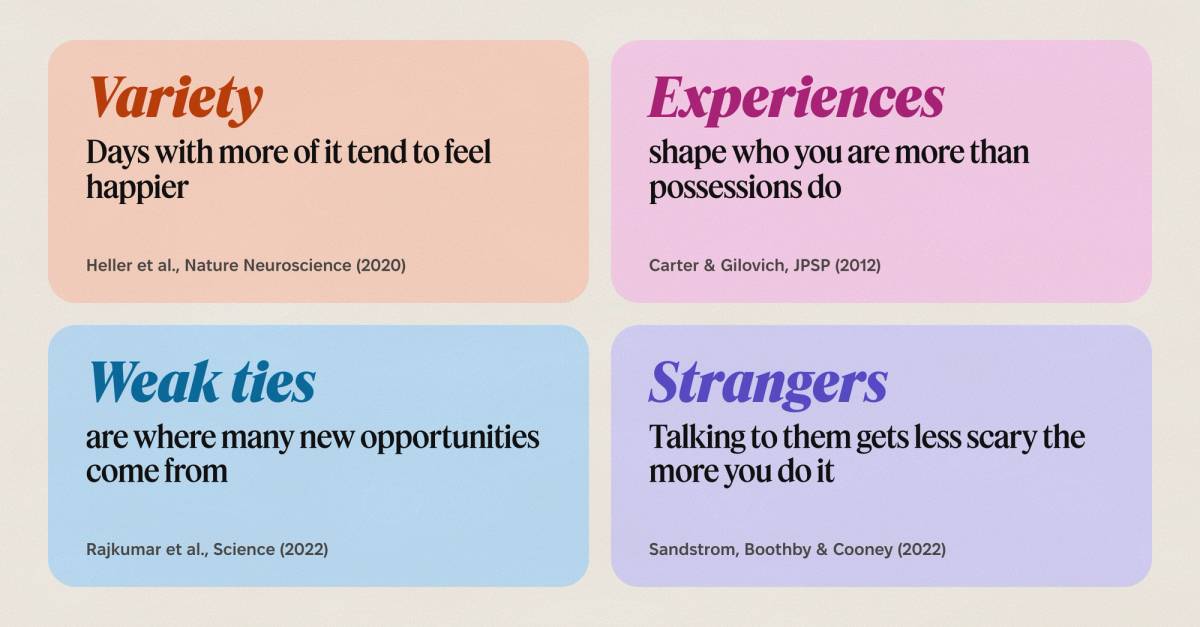
Sources: Heller et al., 2020; Carter & Gilovich, 2012; Rajkumar et al., 2022; Sandstrom, Boothby & Cooney, 2022
Low-energy activities: for recharging, not performing
Under an hour
- Sit somewhere with no agenda – a park bench, a windowsill, a stoop. Twenty minutes of doing nothing.
- Do a museum "power lap" – pick one wing or one floor, ignore the rest, leave before you're tired of it.
- Watch a matinee – weekday afternoons are the closest thing to a private screening you'll get.
Half a day
- Spend an afternoon in a bookshop with no intention of buying anything. Read the first chapter of six different books. [Wildcard: low, staff and fellow browsers make conversation more possible than you'd think]
- Book a solo spa afternoon – massage, sauna, the works.
- Actually walk through a museum properly, slowly, headphones optional, no one to negotiate the pace with.
A full day
- Take a day trip to a nearby town by yourself. No itinerary required beyond "get there and wander."
- Do a full digital sabbath – phone off, one neighborhood, entirely on foot.
- Spend the day at a spa or hot springs if you have one nearby. Bring a book you won't read.
- Run a solo film marathon at home – three movies you've been meaning to watch, back to back, snacks non-negotiable.
Creative activities: for making something instead of consuming it
Under an hour
- Journal with an actual prompt – not "how was your day," something specific, like "what did I avoid today, and why."
- Sketch or doodle in a park, badly, on purpose. Nobody's grading it.
- Learn ten phrases in a language you've always wanted to pick up, with an app and a coffee.
Half a day
- Take a pottery drop-in class [Wildcard: medium–high, wheel-adjacent conversation happens more naturally than you'd expect]
- Try a drop-in painting class [Wildcard: medium, the activity does most of the social work]
- Write the opening chapter of the book, screenplay, or newsletter you keep talking about and never starting.
A full day
- Sign up for a one-day cooking class in someone's home kitchen. [Wildcard: high, you cook and eat together, which is about as good a setup for conversation as it gets]
- Finally build the thing you've been putting off, furniture, a garden bed, a proper photo archive.
- Spend the day at a life-drawing or figure-drawing open session. [Wildcard: medium]
- Start and finish a 1,000-piece jigsaw puzzle, one pot of coffee, zero apologies.
Physical activities: for moving instead of rotting
Under an hour
- Go for a walk with no destination. Just vibes and whatever street looks interesting.
- A thirty-minute strength session at the gym, no class, no plan beyond showing up.
- Stretch or do yoga at home using any free video.
Half a day
- Take a long bike ride somewhere you haven't been.
- Try a drop-in fitness class at a studio you've never used before. [Wildcard: medium, regulars tend to be friendly to newcomers]
- Swim at a public pool or lake, properly, for once, instead of just floating near the edge.
A full day
- Hike a trail you've never done.
- Buy a day pass at a climbing gym. [Wildcard: high, climbing is one of the few gym activities where you sometimes need a stranger's help, and asking is completely normal]
- Join a run club's long-run day. [Wildcard: high]
- Rent a kayak or paddleboard for the afternoon and treat it like a mini expedition.
Social-adjacent activities: the wildcard section, for when you want company but not the planning
This is the mood for the people using this list who want ideas that put them near other humans, without forcing an interaction that feels artificial.
Under an hour
- Sit at the counter, not a table, at a restaurant you already like. [Wildcard: medium]
- Show up to trivia night solo and ask to join a team that's short a player. [Wildcard: high]
- Go to a free gallery opening. [Wildcard: medium]
Half a day
- Join a run club's regular weekly meet. Most end with coffee, which is often the actual point. [Wildcard: high]
- Take a drop-in dance or movement class. [Wildcard: high]
- Go to a farmers market and actually talk to a vendor about what you're buying. [Wildcard: low–medium]
- Attend a language exchange meetup. The format requires you to talk to people, which removes the pressure of engineering it yourself. [Wildcard: high]
A full day or evening
- Go to an open mic, comedy or poetry, and stay after instead of leaving right when it ends. [Wildcard: high]
- Book a seat at a supper club or communal dinner series in your city. [Wildcard: high]
- Book a Timeleft dinner. A group of 4–6 people, a restaurant someone else picked, conversation starters if you need them, and nothing to plan except showing up. [Wildcard: highest]
- Try Timeleft coffee or drinks if a full dinner feels like a lot for a first step. Same format, even lower stakes. [Wildcard: high]
- Volunteer for a single shift with a local organization. When the goal is the task, not the small talk, connection tends to happen more naturally. [Wildcard: medium–high]
- Join a recreational sports league as a free agent. Most will place solo sign-ups onto a team. [Wildcard: high]
- Take a co-working day pass and sit at the communal table instead of a private desk. [Wildcard: medium]
- Pick one recurring class and go back the following week. Repetition, more than any single outing, is what actually turns a room of strangers into people you recognize. [Wildcard: high]
Things to do alone that often lead to making friends
A few entries above deserve their own callout, because they're not just "things you can technically do alone", but they’re also structurally social: formats built so that showing up solo is the whole point, and the connection isn't something you have to engineer yourself.
- Run clubs → built-in repetition, low pressure, usually ends in coffee.
- Recurring classes (pottery, climbing, dance, language exchange) → same room, same people, week after week, which is how familiarity actually builds.
- Supper clubs and communal dinner series → a shared table with strangers by design, not by accident.
- Open mics → a room full of people who showed up alone on purpose, which makes striking up a conversation far less weird than it sounds.
- Timeleft events (dinner, drinks, coffee, or a walk) → the most structured version of this idea. A small group, a venue someone else chose, and conversation starters built in if the first five minutes feel awkward. No swiping and no planning your own logistics. You show up, we handle the rest.
Research from Hall (2018) found it takes around 50 hours of shared time to go from acquaintance to casual friend, and about 200 to become a close friend, which is why one-off outings rarely add up on their own. The activities in this section work because they're built for repeat visits, not because any single one of them is magic.
Fun solo activities to do at home
Not every free evening calls for leaving the house. A few good options for when you'd rather stay in:
- Cook a proper, slightly ambitious meal just for yourself, plating included.
- Start a "one great film a week" project and actually stick to it.
- Reorganize the one room you've been avoiding for months.
- Do a full skincare or grooming reset, the kind that takes actual time.
- Bake something that requires patience, like bread, a laminated dough, or a cake with more than one layer.
- Build a "rainy day" playlist, one decade at a time.
- Cook the recipe from the cookbook you own but have never actually opened.
- Write an actual letter, on paper, to two people you've lost touch with.
FAQ
What can you do alone for fun?
Almost anything: a museum morning, a long run, a pottery class, a solo dinner at the counter, a day trip, a new hobby. The best solo activities tend to fall into one of two camps: pure recharge (a walk, a bath, a film) or social-adjacent (a run club, a class, a Timeleft dinner), depending on whether you want the time entirely to yourself or want it to put you near other people.
What is the best activity to do by yourself?
There isn't one universal answer, it depends on your mood and how much time you have. If you want a starting point: a solo museum visit is one of the most consistently enjoyable low-effort options, and a Timeleft dinner is one of the easiest ways to turn a solo evening into a social one without any extra planning on your part.
How do I enjoy spending time alone?
Start by picking an activity that matches your actual mood rather than what you think you "should" do with your free time. Research on solitude suggests the difference between enjoyable alone time and lonely alone time often comes down to choice: solo time you actively chose tends to feel restorative, while solo time that feels imposed on you tends to feel isolating. If you notice you're craving company more than solitude on a given day, that's worth listening to, not overriding.
Fifty-plus ideas is a lot, but the real trick isn't finding something to do
It's being honest about which version of alone you're actually looking for today.
Some days, that's a museum wing and total silence. Other days, it's a run club, a supper club, or a dinner with strangers you didn't have to organize yourself.
If it's the second kind of day: start your Timeleft membership and see what's on in your city this week.