TL;DR: The failure of profile-based friend apps is structural, not personal. A match isn't a plan, and someone still has to message, agree on a place, and hope it isn't weird. The metric that matters is time-to-meeting, and event-based platforms can compress that gap significantly. Timeleft puts you at a table with a matched group on a set date, with no opener, no profile browsing, and no planning required. Other alternatives work for specific needs, but only event-based formats remove the gap between matching and meeting entirely.
Dozens of matches, zero plans. The format generates introductions and stops there.
The most frustrating part of Bumble BFF comes after the match. Someone has to plan something, and nobody does. You message back and forth for a few days, suggest a coffee "sometime next week," and then the conversation fades into the same pile as the last dozen. The app did its job. It introduced you. But it stopped there, and left the hardest part to you.
This article ranks the best Bumble BFF alternatives by one metric, time-to-meeting. How many days pass between signing up and sitting across from someone in person? That's what separates apps that generate matches from platforms that generate plans. Some alternatives are free, and some require a subscription. The ones worth your time are the ones that remove the gap between matching and meeting by putting you in a room with people on a set date, with the logistics handled.
In this article:
- Why Bumble BFF matches don't become plans
- How these alternatives to Bumble BFF were ranked
- Comparison table: Bumble BFF alternatives ranked by time-to-meeting
- Ditch the app with Timeleft dinner events
- Find your crowd through Meetup activities
- Best for structured friend-dating: Friended
- Find your neighborhood squad on Peanut
- Best for niche interests: Eventbrite and local groups
- Where to turn when apps stop working
- FAQs
Why Bumble BFF matches don't become plans
Bumble BFF is free, and every match has passed selfie verification, which helps keep the community safe. Those are real strengths, but the app's core model still leaves the planning to you.
The structural flaw of app profiles
Profiles are an audition. They reward people who are good at presenting themselves, not people who are good at connection. You build a bio, pick photos, write an opener, and hope someone responds before the match expires. If you're exhausted by that process, that's a rational response to a format that selects for performance, not a reflection of your social ability.
Bumble introduced a "Plan" tool designed to make it easier to take connections offline by letting users set up hangs in the app instead of endless back-and-forth messages. Even with that tool, someone still has to suggest the plan, and the other person still has to agree. The asymmetry doesn't go away.
Effort asymmetry and ghosting
One person always has to plan the first meet. That asymmetry is where matches go to die. The person who cares more does the work, and the other person drifts. On a one-on-one match, you message, agree on a place, negotiate a time, and hope it isn't weird. Many matches go nowhere because the planning step is where the friction lives.
Bumble BFF relaunched as a standalone app in September 2025, built on Geneva, and it's live in the U.S., Canada, and Mexico. The new app includes interest-based Groups, which helps members plan meetups. Even with those features, someone still has to organize the event, and the app's design still centers on browsing profiles and sending waves.
Bumble BFF is free, with an optional premium tier for convenience features, but nothing essential requires payment. Free access is a real benefit. Free access doesn't guarantee follow-through, and the app's core mechanic still relies on members choosing who to meet and then coordinating the logistics themselves.
Why platforms lack social friction
Social friction is the small resistance that keeps people from following through. Profile-based apps remove all friction from matching but add it all back at the planning stage. The result is a queue of matches and an empty calendar. A match decision takes only a few seconds, but turning a match into a real plan requires negotiating a time, picking a place, and hoping the other person doesn't ghost.
Event-based platforms work differently. The event is the plan. You book a date, and the venue and group are handled. Nobody has to chase a confirmation. The friction is removed at the planning stage, not the matching stage.
How these alternatives to Bumble BFF were ranked
The alternatives below are ranked by time-to-meeting, format, and cost. Each one solves the "matches never become plans" problem differently, and each one works best for a specific type of person.
Time-to-meeting as the core metric
The metric that matters is how many days pass between signing up and sitting across from someone. A match isn't a meeting. Profile-based apps can take weeks of messaging before you meet in person, if you meet at all. Event-based platforms put you at a table on the date you book, often within days.
Format: who plans, who shows up
Event-based platforms plan for you. Profile-based platforms leave planning to you. Chat-based apps open with prompts and games instead of a polished profile, then hand you the logistics. The format determines whether you'll meet someone this week or next month.
Subscription fees and user effort
Cost matters, but so does effort. A free app that requires 10 hours of messaging is more expensive than a subscription that puts you at a table this week. Your time has value, and the effort required to turn a match into a plan is a real cost, even if it doesn't show up on a credit card statement.
Comparison table: Bumble BFF alternatives ranked by time-to-meeting
| Platform | Model | Typical time-to-meeting | Who plans |
|---|---|---|---|
| Timeleft | Event-based | The date you book | Timeleft |
| Meetup | Event-based | Varies by when the next event is scheduled | Organizers |
| Bumble BFF | Profile-based | Weeks to never | Members |
| Friended | Chat-based (icebreakers and games) | Often online-only | Members |
| Peanut | Profile-based (life-stage filter) | Weeks | Members (connect, then self-organize) |
| Eventbrite | Event marketplace | Days to weeks | Event organizers |
This table maps each alternative to its underlying model. The event-based options compress time-to-meeting because the event is the plan. The profile-based and chat-based options stretch time-to-meeting because someone still has to coordinate.
Ditch the app with Timeleft dinner events
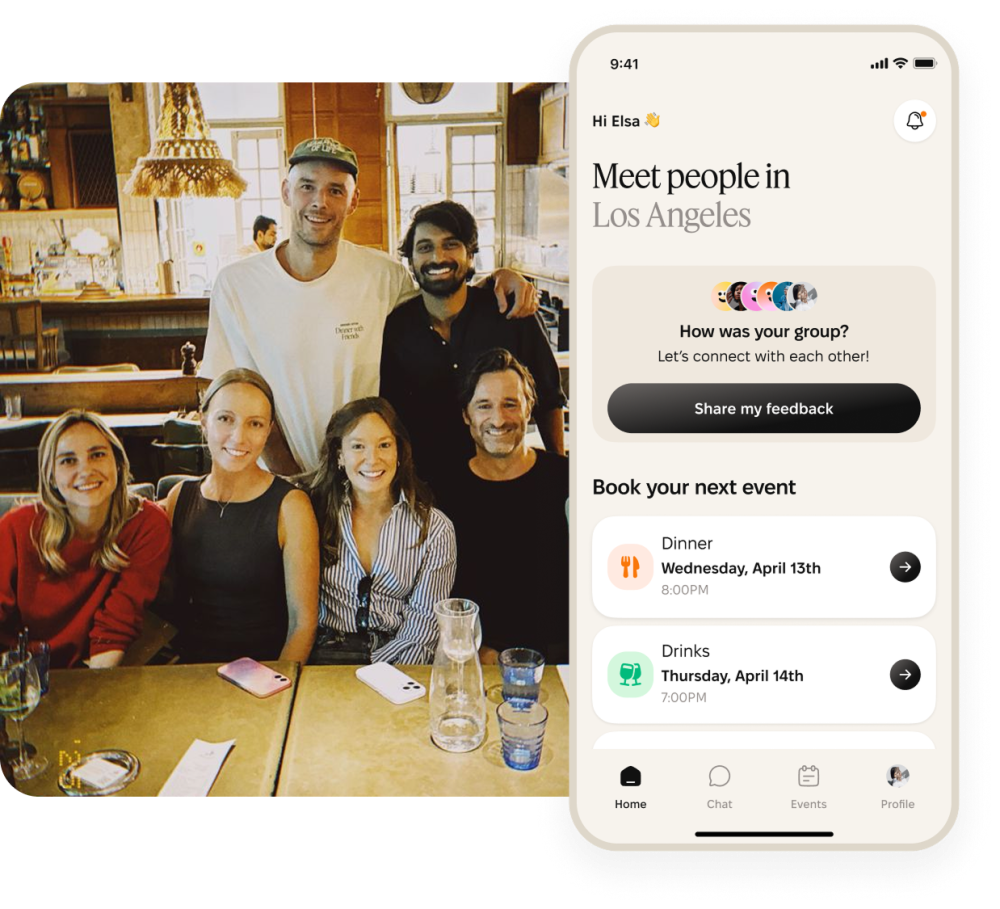
Timeleft is the IRL connections app. It's not a dating app, not a networking app, just real people meeting face-to-face to build real connections. The platform removes every step between "I want to meet people" and sitting at a table with interesting strangers.
How the dinner format works
You take a short personality quiz, subscribe, pick a format, date, and neighborhood, and show up. Timeleft matches the group and books the venue. For dinners, the target group size is four to six people, though the number on the night can be smaller. The venue is revealed 12 hours before the event, and a preview of who you'll meet appears on the day. Dinners usually run about three hours.
The quiz asks about your age group, interests, and what you're looking for, whether that's making new friends, getting out more, or having meaningful conversations. Timeleft uses those answers to build each group, matching across backgrounds, ages, and personality quiz answers. 96% of diners report feeling compatible with their group.
The venue network includes 20,000+ hand-selected restaurant and bar partners. Every event happens at a public venue, somewhere you could walk into off the street. Members pay for their own food and drinks at the venue, and Timeleft handles everything else.
Timeleft operates across 52 countries and 200+ cities, which means you're likely to find events in major metros across North America, Western Europe, Australia, and Southeast Asia.
How to secure your seat at the table
A subscription is required before attending any event. Once subscribed, members can attend as many events as they like per month, across any format or city. One subscription works in every Timeleft city, so members can use it while traveling.
Booking and rescheduling close 13 hours before an event starts, in every city. Cancelling stays open until four hours before. Knowing you have that window lowers the barrier if you're nervous about committing.
There's no minimum event frequency, and you can cancel your subscription any time, effective at the end of the billing period. The per-event cost works out well for members who go to a few events a month.
When to choose this over other apps
Choose Timeleft when the problem is the gap between matching and meeting. The format removes the need to audition, plan, or chase anyone down. You book a date, and the rest is handled.
The group dynamic also distributes the conversational load. A table of strangers with a shared reason to be there is lower pressure than a one-on-one match. If one conversation stalls, another picks up. Most tables don't end up needing the In-app Icebreakers, but they're there if the first five minutes feel awkward.
After each event, members see what people appreciated about them through a feature called Impressions, which builds confidence. Members also choose who to stay in touch with through Connect, and nobody gets anyone's details unless both opt in.
Find your crowd through Meetup activities
Meetup is an open platform, founded in 2002, where organizers host events and anyone can RSVP by interest. There's no matching. You browse events, RSVP, and walk into a room where the organizer is a stranger and the format is unclear.
Beyond profiles: the event-first model
Meetup's strength is hobby breadth. You can find events for hiking, board games, book clubs, language exchanges, tech meetups, and nearly any interest. The event is the plan, so you skip the messaging phase entirely. The weakness is that quality depends on the organizer. Some Meetup groups are well-run and welcoming. Others are disorganized or cliquish.
Moving from digital match to real life
Meetup is free to attend most events. Organizers pay from $29.99/month for a Standard plan or from $55/group/month for a Pro plan. Meetup has 60M+ members, which gives it a large user base and broad event coverage.
Membership costs and event availability
Meetup is free to browse and free to attend most events. Some events have a small fee to cover venue costs or materials, but many are free. The platform works best in large cities with active organizer communities.
Why Meetup suits personality types
Meetup works well for people who are comfortable showing up alone and who want to bond over a shared activity. If you'd rather talk about hiking boots than make small talk, Meetup gives you a built-in conversation starter.
Timeleft matches the group and handles the venue. Meetup hands you a calendar of options and leaves the rest to you. One works best when the activity is the draw. The other works best when the company is.
Best for structured friend-dating: Friended
Friended uses structured prompts and games to start conversations, which removes the blank-profile problem. The format is designed to get people talking faster than a bio-based app.
Why Friended skips the profile phase
Instead of building a profile and waiting for matches, Friended members answer prompts and play games that reveal personality through interaction. The app's design assumes that conversation is a better filter than photos, and the structured format gives people something to talk about right away.
Reducing time from match to meet
The structured format compresses the messaging phase, and members report feeling more comfortable before the first meet. Friended gives you practice with low-stakes conversation, and Timeleft gives you the table and the group so you can skip straight to in-person connection.
What Friended costs
Friended is free to download and use, with an optional premium subscription package. After a 7-day free trial, a one-week subscription costs $7.99. The premium tier unlocks additional features, but the core experience is available for free.
Who will thrive using Friended
Friended suits people who want a low-pressure way to practice conversation before meeting. If the idea of walking into a dinner with strangers feels too intense, Friended lets you build comfort through structured interaction first. For those ready to skip the practice and sit at the table, Timeleft puts the group and the venue in place.
Find your neighborhood squad on Peanut
Peanut connects people by life stage and neighborhood. The app started as a platform for mothers and has expanded to include women at all stages of life. The local focus makes first meets logistically easier because members are already nearby.
How Peanut facilitates local connection
Peanut members build profiles and connect based on shared life stages, interests, and location. The app provides prompts and group features to help members start conversations, but members still coordinate the meet. Members in the same neighborhood can suggest a coffee at a local spot more easily than coordinating across a city.
The app's focus on life stage (motherhood, pregnancy, trying to conceive, menopause) creates a built-in shared context that makes conversation easier.
Real costs of joining Peanut
Peanut is free to download and use, with optional premium features. The premium tier unlocks additional features, but the core experience is free.
Peanut user profile and expectations
Peanut works best when life stage is the common thread, especially motherhood. The shared context makes conversation easier, and the local focus makes meetups logistically simpler. Timeleft matches across backgrounds and ages, so the common thread is curiosity rather than circumstance.
Best for niche interests: Eventbrite and local groups
Eventbrite is a ticketing marketplace where organizers post events and attendees browse by interest. Local groups (book clubs, running clubs, volunteer organizations) operate similarly, with a shared activity as the reason to gather.
How niche groups build genuine rapport
Shared interest creates a built-in reason to be present. The activity is the conversation starter. If you're at a book club, you talk about the book. If you're at a running club, you talk about the run. The activity gives everyone a reason to be there, which removes the pressure of making small talk from scratch.
Why offline events beat app matching
Offline events skip the matching phase entirely. There's no profile to build and no opener to craft. You show up, and the event happens. The tradeoff is that you have to find the event and walk into a room where you might not know anyone. Eventbrite doesn't match you with a group or book a venue for you.
Timeleft handles the finding and the group. You don't browse events or walk in alone. You book a date, and Timeleft matches you with a group and books the venue. Eventbrite gives you more control over the event. Timeleft gives you less work.
Membership fees and event access
Eventbrite is free to browse. Individual events set their own ticket prices. Free events carry no ticketing fees, and paid events use a tiered pricing model with fees that vary by plan.
When to trade apps for events
Choose niche events when the interest is the point. If you want to meet people who share your love of rock climbing or board games, a niche event gives you that filter. Choose Timeleft when the connection is the point and the interest is secondary. Timeleft's groups are matched by personality, not by hobby, which means you'll meet people across a range of interests.
Where to turn when apps stop working
If you've tried Bumble BFF and the matches never turned into plans, the problem isn't you. The format is designed to generate matches, not meetings. The alternatives worth your time are the ones that remove the gap between matching and meeting by putting you in a room with people on a set date.
Choose zero-pressure social settings
A table of strangers with a shared reason to be there is lower pressure than a one-on-one match. The group dynamic distributes the conversational load. If one conversation stalls, another picks up. You're not responsible for carrying the entire interaction, and neither is anyone else.
Why structured events provide focus
A pre-booked venue, a set date, and a matched group remove the decisions that cause matches to stall. The structure does the work. The only decision left is whether to show up. You're not negotiating a time, picking a place, or chasing confirmations. The event is the plan, and the logistics are handled.
Think of it as a reservation someone else made, for a group you didn't have to organize, at a venue you didn't have to research. That structure removes the friction that kills most app-based matches. The hardest part is walking through the door. After that, the evening unfolds on its own.
Take the personality quiz and subscribe to Timeleft.
FAQs
What is better than Bumble BFF for meeting people?
Event-based platforms like Timeleft beat profile-based apps for time-to-meeting because the event is the plan. You book a date, and the venue and group are handled. Profile-based apps leave the planning to you, which stretches time-to-meeting from days to weeks, if the meet happens at all.
Are there free apps like Bumble BFF that lead to real plans?
Meetup is free to attend most events, and organizers pay from $29.99/month. The tradeoff is that you browse, RSVP, and walk in alone. Timeleft costs a subscription but removes the planning, matches the group, and books the venue.
How long does it usually take to meet someone in person on these platforms?
Profile-based apps can take weeks of messaging before you meet, if you meet at all. Event-based platforms like Timeleft put you at a table on the date you book, often within days. The difference is whether the platform plans for you or leaves planning to you.
Do any of these alternatives work for people who just moved to a new city?
Yes. Timeleft works across 52 countries and 200+ cities, and one subscription works in every Timeleft city. Meetup and Peanut also have strong local footprints, though Meetup's quality depends on the organizer and Peanut's focus is on connecting women by life stage.
What happens after booking a Timeleft event when plans change?
Booking and rescheduling close 13 hours before an event starts, while cancelling stays open until four hours before the event. Charges are non-refundable in most regions, so cancel inside the window to release your seat rather than expecting money back. Members in the EU, EEA, or UK may have a 14-day statutory withdrawal right from the date of purchase, subject to Timeleft's terms and conditions.