TL;DR: Timeleft matching works by turning a short personality quiz into a compatibility profile. From that profile, the algorithm assembles a table of four to six people from everyone who picked the same city and date, matching on personality, age range, and language preferences. The algorithm balances people who'll get on with people who are different enough to be interesting, so you get a table of strangers, not clones. Groups typically run four to six people. That range is large enough that nobody has to carry the conversation, and small enough that nobody disappears into it. Timeleft also handles the venue, the timing, and the booking, so your only decision on the night is what to order.
Most social apps make you do the matching yourself. You browse, you message, you try to nail down a time and a place, and most of it goes nowhere. Timeleft does the opposite. You answer a short quiz, pick a date, and the algorithm builds the table.
If you've read how dinner with strangers works and you're now asking how Timeleft chooses your table, this article is the mechanics behind that answer. This article walks through what the quiz measures, how compatibility is built, why the table is typically four to six people, and what the system honestly can and cannot promise. No jargon, no mystique. Just how it works.
In this article:
- How the Timeleft matching algorithm works
- How a small group eliminates social friction
- What Timeleft matching can and cannot guarantee
- How the system selects your tablemates
- Handling attendance gaps in your dinner group
- FAQs
- Key terms glossary
How the Timeleft matching algorithm works
Your quiz answers become a compatibility profile. From there, the algorithm compares it against everyone who picked the same date and format in your city and assembles a table that balances compatibility with variety. The official version is in the matching help article, but here's the plain-language breakdown.
Using the quiz to build your group
Everything starts with a short personality quiz inside the app. The quiz asks about your values and how you think. According to Timeleft's explanation of the algorithm, questions include things like whether your opinions are guided by logic and facts or emotions and feelings.
- The quiz gives the algorithm the data it needs to assemble a table. Your answers are the raw material; the output is a matched group, not a profile you manage.
- After the quiz, you pick a format and a date. There are no profiles to browse and nobody evaluating yours.
How the algorithm calculates compatibility
Each answer feeds into a compatibility profile, and the algorithm uses that profile to estimate how well two people are likely to get on over dinner. The system learns continuously. It takes into account the personality and post-event feedback of each participant and refines its understanding of what makes a fruitful match over time.
That last part matters for your Timeleft compatibility over the long run. The score isn't static. Feedback after each event improves future predictions, which is part of why 96% of diners report feeling compatible with their matched group.
One clarification, because people often get this wrong. A high compatibility score doesn't mean two people are identical. It means they're likely to have a good evening at the same table. The score is a logistical tool for table assembly, not a judgment of how likable you are.
What the algorithm optimizes for
When the algorithm assembles your table, it's weighing whether people are likely to get on, whether there's enough variety to keep things interesting, whether everyone picked the same city, date, and format, and whether enough people have booked for the event to run at all. It isn't optimizing for your future best friend or your soulmate. It's optimizing for a good evening. Can these four to six people hold a shared conversation for a couple of hours without it feeling like work? What a connection becomes afterward is open-ended by design.
Each of these priorities also removes a piece of the invisible work that unstructured social formats force you to do manually: reading the room, finding your conversational fit, deciding when it's okay to leave. The algorithm does that work for you, so you can show up without managing the room.
How a small group eliminates social friction
Here's the contrarian claim at the center of this piece. The most important number in a Timeleft dinner isn't your compatibility score. It's the group size. A dinner with four to six people is the format, and the exact number varies by event. The format is carrying more of the evening than most people expect.
Why four to six is the ideal group size
In practice, group size tends to shape the evening in predictable ways:
- Go smaller than four and the pressure on each person becomes noticeable. One quiet tablemate can shift the whole dynamic.
- Go bigger than six and the conversation tends to fragment into separate threads, with no clear way to pull it back together.
- Four to six is the range where there's enough flexibility that if one pairing runs dry, the conversation can shift without anyone having to orchestrate it. Nobody has to carry the room, and nobody can hide in it.
Scientific reasons for the group-size range
This isn't just a vibe. Anthropologist Robin Dunbar's research on conversation finds that natural conversational groups optimally hold around four people (one speaker plus roughly three listeners), and this write-up of Dunbar's research describes observational data from restaurants and university refectories showing that groups tend to partition into new conversational cliques at around that size. That finding explains why the four-to-six range works so well.
A table of four to six sits in a useful spot relative to that limit. It's small enough for one shared conversation when the whole table is engaged, and large enough to flex into two overlapping threads without anyone being stranded outside both. Timeleft has written before about the history of the table as a social object, and this size range has a long track record for a reason.
How table size affects matching quality
The group size also makes the algorithm's job possible. With four to six seats, there's room for a mix of conversation styles and backgrounds without forcing anyone into a role they don't want. The quiet person gets space to warm up, and the talkative person gets an audience that can rotate.
What Timeleft matching can and cannot guarantee
Both sides are worth stating plainly.
What compatibility scores actually measure
The compatibility score is built from your quiz answers and takes into account post-event feedback over time. What it's estimating is whether a group is likely to get on well over the course of the evening. What happens beyond that is open-ended by design.
What the algorithm cannot guarantee
Timeleft's terms and conditions are plain about this. The system cannot guarantee a specific gender ratio or age range at events, and cannot guarantee acquaintance with other participants. The counterweight built into the format is that everyone at the table self-selected into the same thing: they all chose to show up and meet new people, which gives even an imperfect table something in common.
So, explicitly, the algorithm cannot guarantee:
- Friendship, chemistry, or a specific outcome from any evening.
- That every tablemate shares your exact interests or humor.
- That nobody cancels at the last minute (more on how that's handled below).
The algorithm raises the odds of a good evening and removes the logistics. It doesn't remove chance.
Timeleft isn't positioning itself as a dating app or a networking app, and the people who attend tend to agree. One returning diner described the algorithm's consistency this way:
"Everything has been fine so far and I've met plenty of wonderful people in great restaurants. The algorithm of putting people together with the same view on life seems to be working better than any other app I've tried so far" - Olivier on Trustpilot
The logic behind the group size
The table is set at four to six people because larger groups make it harder to have one shared conversation, and easier for someone to go unnoticed.
Four to six people is the number that balances variety against intimacy, and it keeps the evening inside a structure that stays manageable even on a low-battery night. If you're weighing whether that structure suits you before booking, the self-assessment for the format walks through exactly that question.
How the system selects your tablemates
Here's the full pipeline, from quiz to your seated table.
Prioritizing your location and timing
The algorithm's first filter is pure logistics. It starts with your city, your chosen date, and your chosen format (dinner, drinks, or coffee, depending on what's live in your market, which you can check on the locations page). The algorithm only matches members who picked the same slot.
The matching pool keeps evolving as more members book, so the group isn't locked in far in advance. You never coordinate timing with anyone. You pick a date, and Timeleft finds everyone else who picked it too.
How the matching algorithm builds groups
From that pool, the algorithm compares compatibility scores and assembles a group that balances high compatibility with a mix of backgrounds, ages, and personalities. The algorithm avoids building a table where everyone is the same, because identical people make for a flat evening.
Here's what the numbers show: 94% of group chats are never flagged for safety concerns, and 99% of experiences occur without a safety incident.
The difference from apps where you do the picking yourself is easiest to see side by side:
| Timeleft | Meetup | Bumble BFF | |
|---|---|---|---|
| Matching approach | Algorithm builds the group | You browse and RSVP | You swipe, or join groups |
| IRL infrastructure | Pre-booked venue, fixed format | Organizer-dependent | Not confirmed, verify current app |
| Coordination load on you | None on the night | Varies by organizer | Chat, plan, negotiate |
| Group format | Fixed table of 4-6 | Open attendance | Groups and 1:1 |
Meetup's scale and free browsing work well if you enjoy browsing events and don't mind organizer-dependent quality, and Timeleft gives the same discovery outcome with a fixed format and a pre-matched group waiting for you. Bumble BFF relaunched as a standalone app in 2025 and its current feature set is worth checking directly before drawing comparisons. The core difference remains the same: Timeleft removes the negotiation phase entirely for people who find it exhausting. The Meetup comparison is broken down further in Timeleft vs Meetup.
How the final group is confirmed
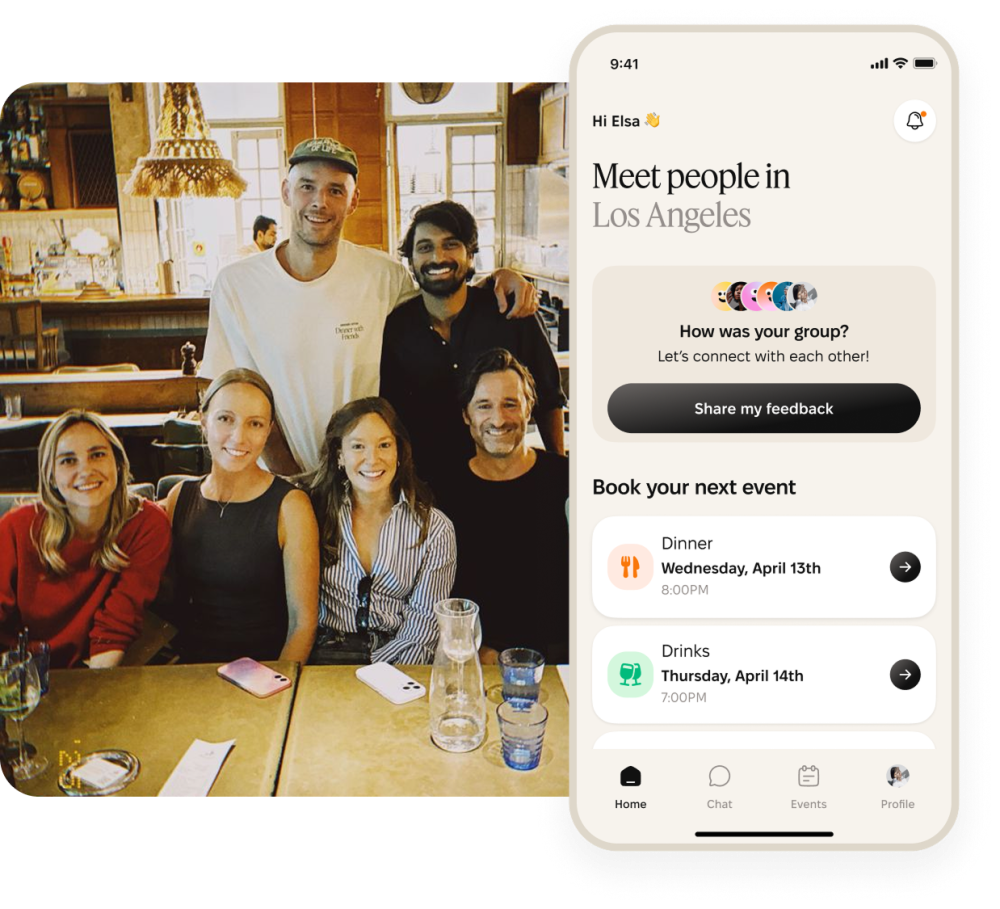
At this point, Timeleft finalizes the group and pre-books the venue. The name, address, and meeting time appear in the app the day before your event.
The venue is revealed the day before on purpose, not as a tease. The decision is already made, so there's nothing left to research, second-guess, or pre-manage. If something does go sideways on the night, there are clear paths for that too, including what to do at the wrong table and handling a late-running group.
Handling attendance gaps in your dinner group
What happens if someone doesn't show up?
Why no-shows are the biggest friction point
Timeleft works to fill every table. But no-shows are a real, named issue across the platform. It's the biggest real problem with the format, and it's why there's a no-show penalty at all.
Handling unexpected gaps in attendance
Timeleft charges a no-show penalty of 35% of the monthly subscription price ($19.99/month in the US; pricing may vary by region) when someone books and simply doesn't appear, per Timeleft's terms linked above. Three or more late cancellations within two months can lead to suspension.
Everyone at the table paid to be there, and they're covering their own food and drinks on the night too. Nobody wanders in off the street.
Handling mismatched group sizes
Groups typically run four to six people, and real-world attendance can vary. The format works across that range because the structure carries the evening: fixed time, fixed seat, a pre-booked venue, in-app conversation starters for the opening minutes, and a clear end point. If a language mix-up ever does occur, there's a process for that as well, covered in the language mix-up article.
Timeleft operates in 52 countries and 200+ cities, which means the matching pool in most major metros is deep enough for the algorithm to do real work rather than grab whoever's available. Take the personality quiz and start your Timeleft membership.
FAQs
Does the algorithm learn from my past dinners?
Yes. Post-event feedback refines future matches, and the system uses your feedback alongside everyone else's to improve compatibility predictions over time.
Will I ever be matched with the same people twice?
The algorithm prioritizes compatibility for a given date and format, so it's possible a previous tablemate could reappear if they're a strong fit for the same evening.
How specific are the compatibility categories?
The quiz answers map to compatibility dimensions that help the algorithm build a balanced table. The exact parameters aren't published, but the confirmed inputs include personality, age range, and language preferences.
What decisions does the algorithm remove on the night?
Timeleft settles where to go, when to arrive, who you'll sit with, and when it ends before you leave home. The only decisions left are what to order and whether to join the optional after-event gathering in cities that offer it.
What does a Timeleft dinner cost in total?
The subscription is $19.99/month in the US (pricing may vary by region) and is required before attending any event, and you pay for your own food and drinks at the venue on the day. Once subscribed, you can attend as many events as you like that month.
Is Timeleft matching romantic?
For standard dinners, drinks, and coffee events, no. Matching means compatibility for conversation at a shared table, and the format doesn't signal anything beyond that. Timeleft does run Singles Events, where the romantic angle is explicit. Outside of those, what a connection becomes afterward is open-ended and entirely up to the people at the table.
Key terms glossary
Compatibility score: A number representing how likely two people are to have a good conversation at the same table, built from quiz answers and refined by post-event feedback.
Matching algorithm: The system used to assemble a group of four to six from quiz data, location, timing, and format. In practice, it balances conversational compatibility and a mix of backgrounds and personalities, within the practical constraints of city, date, format, and available venue.
Table assembly: The process of building a final group from the pool of members who selected the same date and format, balancing compatibility against a mix of backgrounds and personalities.
Day-before reveal: The moment, the day before your event, when the venue name, address, and meeting time appear in the app. It removes venue research and pre-event second-guessing from your plate.
No-show penalty: A charge of 35% of the monthly subscription price applied when a member books and doesn't attend. It exists to protect the other diners and the venue holding the table.