TL;DR: Bumble BFF is free, every match is selfie-verified, and it works if you want to choose exactly who you meet and don't mind arranging the meetup yourself. But you still browse profiles and pitch yourself before anyone meets you. Timeleft runs on a monthly subscription plus what you spend at the venue, and skips the profile stage. You're matched into a group of four to six at a pre-booked table.
For many people, the profile-first format doesn't produce real connection, and that has nothing to do with effort or social skill. The format asks you to perform before you've been met. That's a real cost, and no amount of profile-polishing changes it.
In this article:
- What is Bumble BFF and how does it work?
- Bumble BFF pros: where it gets the experience right
- Bumble BFF cons: structural limitations
- What format solves the problems Bumble BFF can't
- FAQs
What is Bumble BFF and how does it work?
Bumble BFF launched as a mode inside the Bumble dating app in 2016. Bumble For Friends launched as a standalone app in 2023. In September 2025, it relaunched under the name BFF, adding group chat rooms powered by Geneva, a way to find local events through Groups, interest-based matching, photo prompts, and customizable profiles. Group discovery was added in early 2026.
The profile-based matching system
You build a profile with photos, a bio, and up to 10 interests. The app shows you other profiles based on location and age preferences. You browse other people's profiles and choose who to connect with. If both people choose to connect, you can start chatting.
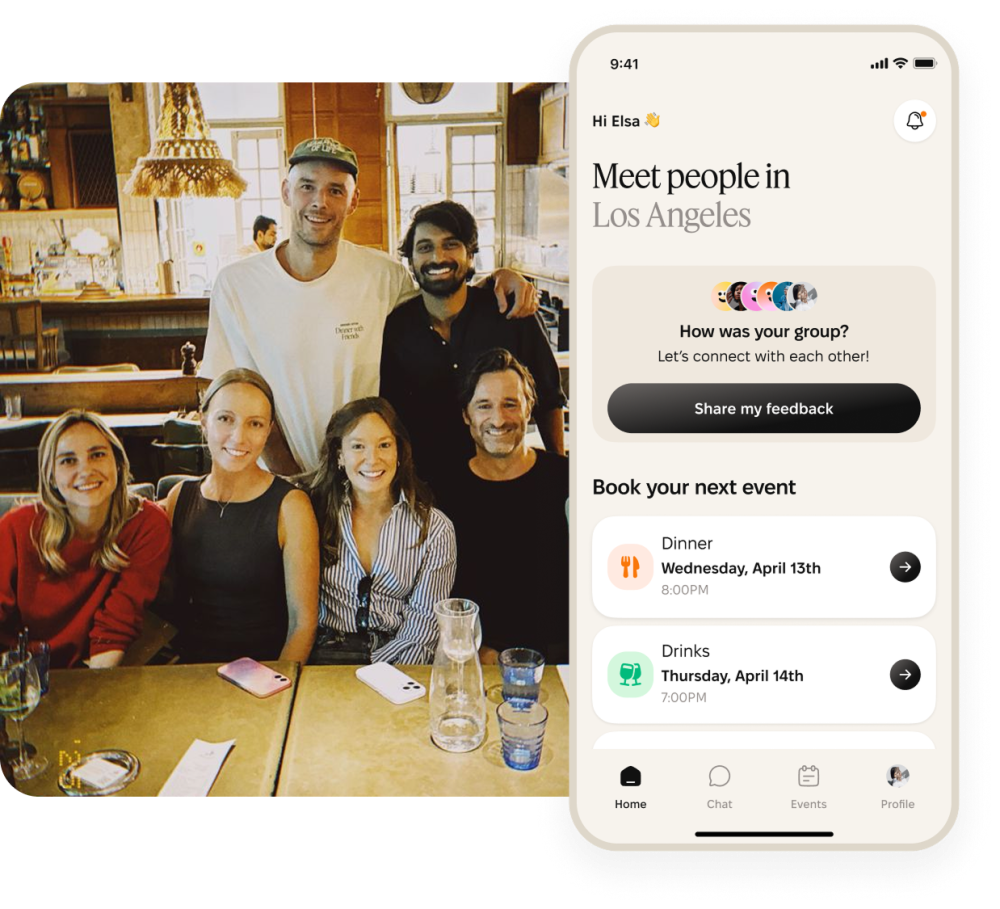
Timeleft skips the profile-browsing step, so there's no one to evaluate before you meet. You take a personality quiz, and the app matches a group of four to six people based on answers that surface how you think and what you value. Photos don't come into it.
The stated intent is friendship, not dating, but the profile step works the same way. You're still evaluating strangers based on chosen photos and a few lines of text, and they're doing the same to you.
Who Bumble BFF suits
The app works best for people who are comfortable initiating conversations and don't mind the legwork of turning a match into a real-world plan. The new BFF app is available in the U.S., Canada, and Mexico. Elsewhere, the older Bumble For Friends app may still be what you get.
Bumble BFF pros: where it gets the experience right
Bumble BFF does several things well. It's a well-executed version of a format that works for some goals and not others.
It's free
Bumble's App Store listing says every feature is free, with no paywalls or upgrades. That's a meaningful advantage over any subscription-based alternative.
Verified profiles build genuine trust
Every BFF match has passed selfie verification, and verified accounts show a blue shield. Bumble's safety documentation says uploaded photos are reviewed by humans and technology for nudity, weapons, drugs, and hate symbols.
Timeleft handles trust differently. Members meet at a pre-booked venue with a matched group, in a public place, with other people already there. 96% of diners say they felt compatible with their group.
A large pool in major cities
Bumble BFF's large user base means plenty of potential matches in big U.S. cities. If you live in a major metro, you're unlikely to run out of people to browse through. That's a real advantage if control over who you meet matters more to you than the time it takes to get there.
Privacy before you meet
BFF Groups support in-app chat, so you can talk before sharing a phone number.
Timeleft's privacy model is structural. Members can't message anyone one-on-one or see other members' profiles or photos until after an event. A group chat with the table opens shortly before each event, but apart from the preview of who you'll meet, there's no pre-event messaging. After the event, members choose who to stay in touch with, and nobody gets anyone's contact details unless both opt in.
Bumble BFF cons: structural limitations
The limitations below come with the profile-first format, not from a lack of polish on your end.
Escaping the profile audition
The core one-on-one action on Bumble BFF is browsing profiles and deciding who to connect with. You're judging someone based on a few photos and a bio, and they're judging you the same way. It's an audition, and it happens before you've met.
A similar dynamic can apply whenever you size people up from a profile. The format selects for people who perform well in a bio and an opener. Whether they're interesting in person is a different question entirely.
Match fatigue and conversation drop-off
Even when matches do turn into conversations, many fizzle within a few messages. Two people who know almost nothing about each other, with no shared context, are trying to build a friendship through text. Without a reason to invest, plenty stall before a meeting is ever planned.
Pressure to perform from match one
Once a match is made, the pressure starts. You need a good opener and enough momentum to suggest meeting. The whole interaction is framed by the knowledge that the other person is evaluating you, and you're evaluating them.
The time investment doesn't scale
Bumble BFF requires time. You browse, choose, match, message, and then negotiate a time and place to meet. If a one-on-one match turns into a meetup, you've invested hours in a single person with no guarantee of compatibility.
On Timeleft, the logistics are handled before you arrive. You subscribe, pick a format, choose a date and neighborhood, and show up. One evening with four to six people, and if the fit isn't there, the same format is available next week.
Someone still has to organize it
Groups and Events help BFF users get from chat to a meetup, but someone still has to organize it, and you still choose which strangers to bet an evening on. One-on-one matches still leave the planning to the two of you.
On Timeleft, someone already has. The table gives the conversation somewhere to start, and with four to six people, nobody has to carry the evening.
"Chance to make new friends around a nice dinner. I really appreciated the chance to connect afterwards with people I had met." – Cliff on Trustpilot
What format solves the problems Bumble BFF can't
The structural problems above share a root cause. On a one-on-one BFF match, two people have to work their way through a text conversation before they ever sit in the same room. A different format skips the text-conversation stage entirely.
No opener, no pitch, just a table
On Bumble BFF, you're pitching yourself in a bio and an opener before you've met anyone. On Timeleft, the restaurant is booked and the group is matched before you arrive. You meet in person first, with other people at the table and no pressure to perform. Whether to take it further is a decision that comes after the evening.
| Aspect | Bumble BFF | Timeleft |
|---|---|---|
| Matching | Self-selection via profile browsing | Matched group of four to six |
| Who you meet | One-on-one or groups | Four to six people in a group setting |
| Venue | You arrange | Pre-booked, revealed 12 hours before the event |
| The audition | Profile photos, bio, opener required | Show up and start talking |
| Planning required | You coordinate time and place | Pick a format, date, and neighborhood |
| Cost | Free, every feature included | Monthly subscription + venue spend |
| Formats | Group chats, community groups, events, one-on-one meetups | Dinners, women-only dinners, drinks, coffee, runs, walks |
| Global availability | U.S., Canada, Mexico | 52 countries, 200+ cities |
Timeleft is a subscription, and it's required before attending any event. Once subscribed, members can attend as many events as they like across any format or city. Food and drinks are paid separately at the venue. The per-event cost works out well for members who go to a few events a month.
Which one fits depends on what you want.
| User goal | Recommended approach | Typical event duration |
|---|---|---|
| Full control over who to meet | Bumble BFF | Varies by user |
| A pre-arranged evening with no logistics to manage | Timeleft subscription | Varies by format |
| Low-pressure format with no audition | Timeleft group dinners | About three hours (dinners) |
| Recurring social ritual | Timeleft weekly events | Varies by format |
If choosing exactly who you meet matters more than how the meeting feels, it's a reasonable option. If the audition is what's wearing you down, Timeleft removes it entirely. No bio, no opener, just a pre-booked table and a matched group. See which formats are available in your city.
FAQs
Is Bumble BFF worth it in 2026?
Bumble BFF is worth it if the legwork of browsing, matching, messaging, and arranging your own meetup doesn't put you off. But if you've tried the apps and concluded the format itself is the problem, Bumble BFF won't solve that.
How long does it take to make friends on Bumble BFF?
There's no fixed timeline. Some people meet a friend within weeks. Others browse for months without a single real-world meeting. The variance depends on how much time you invest and whether you live in a city with a dense enough user base to keep the pool moving.
What are the best alternatives to Bumble BFF?
If you want to pick events by interest, Meetup offers interest-based groups with no matching. If you want a low-pressure format where connection can happen before you've had to sell yourself to a stranger, Timeleft removes the audition entirely. You show up to a pre-booked venue and meet the group in person.