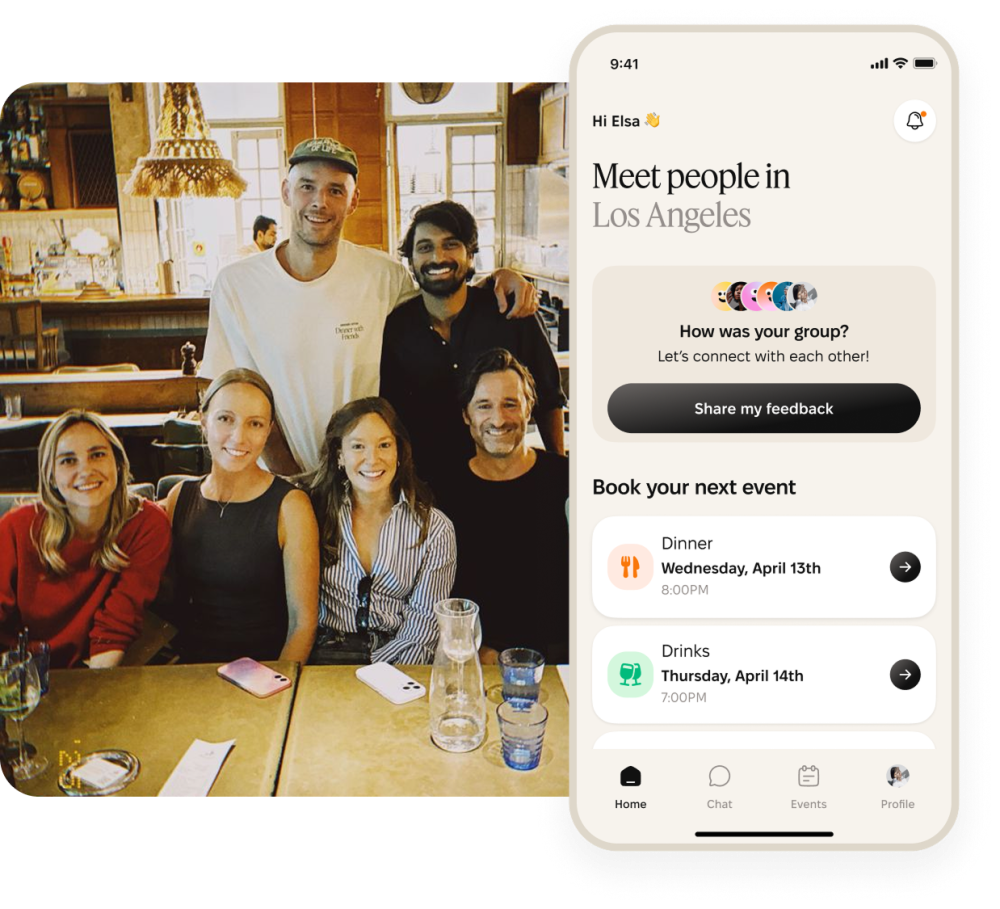
TL;DR: Timeleft handles every decision so you don't have to. You take a personality quiz and pick a format and date. Subscribing costs $19.99/month (U.S.) and unlocks your first booking. Timeleft matches you with a group of four to six people and pre-books the venue. You find out where you're going the day before. Show up at the stated time; the evening runs about three hours. You pay for your own food and drinks at the venue. This guide covers every stage, from quiz to post-dinner follow-up, so you know exactly what you're booking.
Most social events ask you to do the hardest part yourself. Where to stand, when to leave. What to actually say when there's a lull. All of that lands on you. Timeleft doesn't. The entire format is built so the structure does the interpretive work that open-ended socializing normally dumps on you.
Timeleft is a subscription platform that matches a group of strangers algorithmically and pre-books the venue. You find out where you're going the day before. Your only job is to show up. This article walks through every stage of that process, from the personality quiz to the end of the evening, so you can decide whether this format works for you before you spend a dollar.
In this article:
- How Timeleft works: a step-by-step breakdown
- The science behind Timeleft personality matching
- How Timeleft selects your dinner companions
- Step-by-step: finalizing your Timeleft reservation
- The day-before countdown to your venue reveal
- Predictable logistics for a stress-free meal
- How Timeleft maintains a safe, structured space
- How Timeleft compares to other ways of meeting people
- FAQs
- Key terms glossary
How Timeleft works: a step-by-step breakdown
If you've been searching "how does Timeleft work" and getting fragments from five different pages, here is the whole thing in one place. The process has six stages, and none of them require you to organize anything:
Personality quiz: A short assessment covering your personality and social energy, plus practical preferences like neighborhood, language, dietary needs, and budget.
Choose a format and date: Dinner is the core format, with drinks, coffee, runs, and more available in most markets.
Subscribe: The plan is $19.99/month in the U.S., and you need an active subscription before you can attend any event. Once subscribed, you can book as many events as you like that month.
Get matched: The algorithm builds your table of four to six people.
Venue reveal: You find out where you're going the day before the event.
Show up: You arrive at the stated time, find your reserved table, and the evening runs about three hours.
That's the entire workflow. No swiping, no browsing profiles, no group chat to manage beforehand, and no venue research. You pay for food and drinks separately at the venue on the day.
How the Timeleft matching process works
How Timeleft matching works is simpler than most people expect. The algorithm draws on your quiz answers, age range, language, and stated preferences to build a balanced table, and it refines itself over time using the compatibility feedback guests leave after each dinner. Timeleft does the matching. You don't.
How fixed logistics reduce social fatigue
If unstructured socializing exhausts you, the problem is usually the micro-decisions, not the people. Where to stand, when to arrive, how to exit without it being awkward, whether the conversation will dry up. Timeleft removes all of those. Fixed seat, fixed time. No decisions on the night. The evening has a clear shape, and you know what that shape looks like before you leave your house.
The science behind Timeleft personality matching
The quiz aims for a compatible table, not a perfect one. A good dinner needs enough overlap so conversation starts easily and enough difference so it stays interesting. That distinction matters, because 96% of diners report feeling compatible with their matched group, and that number comes from aiming for balance rather than cloning. The biggest lesson from getting it wrong is that chemistry is less predictable than people expect, and less necessary than they fear.
How your answers shape your table
The quiz covers your personality and how you tend to show up socially, then layers in practical inputs like age range, language, and neighborhood to build the group. The matching help article confirms that the goal is a compatible, varied group rather than six people with identical profiles. Event language and age band are factors, but so is who else has booked the same dinner, which means the final mix can shift as people book or cancel closer to the date.
Completing the personality assessment
You fill in the quiz during onboarding, and it takes a few minutes. Be honest rather than aspirational. The algorithm can only work with what you give it, and answering for the person you wish you were at dinner produces a table built for someone else.
How to reset your quiz data
If your circumstances change, you don't need to re-register. Update your personality details in your profile and the new information feeds into your upcoming matches automatically.
How Timeleft selects your dinner companions
Timeleft typically matches four to six people per table. The algorithm aims for a mix of ages and backgrounds, though the final group depends on who has booked the same dinner. One verified user described the result after her first dinner:
"My experience exceeded my expectations by far. I spent a wonderful dinner with bright and open-minded strangers. The event was well-organised and most likely the algorithms were working well too, to have created this combination of participants. 5 stars" - Regina on Trustpilot
How Timeleft assigns your table
Once you've booked, the algorithm takes your quiz data and builds the group without any further input from you. It runs automatically. A preview of your group appears in the app before you arrive.
Defining search distance and age expectations
You can set your preferred neighborhood and price range during booking, and the algorithm draws from that pool. Timeleft cannot guarantee a specific age range, though the system aims for a balanced mix. In dense markets the pool is large, which is why Timeleft works best in major metros across its 200+ cities in 52 countries. You can also book events in another city when you travel, since one subscription works across the whole footprint.
Step-by-step: finalizing your Timeleft reservation
The booking flow is deliberately short, because every extra step is another chance to talk yourself out of going:
Pick a format: Dinner, drinks, coffee, or a run, depending on your city.
Pick a date: Dinners run on set evenings each week, with Women-Only Dinners on Tuesdays in 50+ cities.
Confirm your subscription: $19.99/month covers unlimited bookings during the active period.
Done: You can book up to 13 hours before an event starts, in every city.
Checking local dinner availability
Available dinners appear in the app based on your city. Availability scales with local density, so major metros have the most options, and Timeleft now hosts roughly 6,500 dinners each week across its footprint.
Dinner pricing and payment details
The subscription is $19.99/month in the U.S., and pricing varies by market. That covers everything except your meal and drinks. You pay for your meal and drinks directly to the venue on the night, so budget for both. You can attend as many events as you like within a month. Go four times and the subscription works out to around $5 per dinner, before food and drinks.
Managing your booking confirmation
After you book, confirmation is held in the app. The venue is revealed the day before, and if your plans change, you can cancel or reschedule within the allowed window without penalty.
The day-before countdown to your venue reveal
You find out which restaurant you're going to the day before, which means you can't overthink it. That's the point. It's like getting a gift you can't return. The decision is already made, so there's nothing left to dread.
The countdown explained
All key event details are released in the app the day before your event. That means the venue name and address. Start times vary by city. Your table number or name appears one hour before start. The booking cutoff is 13 hours before the event. If you book after the day-before reveal has already gone out, the venue details appear in the app an hour after you confirm your spot.
Previewing your upcoming match
Before the event, the app shows the format, time, group size, and eventually the venue. Neither names nor photos are shown beforehand. There's nothing to pre-judge and nobody to research at 11pm the night before.
Eliminating pre-dinner social anxiety
Most people feel a bit nervous before their first dinner. That's normal, and the awkward part usually lasts about ten minutes. Knowing exactly when the evening ends before you arrive changes how that nervousness feels. What feedback describes, over and over, is that the first ten minutes are the whole of the hard part. After that, most people stop noticing the format at all.
Predictable logistics for a stress-free meal
Here is Timeleft explained as an actual evening, from the moment you arrive to the moment you leave.
How to locate your assigned table
The venue is pre-booked and they're expecting you. The app shows your table number or name an hour before the event. You walk in and give the reservation details. They show you to the table. No hovering near the entrance scanning the room.
No waiting: the benefit of fixed starts
A fixed start time is set for each dinner. Everyone knows when to arrive, which removes the uncertainty of open-ended social events.
How Timeleft manages your conversation
Timeleft provides in-app conversation starters to help your group get past the opening minutes, acting as scaffolding rather than a script. They're there if the table needs them and ignorable if it doesn't.
Knowing exactly when dinner concludes
Dinners run about three hours. You know the end time before you arrive. That changes the entire psychology of the evening. You're never calculating your exit, because the exit is built in.
Post-dinner logistics and departures
When dinner ends, it ends. In select cities, Timeleft offers an optional Last Drinks stop at a nearby bar if you want to keep the evening going, no pressure either way. Afterward, the Connect feature lets you choose who to stay in touch with by sending a connection request through the app, and the Impressions feature shows you what people appreciated about you in a feedback summary visible after the event. If you want to turn a good table into an ongoing friendship, Timeleft Repeat exists specifically to help you reconnect with people you've already clicked with.
How Timeleft maintains a safe, structured space
Safety is designed into the platform, not bolted on afterward. A report button is a last resort, not a strategy, which is why Timeleft leans on proactive screening and visible expectations rather than after-the-fact moderation. That approach shows in the numbers. 94% of post-event group chats are never flagged for safety concerns, and 99% of experiences happen without a safety incident.
How Timeleft verifies participant identity
Timeleft requires every member to be 18 or older (21+ in the UAE) and to register under their legal name with a clear, unfiltered photo. No pseudonyms, no blurred headshots. ID verification may be requested, and misrepresenting your age is grounds for removal.
Setting clear expectations for diners
Community guidelines are available on the website. They cover how guests are expected to treat each other, including no continued romantic pursuit after rejection and zero tolerance for abuse of any kind, including "zero tolerance for any behavior involving or that could lead to the sexual exploitation or abuse of minors, online or offline." Enforcement follows a three-stage ladder from educational warning to formal warning to permanent ban.
Safety support and incident reporting
You can block or report any user at any time. Per Timeleft's terms and conditions, reasonable efforts are made to ensure blocked users aren't surfaced or matched at the same event. The help center also covers staying safe at meetups and keeping the community safe in practical detail.
How Timeleft vets its partner restaurants
Every event is hosted at a vetted venue from a network of hand-selected partners, never a random hired room. Restaurants are selected for accessible price ranges and inclusive menus, per the guide to Timeleft restaurants, and post-event venue reviews from participants keep quality control running at scale. Restaurants interested in joining the network can read about partnering with Timeleft.
How Timeleft compares to other ways of meeting people
For context, here's how the format stacks up against the two alternatives most readers have already tried:
| Timeleft | Meetup | Bumble BFF | |
|---|---|---|---|
| Matching | Algorithmic group of 4-6 | Organizer-led, whoever shows up | Swipe-based 1:1 |
| Planning required | None, venue pre-booked | Browse, RSVP, unclear format | Match, then message to arrange |
| Structure | Fixed start, dinner runs roughly 3 hours | Varies by organizer | None after matching |
| Cost | $19.99/mo + own meal | Free to browse | Free, paid premium features |
Meetup carries local inventory across every interest category, and Timeleft covers your city with 6,500 dinners weekly in a fixed format that requires zero research or organizing. Bumble BFF brings an existing user base, and Timeleft brings algorithmic matching without the message negotiation. The venue is booked and the group is built. You just show up. Both platforms leave everything after the match or RSVP to you, and that manual layer is exactly what Timeleft removes. For a deeper breakdown, see Timeleft's own Timeleft vs Meetup comparison.
The format either works for you or it doesn't. The only way to find out is to try it. Take the personality quiz and start your membership.
FAQs
What if I need to cancel?
You can cancel your subscription through your account settings. A no-show penalty of 35% of the monthly subscription price applies, per Timeleft's terms and conditions. It exists to respect the time of the other diners at your table and of Timeleft's venue partners, not just as a fee. Repeat no-shows can lead to suspension.
Can I bring a friend?
Yes. You can bring a +1 to any event, whether they're a Timeleft member or not, which lowers the barrier if you're not ready to show up solo.
Is this a dating app?
Not a dating app. Not a dinner club either. Just weekly plans with four to six people matched to you, meeting face-to-face to build real connections. Connection outcomes are open-ended, and Timeleft offers Singles Events as a variant for members specifically seeking romantic connection.
What if I don't click with anyone?
That can happen, and the end of the evening is scheduled, so you're never stuck. You choose who to stay in contact with afterward through the app, with no pressure in either direction.
Do I pay for my own meal?
Yes. You pay for food and drinks separately at the venue on the day. The subscription covers the matching and booking. You handle the meal and drinks directly at the venue.
Key terms glossary
Algorithmic group matching: How Timeleft builds your table of four to six from quiz answers, age, language, and preferences, refined by post-dinner feedback.
Day-before reveal: When the venue name and address are released in the app, the day before your event. Start times vary by city.
Fixed end time: When every dinner wraps up, roughly three hours after the stated start.
Format: The event type you book: dinner, drinks, coffee, or a run, with variants like Women-Only Dinners (available in 50+ cities) and Singles Events.
Personality quiz: The onboarding assessment covering your personality traits, interests, and how you tend to show up socially.
Subscription: The $19.99/month (U.S.) plan required before attending any event, covering unlimited bookings during the active period.
Venue network: Timeleft's hand-selected restaurant partners where every event is hosted.
Conversation starters: Optional in-app prompts provided to help your table get past the opening minutes.
Impressions feedback: The post-event feature showing what your table appreciated about you.
Last Drinks: An optional bar stop after dinner in select cities, with no pressure to attend.