In this article
The short version
The best apps to make friends in 2026 work in four different ways. Some put you straight into a planned meetup, some help you find events around a hobby, some let you chat with people nearby first, and a few run members-only clubs for women. Research suggests it takes roughly 50 hours together to go from acquaintance to casual friend (Hall, 2018), so the apps that get you into a room sooner give that clock an earlier start. If you'd rather skip the messaging, Timeleft, with 4M+ members in 200+ cities, puts you in a group of 4–6 people for dinner, drinks, coffee or a walk.
These days, it can feel easier to change careers, move cities, cross the finish line of a marathon, or even travel to the moon than it is to make new friends.
That might sound dramatic, but if you've ever downloaded an app, matched with a few people, and then... never actually met them, you know exactly what we mean.
The good news is that a whole wave of apps now exists to fix this. From one-on-one matching to group dinners with strangers, each one tackles a different stage of friendship.
We compared the best apps to make friends in 2026 to see which ones actually get people meeting, and we checked every app's own website and app store listing in October 2026.
Why do we even need these apps?
Figuring out how to make friends as an adult is harder than it used to be, and the numbers show it.
In a 2023 advisory, the U.S. Surgeon General called loneliness and isolation an epidemic, with a mortality risk comparable to smoking up to 15 cigarettes a day. In June 2025 the WHO Commission on Social Connection estimated that about one in six people worldwide feel lonely, and linked loneliness to around 871,000 deaths a year. And the share of Americans who say they have no close friends rose from 3% in 1990 to 12% in 2021, according to the Survey Center on American Life.
School, shared housing and the office used to put the same people in front of us week after week. When those routines fall away after a move, a new job or a breakup, many people now turn to an app to fill the gap.
In an April 2026 roundup, TechCrunch counted more than a dozen apps built to help people meet friends nearby, from group dinners to activity apps for people over 40.
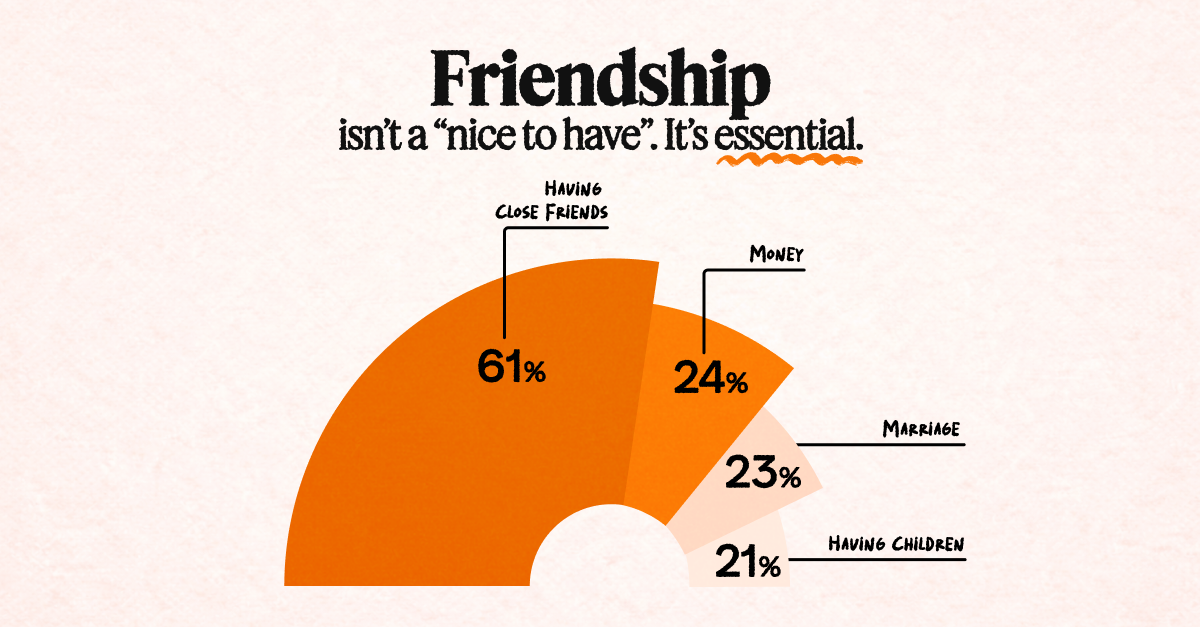
Most adults rank close friends above money and marriage.
61% of U.S. adults say having close friends is extremely or very important to living a fulfilling life, far more than say the same about money (24%), marriage (23%), or having children (26%). (Pew Research Center, 2023)
The four types of friendship apps
Most friendship apps fall into one of these four categories.
1. Structured IRL meetups
These apps are built for people who want to skip the chatting and go straight to meeting up in real life. They plan small group gatherings, like dinners or nights out, and handle the logistics so you don't have to. Timeleft and 222 both sit in this category.
2. Interest and event discovery platforms
These apps help you find things to do and meet people through shared activities. They suit you if you already know what you enjoy and want to meet people around it. Think Meetup, WeMeet, or Meet5 if you're over 40.
3. Chat-first friend matching
Apps like Bumble BFF and Peanut show you profiles of people nearby and let you chat before you meet, much like a dating app. They're a good choice if you'd rather start with a conversation.
4. Members-only clubs for women
A newer group of apps runs paid, application-only communities for women, with small events and introductions. Les Amis and After5 are the clearest examples.
Most apps overlap a little, but each has a clear primary strength. Knowing which type fits you narrows the list quickly.
How we evaluated each one
We didn't rank every app on a single scale. We looked at what shapes your experience once you've downloaded one.
- How you meet people. Is it messaging first, joining a group activity, or showing up to a dinner? This often decides whether anything happens at all.
- Structure or flexibility. Some apps handle everything and others leave it up to you, so it comes down to how much effort you want to put in.
- Speed to real life. How long is it from download to an actual in-person meeting? This is where most apps lose people.
- Type of connection. Are you after one-on-one friendships, a group, or a looser social circle?
- Availability and cost. Does the app run in your city, does it run regularly, and what do you pay before you meet anyone?
Different apps, different outcomes
Put side by side, the best app turns out to be the one that matches how you like to meet people.
Some apps are good for browsing and chatting. Others are better for joining activities and groups, and a few are built for sitting down with new people and talking. Knowing the difference saves you from downloading five apps and hoping one works.
A quick note from us
We're the team behind Timeleft, an IRL connections app with 4M+ members. Each week, small groups of strangers meet for dinner, drinks, coffee or a walk in 200+ cities across 52 countries. If you live in New York, our guide to making friends in NYC covers the city in more detail.
We think meeting in person is the quickest way from stranger to friend, which is why Timeleft has no messaging before you meet. Our piece on dinner with strangers explains why that works for so many people. We also know it doesn't suit everyone.
So this guide is here to help you find the app that fits you. We'll be straight about where Timeleft works well and where another app might suit you better.
Quick comparison: 9 best apps to make friends in 2026
| App | Best for | How it works | Friendship depth | Structure level |
|---|---|---|---|---|
| Timeleft | Meeting a small group of strangers in person | Personality-matched groups of 4–6 meet in person every week | Very high | Very high |
| Bumble BFF | One-on-one friend matching | Swipe, match, and chat before meeting, or join interest groups | High | Medium |
| Meetup | Large group activities and communities | Join meetups based on interests and show up to group activities | High | Medium |
| 222 | A planned night out with a matched group | Get invited to group outings and meet a matched group of about six | High | High |
| Les Amis | Women who want a members-only club | Apply to join, then book small events and get suggested matches | High | High |
| Meet5 | Group activities for people over 40 | Join or create activities and chat with the group before and after | Medium | Medium |
| Peanut | Moms looking for friends nearby | Swipe, match, and chat, or join groups | Medium | Low |
| WeMeet | Interest-based group activities in Europe | Join hobby-driven events and social activities | Medium | Medium |
| After5 | Career-focused women in European cities | Apply, then join small dinners and one-on-one introductions | High | High |
The 9 best apps to make friends in 2026
Timeleft
Best for: People who want a clear, low-effort way to meet new people in person, without messaging first
At Timeleft, you pick a format and a time, and we put you in a group of 4–6 strangers, matched with the help of a short personality quiz. You meet in person over dinner, drinks, coffee or a walk, depending on what runs in your city. There are no bios to scroll and no chat to keep alive beforehand. We reveal the venue and your group just before, and all you have to do is show up.
Because it runs every week, you can come back and keep meeting new people, which is how acquaintances slowly turn into friends. If that sounds like your kind of evening, book a dinner and see who's at the table.
Strengths
- Skips the endless messaging phase entirely
- Highly structured and low effort, since the venue and the group are handled for you
- Works for people who want real conversation without dating-app pressure
- New events every week in 200+ cities across 52 countries
- Report someone and you're never placed with them again
Limitations
- Not available in every city, and coffee, drinks and walks run in fewer cities than dinners
- Less control over who you're matched with
- You need a subscription before you book, and you pay for your own food and drinks at the venue
- The weekly rhythm may not suit every schedule
“Making and meeting new friends in a new city is not easy. Timeleft changed that. I just had my first dinner yesterday and would definitely recommend it to anyone looking to meet new people and have a good time.”
Bumble BFF
Best for: One-on-one friend matching with a chat-first, familiar interface
Bumble BFF is Bumble's friend-finding app. It started in 2016 as a mode inside the dating app, became a separate app in 2023, and was rebuilt in September 2025 around Groups, where people who share an interest can chat, post and plan hangouts. You can still swipe through profiles nearby, match, and chat before deciding to meet. In the US, the new app's listing says every feature is free.
Strengths
- Free in the US
- Familiar interface for anyone who's used a dating app
- Bumble says every profile is selfie-verified
- Groups make it easier to meet several people who share an interest
Limitations
- Heavy reliance on messaging, so many matches never turn into actual meetings
- Getting from a match to a meetup takes effort from both sides
- In the UK, Ireland and Germany the store still lists the older Bumble For Friends app, last updated in September 2025
Meetup
Best for: Large interest-based group activities and established communities
Meetup connects people through shared interests, from hiking and book clubs to language exchange and professional groups. Founded in 2002, it's one of the longest-running platforms for meeting people in real life. You join a group, sign up for an event, and show up. Its app listing counts over 60 million members and around 100,000 events a week, the broadest community on this list.
Strengths
- Enormous variety of interests and communities
- Suits activity-driven socializing
- Low pressure, because conversation happens naturally around the activity
- Many groups have long histories and tight-knit regulars
Limitations
- Friendship depth depends heavily on event quality and group culture
- Larger groups can feel impersonal, and it's easy to show up and leave without connecting
- Most groups are free to join, but some organizers charge for events
222
Best for: People who want a planned night out with a matched group and are open to friendship or romance
222 invites you to group outings at bars, restaurants and other venues near you, then picks who you'll meet there from a personality questionnaire. Groups are usually around six people, and you don't browse profiles or message anyone first. Afterward, you say who you'd like to see again, as a friend or for a date. Forbes reported in July 2026 that 222 runs in 17 markets, with New York the largest, and costs $22.22 a month for unlimited events.
Strengths
- No profiles or messaging before you meet
- Members are vetted before they're picked for an event
- Events always take place in public and in a group
Limitations
- Available on iPhone only, according to TechCrunch in April 2026
- Follow-ups can be romantic as well as platonic, which won't suit everyone looking only for friends
- If 222 can't find compatible people for an event, you aren't selected, although you get a refund
Les Amis
Best for: Women, including trans women and LGBTQ+ members, who want a members-only club
Les Amis is a members-only community for women, and its FAQ says trans women and LGBTQ+ members are welcome. You apply to join, then use monthly credits to book small events and trips, and the app suggests women to meet. It runs in 13 cities, including New York, Austin, Paris, Berlin, Barcelona and Amsterdam, and all events are in English. Membership is paid monthly or quarterly, plus a one-time joining fee.
Strengths
- Strong focus on safety, with verified profiles
- Small, planned events make it easier to go from a match to a meeting
- One membership works in every Les Amis city
Limitations
- You apply to join, then pay a monthly membership plus a joining fee
- Only in 13 cities so far, and every event is in English
Meet5
Best for: People over 40 who'd like to meet a group for an activity
Meet5 is a Frankfurt-based app for meeting people through small group activities, from hikes and dinners to concerts and game nights. Members create activities or join other people's, and everything to do with activities is free, while a Premium plan adds private messages. It's built for people over 40, though anyone over 18 can join. The app counts over 3 million registrations across the US, Germany, Austria, Switzerland, the Netherlands, Belgium, Luxembourg and France.
Strengths
- All activity features are free
- Group activities keep the conversation going
- Members go through a verification process
Limitations
- Private messages need a paid Premium plan
- Newer in the US than in Germany, so activity choice depends on your area
- Skews older by design, which won't suit everyone in their 20s
Peanut
Best for: Moms who want friends at the same stage of life
Peanut connects women through every stage of motherhood. You swipe to meet moms nearby, chat when you match, and join groups on topics from newborn sleep to toddler life. The app says over 5 million women use it, every profile is selfie-verified, and it's free to use, with a paid Peanut Plus tier.
Strengths
- Easy to find people at the same life stage nearby
- Selfie verification on every profile
Limitations
- Chat-first, so meeting up is up to you
- Built mostly around motherhood
- Some features sit behind Peanut Plus
WeMeet
Best for: People in European cities who want friendships to form through shared activities
WeMeet is the events app from WeRoad, the group travel company. Members join local events, from cooking classes and day hikes to after-work drinks, in cities including London, Manchester, Dublin, Paris, Berlin, Madrid, Barcelona, Milan and Rome. Signing up is free. It's the app version of joining a running club or a pottery class.
Strengths
- Natural conversation through shared interests reduces social pressure
- Lower stakes than one-on-one matching
- Good for people with a specific hobby or activity they want to share
Limitations
- Only in European cities
- Quality and frequency of events depend on your city
- Friendships can stay activity-specific and not develop beyond the shared hobby
After5
Best for: Career-focused women in European cities who want small dinners and one-on-one introductions
After5 is a members-only friendship app for ambitious women. You apply to join, then book small-group dinners and after-work tables, get one-on-one introductions to women at a similar life stage, and receive invites to themed circles. Its site lists 12 European cities, including London, Amsterdam, Paris, Berlin and Brussels, with a monthly membership or a pay-per-event option.
Strengths
- Small tables make it easy to talk to everyone
- Members are verified and the community is moderated
- The evening format fits around a working week
Limitations
- Women only, by design
- Only in European cities, and you apply to join, so it isn't instant
Which app actually helps you make friends?
There's no shortage of apps to make friends in 2026. The real challenge is figuring out which type of connection you're after, and then actually showing up.
If you're still working out what suits you, start with the format that feels most natural. If browsing profiles and messaging first appeals to you, Bumble BFF or Peanut are good starting points. For something activity-driven, Meetup has been running groups in most major cities for over two decades, and Meet5 does the same for people over 40. Women who'd like a members-only club can look at Les Amis or After5.
And if meeting 4–6 well-matched strangers over dinner, drinks, coffee or a walk sounds like your kind of week, that's what we do.
If you're curious what it's actually like, our piece on dinner with strangers is worth a read. And if you're starting from scratch socially after a move, a breakup or a few quiet years, that's exactly the situation we built Timeleft for.
Frequently asked questions
What's the best app to make friends in 2026?
There's no single best app, because the right one depends on how you want to meet people. If you want to skip messaging and meet in person right away, Timeleft or 222 are your best options. Bumble BFF is the best-known free option for chatting first, and Meetup has the widest range of activities.
Do friendship apps actually work?
They can, but it depends on the app and how you use it. Friendships grow out of time spent together, and seeing the same people again is what adds that time up. An app that brings you back to a group every week makes that easier than one that leaves the scheduling to you. Matches that stay in the chat rarely turn into friendships.
Is Bumble BFF gone?
No. In September 2025 Bumble relaunched BFF as a new standalone app, built on Geneva, a community app it bought in 2024, and added Groups alongside one-on-one chats (TechCrunch). In the US, the new app's listing says every feature is free. In October 2026 the new app was listed in the US, Canada, Australia and New Zealand App Stores, while the UK, Ireland and Germany still listed the older Bumble For Friends app, last updated in September 2025.
Is there an app like Tinder for friends?
Bumble BFF is the closest, because you swipe through profiles of people nearby and chat when you both say yes. Peanut works the same way for moms. BeFriend also uses swiping, but its own listing describes a community of teenagers, so we left it off a list about meeting adults in person.
Are there free apps to make friends?
Yes. Bumble BFF's new app is free in the US, most Meetup groups are free to join, and Meet5's activities are free, with a paid plan for private messages. Peanut is free with an optional paid tier. Timeleft works differently. You need a subscription before you book, and you pay for your own food and drinks at the venue. Prices vary by country, and the app shows the current price before you pay.
Is Timeleft a dating app?
No. Timeleft is an IRL connections app. Each week it puts groups of 4–6 strangers together for dinner, drinks, coffee or a walk in 200+ cities. There's no swiping, and nobody swaps private contact details before you meet. Everyone arrives at the same place at the same time. If you're open to romance, some cities also run separate singles events, so you always know which kind of evening you've booked.
What happened to Locals and Thursday?
Both were on earlier versions of this list. Locals closed on May 31, 2026, according to Nasha Niva, which cited the tech site dev.by. Thursday shut its dating app in January 2025 and now runs ticketed singles events under the same name, so it no longer fits a list of apps to make friends.
What's the fastest way to make friends as an adult?
The fastest route gets you into a room with the same people more than once. Research by Jeffrey Hall at the University of Kansas found that going from acquaintance to casual friend takes roughly 50 hours together, to friend about 90 hours, and to close friend more than 200 hours (Hall, 2018). Apps that build in repetition, such as weekly meetups or a regular group activity, help those hours add up faster than one-off encounters or chat-based matching. To go deeper, try our guide on how to make friends as an adult and our list of ice breaker questions that actually open conversations.
Timeleft is the IRL connections app. Small groups of strangers meet each week for dinner, drinks, coffee or a walk in 200+ cities. Find your group.