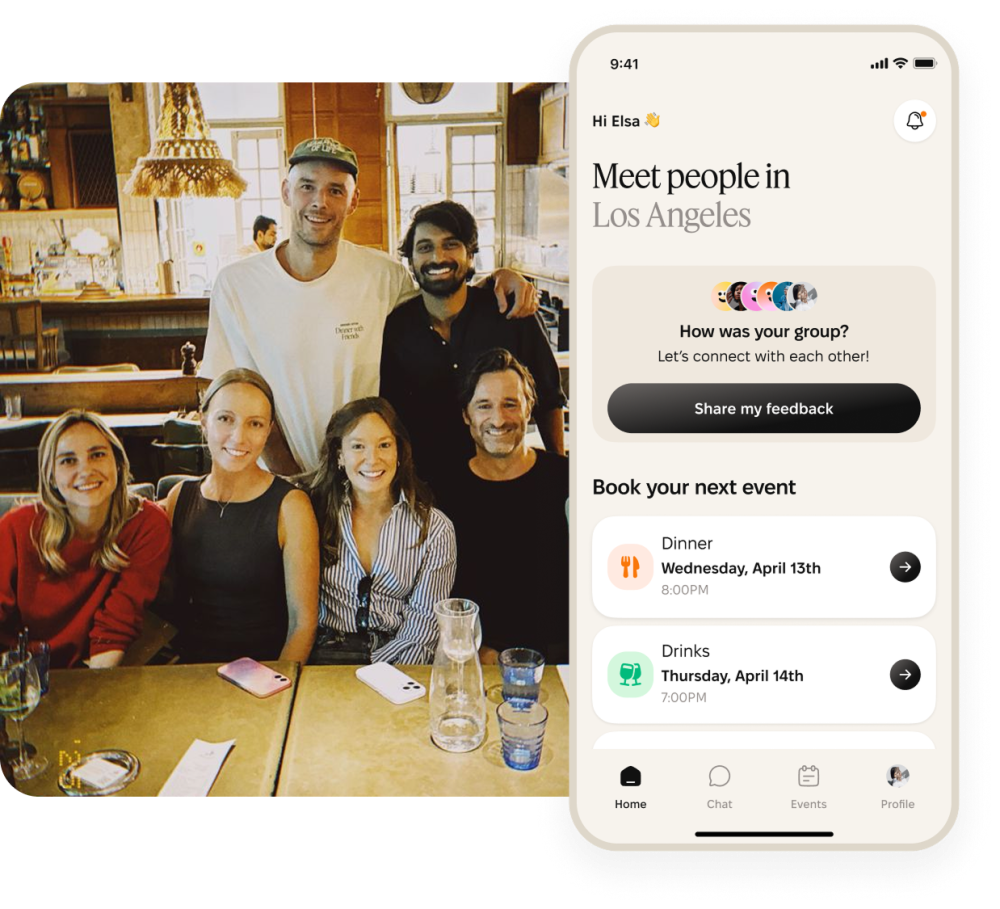
TL;DR: Bumble BFF gives you a profile and a chat window. Timeleft gives you a confirmed spot at a table with four to six strangers and a venue reveal 12 hours before the event. There’s nothing to plan. Bumble BFF is free and every match has already passed selfie verification, and you can request additional verification from a match, though if they don’t complete it in time, the conversation ends. Timeleft runs on a monthly subscription, and you pay for your own food and drinks at the venue. You can book an event up to 13 hours before it starts. Choose Timeleft if you want a guaranteed social experience this week with nothing to plan. Choose Bumble BFF if you want full say over who you meet and prefer a free app.
You have a full queue and an empty calendar, and the problem isn’t your opener. Bumble BFF and Timeleft both promise to help you meet people, but they solve different problems. One gives you a profile, a browse feed, a chat window, and in-app planning tools to organize meetups. The other gives you a confirmed spot at a table with four to six strangers, a venue revealed 12 hours before, and nothing to organize. If you want to choose who you meet, Bumble BFF is built for that. If you want to skip that layer entirely, Timeleft removes it.
In this article:
- The path from digital download to shared table
- How quickly each app gets you to a table
- Value breakdown for Timeleft and Bumble BFF
- Finding your best fit for real connection
- The time cost of finding a connection
- Turning virtual matches into actual events
- FAQs
The path from digital download to shared table
The structural difference between these apps determines what your Wednesday night looks like.
| Feature | Bumble BFF | Timeleft |
|---|---|---|
| Format | Discovery-based friend matching | Event-based group dining |
| Your role | Browse profiles, connect, chat, plan | Take quiz, subscribe, show up |
| First meeting | Negotiate 1-on-1 after match | Group of four to six people at a booked venue |
| Planning | In-app Plans to coordinate meetups; venue, time, and activity arranged independently | None (venue booked for you) |
| Cost | Free core features | Monthly subscription + venue spend |
How Bumble BFF works
Bumble BFF works like a friendship app. You build a profile with photos and an About section, then browse other profiles. When two people show mutual interest, you match and can start chatting. Either person can send the first message once you match. Filters for age and distance are free, and that's the full set, there's no premium tier behind it. Interest-based Groups and Events let you organize meetups directly in the app.
The mechanics of a Timeleft dinner
Timeleft removes the browse-and-match layer entirely. You take a short personality quiz, subscribe, pick a format (formats vary by city), choose a date and neighborhood, and show up. Timeleft matches you with a group of four to six people based on compatibility factors, not your browsing choices, and books the venue. You find out where you’re going 12 hours before the event, and you see a preview of who you’ll meet on the day. Dinners run about three hours, and you pay for your own food and drinks at the venue.
How quickly each app gets you to a table
One cost of browse-based apps is the gap between matching and meeting in person. The match is easy. Getting from a chat window to a confirmed plan on a specific evening is where the real time goes.
Bumble BFF: from profile to first meeting
The Bumble BFF path runs from download to profile build, then browse, connect, chat, plan, and meeting in person. The timeline can vary. You're responsible for choosing the venue, time, and activity, but the Plans feature keeps the coordination in one place.
Predicting your first event date
With Timeleft, the timeline is fixed. Once you subscribe, you can attend as many events as you like that month, across any format or city. The venue reveal happens 12 hours before the event, so there’s less time to overthink it before you go.
Friction points in your planning
With Bumble BFF, getting to an in-person meeting depends on both people following through from the first message to an agreed plan. Timeleft's model requires a subscription upfront, but removes the question of whether a plan will materialize. The date is set and the table is booked before you commit. The 13-hour booking window means you can decide on Tuesday that you want to go out on Wednesday, and the system handles the rest.
Value breakdown for Timeleft and Bumble BFF
Both apps have a cost, but they charge it differently. Bumble BFF is free to download and use. Timeleft charges a monthly subscription. What you spend with Bumble BFF is time. Every hour before you sit down with someone in person is part of the cost.
Bumble BFF subscription costs explained
Browsing profiles and chatting are free. Filters for age and distance are included at no cost, and that’s the full set. The app does not currently offer premium subscription options. The standalone BFF app is completely free to use.
Breaking down the Timeleft event cost
Timeleft works on a monthly subscription, plus your own food and drinks at the venue. The subscription works across 52 countries and 200+ cities, so you can use it while traveling.
What you're paying for
Bumble BFF is free, and the cost is the time spent getting from a browse to an actual plan. Timeleft charges a monthly subscription, and it covers the matching and venue booking, none of which you handle yourself.
Finding your best fit for real connection
The right fit depends on whether you want to choose who you meet or hand that decision off entirely.
| If you want... | Choose |
|---|---|
| Choosing exactly who you meet | Bumble BFF |
| Zero cost for core features | Bumble BFF |
| A guaranteed social experience with no planning | Timeleft |
| To meet people this Wednesday without organizing anything | Timeleft |
| Every match pre- verified | Bumble BFF |
| A confirmed spot at a real table with four to six people | Timeleft |
| In-app tools to organize meetups after matching | Bumble BFF |
| Format variety, with options varying by city | Timeleft |
Why Bumble BFF works for new friends
Bumble BFF works if you want to vet every person before you meet them. Every match has already passed selfie verification before you chat, and you can request additional verification from a match, though if they don’t complete it in time, the conversation ends. Timeleft matches you with four to six people based on compatibility factors you can’t pre-screen, but 96% of members report good group compatibility, and the dinner gives you three hours to find out whether you connect rather than making that call from a photo and bio. If you’re comfortable initiating conversations and organizing meetups, Bumble BFF’s free tier offers real value. Timeleft removes the evaluation step. You meet the group first and decide what you think afterward.
When spontaneity beats digital profiles
Timeleft works when you want the decision made for you. The personality quiz handles the matching, and you find out where you’re going 12 hours before the event. You show up as a person, not a profile, and the group format takes the pressure off any single conversation.
One app or a hybrid strategy?
The two apps solve different problems. Bumble BFF suits people who want to choose who they meet before showing up. Timeleft suits people who want to skip that layer and meet a group in person instead.
The time cost of finding a connection
Subscription cost is one part of the equation. The other is time. Bumble BFF is free, but the hours spent nudging a conversation toward an actual plan have a cost of their own.
Escaping the browse-and-bio routine
According to research by Jeffrey Hall at the University of Kansas, it takes roughly 50 hours of shared time to move from acquaintance to casual friend and more than 200 hours to reach close friendship. When you're matching and chatting, you're accumulating almost no friendship hours.
From first message to real plans
This friction is specific to the browse-and-evaluate model. You match, someone sends a friendly opener, the other person responds, and the thread needs enough momentum to get from chat to an actual plan. Bumble BFF's Plans feature and group chat help move things along, but getting two people to commit to a plan still takes effort from both sides. Timeleft skips that negotiation entirely and puts you at a table where the dinner itself creates the context from the start.
How each app facilitates real meetings
Timeleft facilitates meetings by removing the option not to meet. The venue is booked and the group is set. The expectation is that you'll show up. The in-app Icebreakers handle the opening minutes, and Impressions let you know what people appreciated about you afterward. Connect and Repeat let you carry relationships forward, staying in touch with the people who mattered and bringing them to your next event so the room isn't all strangers again.
Turning virtual matches into actual events
Both apps are designed to move people off the screen. They just take different routes to get there.
Why Bumble BFF connections often stall
The browse-and-match model can create a familiar pattern. After a match, the conversation needs enough momentum to get from a first message to an actual plan. The app's Plans and Groups features help facilitate in-person meetups by making it easier to organize hangouts directly in the app.
Building rapport after your first event
Timeleft assumes that one dinner isn't enough, and the app's features support follow-through. Connect lets you choose who to stay in touch with after an event. If you clicked with someone, Repeat lets you bring them to your next dinner so you're not starting from scratch with an entirely new table. In select cities, Last Drinks runs after dinner as an optional bar stop where you can meet people from other Timeleft groups, no commitment required. The Bring a +1 feature lets you bring someone from your existing circle to any event, whether you met them through Timeleft or not.
Take the personality quiz and subscribe.
FAQs
Is Timeleft better than Bumble BFF?
It depends on whether you want control or relief. Timeleft is better if you want a guaranteed social experience without planning; Bumble BFF is better if you want to choose exactly who you meet and prefer a free app.
Which app gets you to plans faster?
Timeleft. You can book an event up to 13 hours before it starts, while Bumble BFF requires you to match, chat, and agree on a time and place with another person.
Do you browse profiles on Timeleft?
No. Timeleft matches you with a group of four to six people based on your personality quiz answers. There are no profiles to browse before you meet.
Is Bumble BFF free to use?
Yes. Bumble BFF is completely free to use. There are no premium subscription options or paywalls within the app.
What if small talk doesn't come naturally?
Timeleft provides in-app Icebreakers for the opening minutes, and the group format of four to six people takes pressure off one-on-one conversation. Most tables find the conversation flows naturally once the food arrives.
Does Timeleft work for people looking for something romantic?
Timeleft is not a dating app, and standard events are not marketed as romantic contexts. For members specifically looking for that, Timeleft runs Singles Events across select cities. These run across the dinner and drinks formats rather than as a standalone format, and the romantic angle is named upfront. What happens at any table is still open-ended, but Singles Events are the right starting point for anyone with romance in mind.
What happens if a booked event needs to be canceled?
You can cancel up to 4 hours before the event starts, and there's no fee for cancelling or missing an event.