TL;DR: A supper club is a ticketed meal hosted by a cook for strangers in a semi-secret venue, where the food is the point. A dinner party is a gathering hosted by someone you know, in their home, where the people are the point. App-organized dinners like Timeleft sit between the two: a pre-booked restaurant table, matched strangers, and nobody playing host. Supper clubs charge a per-person ticket that varies by host and city. Dinner parties are typically free for guests, though bringing something for the host is customary. Timeleft dinners cost a monthly subscription plus your own meal at the restaurant.
You keep seeing both terms. Someone invites you to a "supper club" and it turns out to be four friends in a kitchen. Someone else mentions a "dinner party" and there's a $120 ticket link. The two formats get used interchangeably in 2026, and they're not the same thing at all.
The difference between supper club and dinner party comes down to who hosts, who shows up, who pays, and what the evening is actually about. Once you see those clearly, you can also place the newer third option (app-organized dinners with strangers) where it belongs.
In this article:
- What is a supper club, exactly?
- What is a dinner party, exactly?
- Supper club vs dinner party: the side-by-side comparison
- Cost and etiquette: what you actually pay and how you actually behave
- Where app-organized dinners fit
- How to get a seat at any of the three
- FAQs
What is a supper club, exactly?
A supper club is a hosted, ticketed meal for people who mostly don't know each other. The host is usually a passionate cook rather than a professional chef, and the venue can be a private home, rented space, or unconventional location revealed only after you've bought your ticket. Hotel Seymour's dining guide notes that modern supper clubs are "frequently invitation-only, word-of-mouth affairs hosted in private homes, unconventional locations, or limited-time venues."
Guests typically find events through social media, book online, and show up to a communal table where the menu has already been decided for them.
The food is typically the main event. The host has planned a multi-course menu, often experimental or personal, and the guests are there to eat it. Socializing happens, but it happens around the food, not instead of it.
What is a dinner party, exactly?
A dinner party is a meal hosted in someone's home, for a group the host has personally invited. The host picks the guest list, plans seating, cooks (or orders in), and balances personalities to spark conversation.
Etiquette writer Jean-Marc Ly describes a dinner party as bringing 6 to 10 adults together with an expectation to sustain conversation for three to five hours.
And crucially, the meal is not the point. You could serve pasta from a pot and it would still be a good dinner party if the conversation worked. That inverts the supper club's priority entirely.
Supper club vs dinner party: the side-by-side comparison
The supper club vs dinner party breakdown across every dimension that matters.
| Dimension | Supper club | Dinner party |
|---|---|---|
| Who hosts | A cook (usually not professional) | Someone you know personally |
| Who attends | Strangers who found it online | Friends, colleagues, known people |
| Venue | Private home, pop-up, or secret location | Host's home |
| Cost | Per-person ticket, price varies by host and city | Free, bring a gift |
| Drinks | Usually BYOB (most clubs are unlicensed) | Host provides (or BYOB if requested) |
| Seating | Communal, first-come | Planned seating chart by the host |
| Focus | The food and the menu | The people and the conversation |
| Booking | Buy a ticket online in advance | Personal invitation (text, call, or card) |
| Dress code | Smart casual | Matches the invitation's formality |
The core distinction is straightforward. At a supper club, the host is a stranger showcasing a menu for paying guests. At a dinner party, the host is a friend welcoming people into their life. Both involve a group sitting down to eat, but the social contract underneath is completely different.
All three formats have a place. The question is which one you can actually access this week, not which one wins on paper.
Cost and etiquette: what you actually pay and how you actually behave
The money question is where the two formats diverge most sharply, and where most confusion lives.
Supper club costs
Supper club pricing varies by city, host, and format, but most events charge a per-person ticket that reflects a multi-course meal in a private or unconventional setting. South Fork in North Bend charges $175 per person with 22% gratuity included.
Drinks are usually on you. Most supper clubs don't hold an alcohol license, so guests bring their own, as supper club veteran MsMarmiteLover explains.
Dinner party costs
Attending is typically free, with the host covering the food. Bringing something for the host (wine, flowers, a small dessert) is a common gesture of appreciation, but Jeanne Nelson Etiquette is clear that a hostess gift is not a contribution toward the cost of the evening. It's optional, and it's personal.
Hosting is a different story. Have Wine Will Pair's budget guide puts a casual home dinner party at $15–$25 per head for food and $10–$15 per head for drinks.
Etiquette differences
The etiquette gap follows the money. At a supper club, you're a paying guest in someone's creative project. At a dinner party, you're a friend in someone's home.
Supper club etiquette runs closer to dinner party manners than restaurant rules, as The Takeout's supper club guide points out. Arrive on time, don't request menu changes (the menu is set), and offer to help clear plates at the end rather than during service, per MsMarmiteLover's guide.
Dinner party etiquette is more about being a good guest in someone's personal space:
- Eat what's served. Or quietly eat around it.
- Bring something. Wine or flowers work well. It doesn't need to be expensive.
- Let the host steer. They've planned the seating and the flow. Sophie Williamson Design's hosting guide notes that hosts typically separate couples and mix seating to spark conversation.
- Follow the host's timing cues. When the evening starts winding down, take your cue from the host rather than overstaying or leaving too early. Both formats ask guests to arrive on time and not make the food a problem. The difference is that a supper club adds a transaction on top, and a dinner party adds a personal relationship underneath.
Where app-organized dinners fit
The supper club and the dinner party share one structural problem. Both depend on a host. Someone has to cook, plan, invite, seat, and carry the evening. If you don't know a supper club host, or your friends have stopped throwing dinner parties, both doors are closed.
How app-organized dinners work
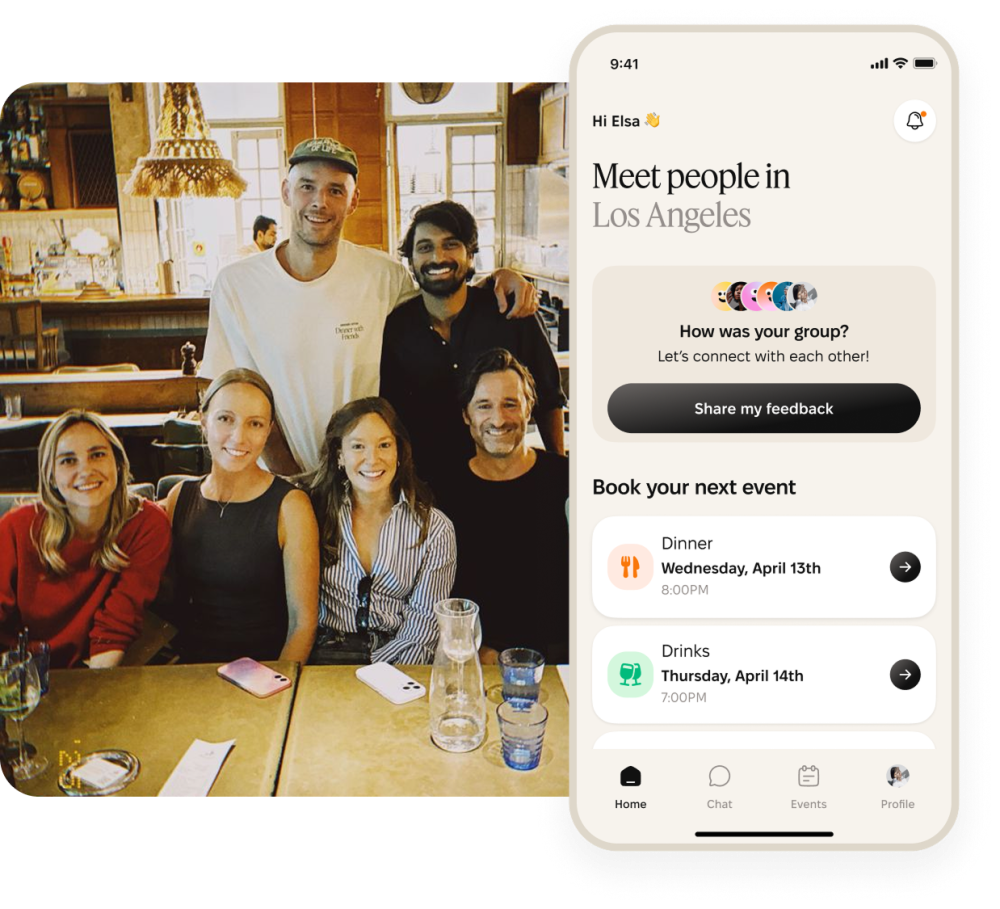
App-organized dinners remove the host entirely. Timeleft matches a group of strangers, books a restaurant table, and sends venue details 12 hours before the event across 52 countries and 200+ cities. Nobody cooks, hosts, or puts together the guest list. You take a personality quiz, pick a date, subscribe, and show up.
As Timeleft frames it in its guide to dinner with strangers: "A supper club is usually hosted by one chef or organizer, held in a home or pop-up, and often focused on the food. A dinner with strangers (in the Timeleft sense) is held at a public restaurant, matches guests by personality, and is designed primarily around conversation and connection – the meal is the backdrop, not the main event."
That positioning is deliberate. Timeleft borrows the stranger element from supper clubs and the conversation-first priority from dinner parties, then strips out the host dependency that makes both hard to access.
Timeleft lands like this on the same dimensions.
| Dimension | Supper club | Dinner party | Timeleft dinners |
|---|---|---|---|
| Who hosts | A cook | Someone you know | No host. Handled by Timeleft |
| Who attends | Strangers | Known people | Matched strangers |
| Venue | Home, pop-up, secret spot | Host's home | Public restaurant |
| Cost | Per-person ticket, price varies by host and city | Free + a gift | Subscription + your meal |
| Focus | The food | The people | The conversation |
| Who picks the group | Open to anyone who buys a ticket | Host's instinct | Timeleft's matching + personality quiz |
| Booking | Buy a ticket online | Personal invitation | Subscribe, pick a date |
How the cost breaks down
There are two parts to the cost, and it's worth separating them. The subscription covers the matching, the booking, and the venue reservation. Your food and drinks at the restaurant are paid separately, just like any normal meal out. So a single evening costs less than most supper club tickets, and if you attend more than once a month, the per-event cost drops further.
How the matching works
The matching is the other differentiator. A supper club host curates by feel. A dinner party host curates by personal knowledge. Timeleft uses a personality quiz that factors in age, personality, and language preferences to build balanced tables of four to six people. The quiz takes about two minutes and covers preferences around conversation style and social atmosphere. Timeleft's own data puts group compatibility at 96%.
Why shared meals work
And there's research behind why shared meals work as social glue. Oxford psychologist Robin Dunbar's study found that people who eat socially more often report greater happiness, more trust, stronger community ties, and more dependable friends. Dunbar noted that communal eating may have evolved as a mechanism for social bonding.
Timeleft's co-founder and CEO Maxime Barbier has been direct about why the format matters: "The only way to solve loneliness is through friendship, through human connection. You can do every online concept you want. You can try a new app to chat with people online, but it's not going to solve loneliness," he told Connexion France.
Why the matching matters
The people it works for tend to say the same thing when asked about the matching.
"I really appreciated the selection of participants at the table: each of us had common points with the others that made conversation easy and enjoyable." - Enza on Trustpilot
Supper clubs bring strangers together, but those strangers self-selected. They all found the same event, which puts a ceiling on how different they can really be. A dinner party brings known people together, so there's no new input by design. A table Timeleft matches is the format where nobody in the room chose the group. Stanford research on the strength of weak ties found that new information and opportunities tend to come from casual connections rather than close ones, since close ties already share most of your knowledge and perspective.
How to get a seat at any of the three
Each format has its own access path, and the difficulty varies wildly.
Getting into a supper club
Find listings. Most supper clubs promote through Instagram and Eventbrite. As far back as 2014, Eventbrite recorded an 82% single-year growth in pop-up dining events, concentrated in several major cities including San Francisco, New York, and Los Angeles, a signal of how early the format found its audience.
Read the details carefully. Check food style, timing, BYOB policy, and cancellation rules before booking.
Communicate dietary restrictions early.
Buy your ticket. The venue reveal often comes after purchase.
Getting invited to a dinner party
This one you can't book. You need to know someone who hosts. If your circle doesn't throw dinner parties, start hosting yourself or become the kind of guest who gets invited back (bring something, be interesting, help clear). There's no shortcut.
Getting a seat at an app-organized dinner
With Timeleft, getting a seat works like this.
Take the personality quiz. It takes about two minutes and runs entirely in the app.
Pick a format and a date. Dinner is the anchor format and runs everywhere. Other formats, including drinks, coffee, and walks, vary by city.
Subscribe. An active subscription is required before you can attend any event. Events are attended solo by default. Per Timeleft's Terms & Conditions, guests can't accompany you by default, though the Bring a +1 feature lets you invite someone from your existing circle. Check the Terms & Conditions for current eligibility. Once subscribed, you can attend as many events as you like that month.
Show up. You get the venue details 12 hours before the event. Booking closes 13 hours before the event starts, so last-minute decisions work. If you have dietary restrictions, you can set those in the app beforehand. If you're traveling, your subscription works in any of Timeleft's 200+ cities.
If your plans change, you can cancel an event booking up to 4 hours before it starts. Cancelling the subscription itself works any time, and takes effect at the end of your billing period. Three or more late cancellations within two months may affect your account, so the window is there to respect the other diners at the table and the venue partners who held the reservation.
The real question isn't which format is "best." It's which one you can actually get into this week without coordinating a group text or waiting for an invitation. Supper clubs require finding a host and a ticket. Dinner parties require knowing someone who hosts. Timeleft dinners require a phone and showing up. That's it.
Take the personality quiz, subscribe, and book your first event this week.
FAQs
What's the main difference between a supper club and a dinner party?
A supper club is a ticketed event hosted by a cook for strangers, focused on the food. A dinner party is a free gathering hosted by a friend for people they know, focused on the company.
How much does a supper club cost compared to a dinner party?
Supper club pricing varies by host, city, and format. Some events, like South Fork in North Bend, charge $175 per person with gratuity included. Dinner parties are typically hosted at the host's expense. Guests don't usually pay to attend, though bringing a hostess gift (wine, flowers, or something small) is a common courtesy. Timeleft dinners cost from $27.99 a month for new members in the US (prices vary by market), plus your own meal and drinks at the restaurant.
Is a supper club the same as a pop-up restaurant?
They overlap heavily, since both are temporary, ticketed dining events in non-traditional venues. The distinction is that supper clubs typically lean toward communal seating, a single set menu, and a social atmosphere.
Can you go to a supper club alone?
Yes, and many people do. The communal seating format is designed for solo attendees, so you'll be seated with strangers by default, which is the point.
Is Timeleft a supper club?
No. Timeleft's dinners happen at public restaurants, not private homes or pop-ups, and there's no host, no set menu, and no performance element. Timeleft borrows the "strangers at a table" concept from supper clubs but removes the host dependency entirely.
Do you need to bring anything to a supper club?
Most supper clubs are BYOB, so bring a bottle. A small gift for the host (wine, flowers, dessert) is a welcome gesture but not required the way it is at a dinner party.
How do you find nearby supper clubs?
Supper clubs scatter across several channels rather than concentrating in one place. Search "supper club" plus your city name on Eventbrite and Instagram, follow local food accounts, and check the food and drink category on Eventbrite. Hyperlocal Facebook Groups and Nextdoor are just as likely to surface neighborhood supper clubs that never advertise anywhere else.
Can you do a dinner party and still go to a Timeleft dinner?
Yes. A dinner party keeps an existing circle together. A Timeleft dinner adds people that circle would never produce on its own. They solve different problems, so most people who like both keep doing both.
What if hosting is the part you enjoy?
Hosting a dinner party is still worth doing. A Timeleft dinner isn't a replacement for it, it's a second format for the weeks when showing up as a guest, not the host, is what you actually want.
Is it awkward meeting strangers at a Timeleft dinner?
Most people feel a bit nervous before their first dinner. That's normal. The awkward part usually lasts about ten minutes, and in-app Icebreakers are there if a table needs them, though most don't.