Social dining in 2026: why the format is replacing the dinner party
Updated September 22, 2026
TL;DR: Social dining is displacing the private dinner party because it removes the logistical grind while restoring the unplanned input that well-optimized adult lives have engineered out. The data is structural, not seasonal. Experiential dining grew 46% year over year in 2026, and 94% of diners are open to sharing meals. The format wins because it delivers what the dinner party can no longer offer. A room your algorithm would never have assembled, at a venue you didn't have to research, with people you didn't have to coordinate.
Somewhere along the way, the dinner party got too organized to be fun. Not because anyone stopped caring, but because adult life is very good at turning a shared table into a scheduling project. The same people, the same Saturday, the same venue nobody actually chose. The unplanned evening didn't disappear. It just got optimized out.
Social dining removes the organizing work and opens the table to people you didn't already know. It doesn't promise surprise. It just creates the conditions where surprise is more likely to happen. And right now, that's a gap worth filling.
In this article:
- Why the dinner party lost its edge
- Defining the modern social dining experience
- Why social dining is gaining momentum
- The anatomy of a truly unscripted evening
- Who is actually showing up
- Separating long-term change from fads
- FAQs
- Key terms glossary
Why the dinner party lost its edge
The dinner party was never just about food. It was about the specific social chemistry that happens when you put people in a room with a shared table and no agenda. But the dinner party required two things that have become scarce. Time to coordinate, and a stable circle to coordinate with.
The coordination tax is real. Organizing a dinner party often means a message thread that outlasts the event itself and a venue that was nobody's first choice. It leaves you with a format that feels like a part-time job with a seating chart.
Time investment matters more than most people admit. Research by Jeffrey Hall found that it takes roughly 50 hours of interaction to move from acquaintance to casual friend, and 200+ hours to form a close friendship. When organizing a single dinner party can involve lengthy message threads and weeks of calendar negotiation, the math stops working. The format cannot sustain the volume required to actually deepen connection.
And then there is the loop itself. Warmth and familiarity are the dinner party's strengths, and also its ceiling. The same people, the same Saturday. It is comfortable, but comfort and generativity are not the same thing. And one of them has been running dry for a while now.
Why friction fuels better social dining
Not all friction is bad. The productive friction of strangers is the entire point. A table of people you did not choose forces conversation that your algorithm would never have produced. The administrative friction of the dinner party is the part that kills it.
Timeleft removes the administrative friction while preserving the productive friction. Everything is handled before you arrive. You show up, and the evening goes somewhere you did not see coming.
The conversation that goes somewhere nobody planned. That is what the format is for.
Why your social loop feels stagnant
None of this is a personal failure. It is a structural condition. Your recommendations are good. Your friend groups are solid. Your routines work. That is exactly the problem. A life so well-managed it has removed its own surprise.
This is not loneliness. It is under-stimulation in an otherwise good life. Flatness in a closed loop is a creative problem before it becomes a social one. The work becomes a higher-fidelity copy of itself. The scene becomes a comfort zone. The Saturday becomes predictable.
Defining the modern social dining experience
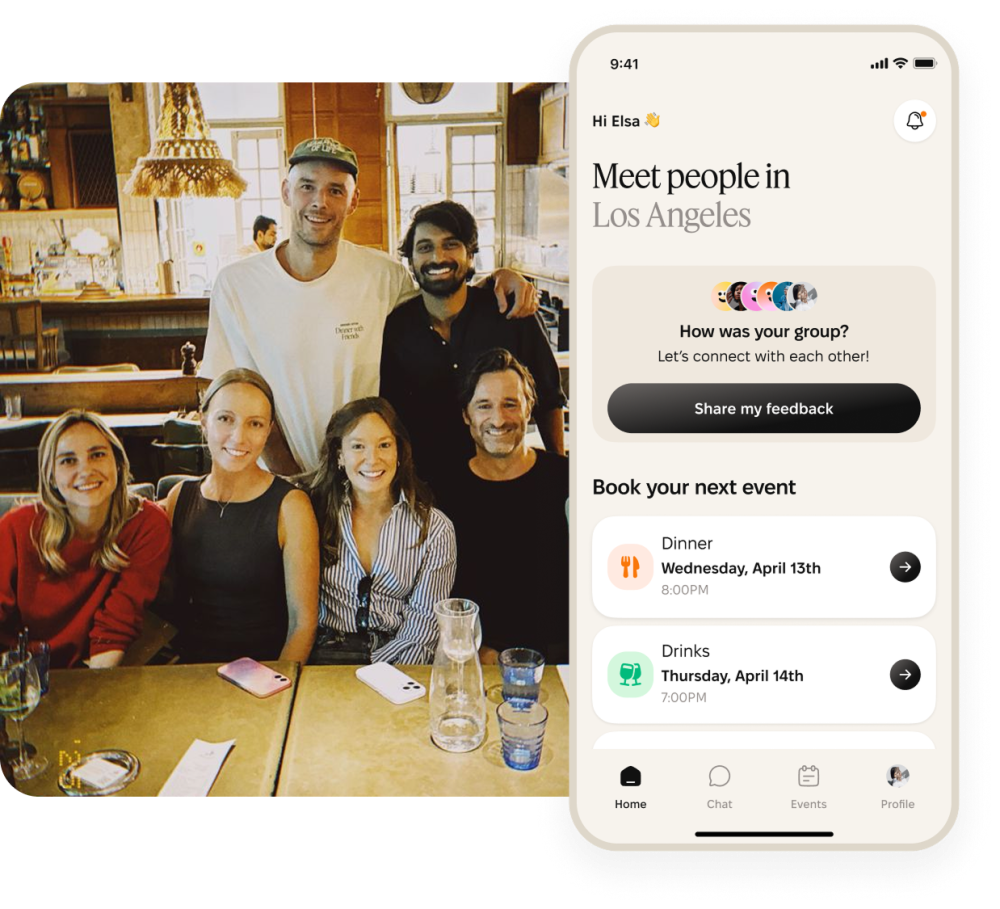
Social dining is a philosophy. The unplanned evening becomes an input source, not a fix. Timeleft is that idea packaged into something you can actually subscribe to. An IRL events app that handles everything so you don't have to.
Anatomy of a 2026 social dinner
Timeleft handles everything up to the moment you walk in. You find out where you're going the night before. Dinners run about three hours. Your only job is to show up. Everything else is handled.
The operational specifics are simple:
- A matched group of four to six strangers
- A pre-booked venue, revealed the day before
- A dinner that runs around three hours
- Matched via personality quiz, not browsing or swiping
The subscription is $19.99/month (US). Food and drinks are paid separately at the venue on the day. The cost is honest and without pressure. For members who go more than once a month, the per-event cost works out well.
The personality quiz helps build groups that are compatible without being identical. The results are used to assemble tables where everyone is willing to show up and open to conversation. The matching eliminates the classic stranger-danger anxiety of communal seating. The group isn't assembled to agree with itself. It's assembled to actually talk.
Timeleft has run this format across 52 countries and 200+ cities, recording over 1.5M bookings. Its community has grown to 4M+ members. 96% of diners report feeling compatible with their matched group. The scale proves the thesis. Algorithmic matching can assemble a compatible group of strangers, and the format is durable enough to repeat weekly.
Why strangers beat your inner circle
The inner circle is warm. That warmth is real, and it matters. But warmth has a ceiling. The people closest to you already know your references, your frame, the shape your thoughts take before you finish the sentence. They stopped offering friction a long time ago. Not because the friendship has failed, but because closeness itself forecloses surprise.
Strangers are unpredictable in ways the inner circle cannot be anymore. The format is not a replacement for closeness. It is what you add when closeness has given you everything it structurally can.
The art of unscripted dining
The unscripted evening is a craft. The format is standardized, the evening is not. The in-app icebreakers are there from the moment the group sits down as conversation starters, available if the table wants them. Scaffolding, not a script. Most tables do not end up using them.
The point is not to control the evening. The point is to create the conditions where one just might.
Why social dining is gaining momentum
The data signals are structural, not seasonal. Experiential dining grew 46% year over year in 2026, according to OpenTable's 2026 dining trends report. 94% of diners are open to sharing meals, according to a 2025 American Express report. Younger generations are showing growing interest in supper clubs and intimate in-person dining experiences, according to Symrise's supper club revival report.
But the structural drivers go deeper than trend. Spontaneous social infrastructure has collapsed, and the lives that replaced it are too well-optimized to leave room for the unplanned. This is not a novelty. It is a response to real, durable conditions.
Why demand for group dining is surging
Group dining is growing because the conditions that suppressed it have compounded. Adult schedules got harder to align. Spontaneous social infrastructure closed or thinned out. The bar with a regular crowd. The office with shared lunches. The neighborhood with a front porch. The gap it left is real, and people are looking for formats that fill it without adding to the coordination load.
The 94% of consumers open to communal dining are not looking for a party. They are looking for a reason to be in a room with people they did not already know, without having to organize it themselves. That is the demand the format is answering.
Why the format is thriving
Younger generations are driving the supper club renaissance, wanting the warmth of the dinner party without the part-time job of organizing it. The appeal is the evening you couldn't have written in advance, with none of the organizing required to get there.
Supper clubs brought strangers back to the same table. Timeleft is an IRL events app that removes the organizing entirely: subscribe, and everything is handled before you arrive. Subscribe, and everything is handled before you arrive. Your only job is showing up.
Trading curation for real connection
What drives the format's appeal is the shift away from curated novelty toward something genuinely unscripted. Engineering the evening is the enemy of surprise, and the format bets on the unplannable.
Real connection is open-ended. No specific outcome is promised. It creates the conditions where one can happen.
The gamble is the point
High social risk and high surprise potential are the bet. And the unscripted outcome is where the stories come from.
The anatomy of a truly unscripted evening
Operationally, it is simple. A matched group, a pre-booked venue, a day-before reveal, show up. The fact that none of it lands on you is the entire point. None of the organizing lands on you.
Standardization is what makes the unplanned possible. You can't have a reliable supply of surprise without a reliable process.
No organizing required
The coordination tax of the dinner party is a message thread that outlasts the evening, ending at a venue nobody actually wanted. None of that overhead survives the model. Nobody's chasing a thread or working out where to sit.
A subscription creates behavioral momentum. The decision to go is already done. You're not deciding each week. You're just checking your calendar.
Escaping your own social loop
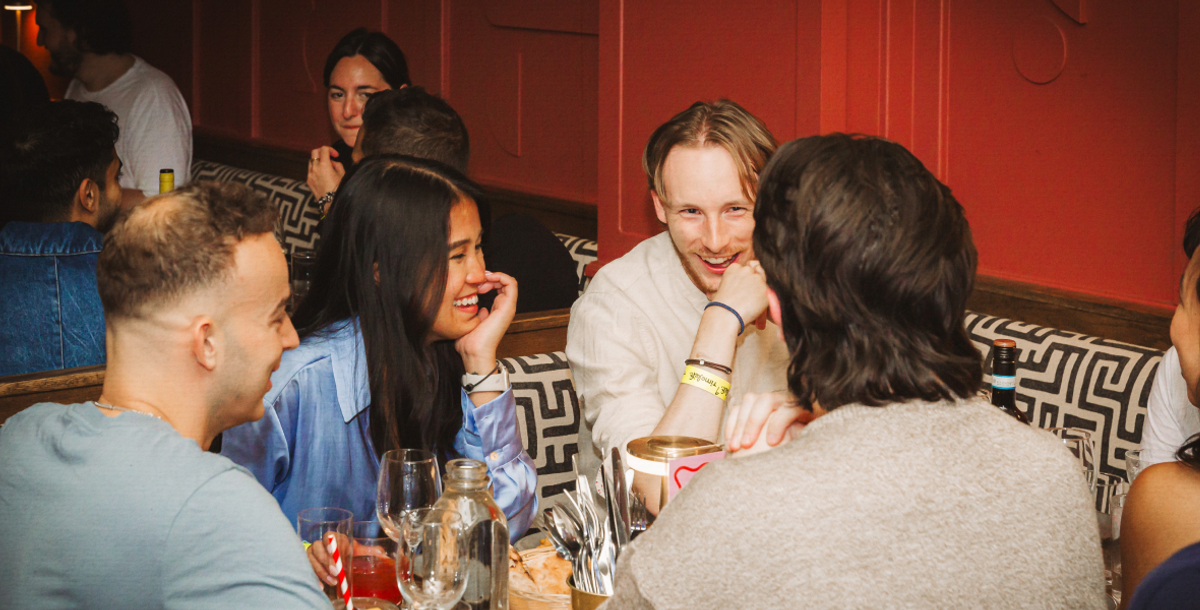
The format assembles a room you didn't choose. People who carry different references, different careers, different cities, different ways of framing things. The operational answer to a closed loop is a table of strangers matched by someone else, populated by people whose inputs don't overlap with yours, made repeatable instead of accidental.
For creative professionals and scene veterans, the value is structural. Fresh input becomes a function of format, not chance. A stranger from a different field brings a frame you stopped encountering years ago.
Standardized process, unique evenings
It is standardized. Personality quiz, matched group, pre-booked venue, day-before reveal. The evening itself stays unscripted, and what varies is the conversation, the people, the venue, the unplanned moment. And that standardization is what makes the unplanned possible. No reliable process, no reliable surprise.
Why strangers spark better conversations
Any conversation your algorithm produces is one you have already had. A stranger brings a different frame of reference, a different set of inputs, a career or a city or a way of seeing things that your existing circle stopped offering years ago.
An unscripted conversation is the product. A shared table with people you did not choose is one of the few remaining social formats where the outcome is genuinely open.
Who is actually showing up
Three types of people keep showing up. Different situations, same underlying problem. Life is good, the calendar is full, and somehow nothing lately has been unexpected.
The solo diner seeking better input
There's a Notes app full of restaurant recommendations that never get used. Eating alone misses the point. Eating with the usual crowd means a group thread that takes three weeks to resolve and ends at somewhere convenient rather than somewhere good. Social dining sidesteps all of that. The table is already booked, the company is already sorted, and the venue is the point again.
Refilling a depleted creative well
Work is fine. That's almost the problem. Every reference, every conversation, every input arrives pre-filtered through the same circle it always has, and the output is starting to show it. A closed loop hits creative people before they can name what's wrong. Social dining isn't a solution to that, exactly. But a table of strangers with genuinely different frames of reference is about as far from your existing echo chamber as you can get on a Wednesday night.
Finding inputs outside your scene
Ten years into the same scene and nobody at the table says anything unexpected anymore. The scene still works, the people are still good, but the surprise has gone. Social dining is one way back in. A room assembled by someone else, full of people your usual world would never have introduced you to. Not a replacement for the scene. Just a door back into the part of it you've outgrown.
Separating long-term change from fads
Durability is the question that matters. Is this a real change or a trend piece?
Those structural drivers are not going away. Spontaneous social infrastructure has collapsed and is not coming back. Coordination costs keep rising. And optimized lives keep closing their own loops.
Format durability follows from condition durability.
Why social dining is back by demand
Demand is real and measurable. 46% year-over-year growth in experiential dining, 94% consumer willingness to share meals. It is structural, not seasonal. And the conditions that created it are not going away.
It is back because the need for unplanned input never left.
Why algorithms fail at human chemistry
Algorithmic matching has real limits. It can assemble a compatible group, but it cannot predict the unplanned moment. And the value of the unplannable is the evening that goes somewhere you did not see coming.
The algorithm can match for compatibility. It cannot engineer the moment that makes the evening worth retelling. Creating the conditions is the point, not controlling the outcome.
Why social dining is becoming permanent
It is becoming permanent because it solves a structural problem. The coordination tax and the closed loop. A subscription creates behavioral momentum. The decision to go is already done.
Timeleft runs dinners, drinks, coffee, runs, and walks across its 200+ city footprint, though format availability varies by city. See which formats are available in your city. Take the personality quiz, subscribe, and show up. No pressure, but the invitation still stands. Next Wednesday too. And the one after that.
FAQs
Is social dining the same as a supper club?
No. A supper club is one hosted dinner format. Social dining is the broader idea of sharing a table with people you didn't already know. Timeleft is neither a supper club nor a restaurant. It's an IRL events app that matches you into small groups and books the venue. Timeleft handles the matching and the venue. You find out where you're going the night before. Nothing to organize on your end.
Why would I pay for dinner with strangers?
The value is the unplannable. The strangers and the unknown venue are the product, not the risk to be minimized. The subscription is $19.99/month (US), less than most streaming subscriptions. You pay for food and drinks at the venue on the day. For members who go more than once a month, the per-event cost works out well.
Is this just for people who are lonely?
No. Most people who show up have a full social life. The problem isn't absence of connection. It's that nothing lately has been unexpected. Social dining is an input source, not a remedy. You're not fixing something. You're just opening the table to people and an evening you couldn't have planned yourself.
How is this different from a dinner party?
The dinner party tends to run on the same group, the same faces, the same shape of evening. Social dining removes the organizing work while opening the table to people you didn't already know. Same format, different premise.
Will social dining replace private dinner parties completely?
No, and it should not. The dinner party does something social dining was never trying to replace. But it requires time to coordinate and a stable circle to coordinate with. Both of those conditions have become scarce. Social dining is a response to the conditions that have made the dinner party harder to sustain: the cost of organizing it, and the ceiling of always doing it with the same people.
Key terms glossary
Social dining: The approach that treats the unplanned evening as a repeatable input source, not a one-off adventure. The strangers and the unknown venue are the product, not the risk.
Supper club: A hosted, usually ticketed dinner, often chef-led, held in a home, pop-up, or restaurant, where guests share a table.
IRL events app: An app that matches people into small groups for in-person events such as dinners, drinks, coffee, runs, and walks. Timeleft runs this model across 52 countries and 200+ cities.
Communal dining: The broader category of any format where strangers share a table, from supper clubs to ticketed dinners to restaurant communal seating.
Experiential dining: The shift from spending on possessions to spending on experiences, with dining as the fastest-growing category. The data signal that 46% year-over-year growth in 2026 and 94% consumer willingness to share meals point to durability, not a fad.