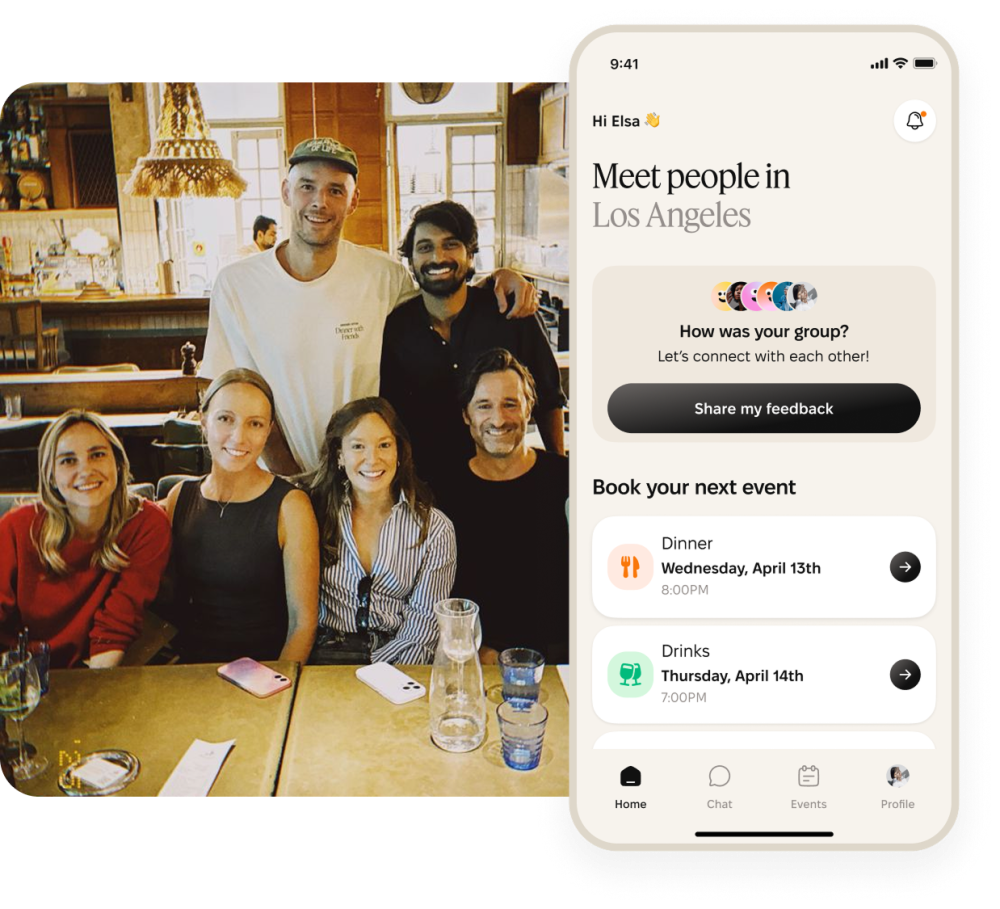
TL;DR: A supper club and a restaurant can serve the same food in the same kind of room and still be different formats. The structural difference is who controls the room. Timeleft matches a table of strangers, pre-books the venue, and sends you the details the day before. No membership committee, no high-priced tickets. The subscription is $19.99/month in the US, and you pay for your own food and drinks at the venue.
You can probably predict your next restaurant meal before you book it. The room, the menu, the conversation, the shape of the whole evening. There's nothing wrong with that, except that a growing number of people have started to notice the prediction itself is the problem. Enough people have clocked that pattern that supper clubs, evenings you couldn't have predicted, are having a genuine cultural moment.
So is a supper club a restaurant? Not in the way that matters. A restaurant sells a meal you already chose, in a room that holds no surprises, for the people you decided to bring. A supper club sells an evening you couldn't have written in advance. This piece separates the two formats on the dimensions that change your night, then shows how to get the supper club's magic without the traditional barriers.
In this article
- What separates a supper club from a restaurant
- Four ways a supper club breaks your routine
- Supper club vs restaurant: side-by-side comparison
- What a supper club does that restaurants can't
- When to choose a supper club over a restaurant
- Decoding the supper club experience
- FAQs
- Key terms glossary
What separates a supper club from a restaurant
The difference isn't what's on the plate. It comes down to who controls the room and whether you had any say in who sits across from you.
Two formats, one name
"Supper club" currently covers two different things, and both are legitimate.
The traditional model is the Wisconsin supper club. An independent, often family-owned restaurant built around a bar and a loyal local clientele, with the weekly menu following a rhythm the regulars knew by heart. The Wisconsin Academy describes it as a restaurant serving traditional American fare with a bar or lounge and space for entertainment, and Lakeshore Magazine notes these clubs tend to sit on the outskirts of towns, in wooded areas along lakes. The classic menu runs on a weekly cycle, from Friday fish fry to Sunday broasted chicken, per Wisconsin Supper Clubs, and the bar is the heart of the room, where dinner orders traditionally get placed over martinis and brandy Old-Fashioneds.
The modern model is what most people mean when they search "supper club vs restaurant" in 2026. It's a recurring or ticketed dining event built around a fixed menu and group seating, often with a venue revealed close to the date. Roadbook's coverage describes how the definition has broadened to encompass one-off and ticketed meals centered on group dining and a fixed menu. Neither model is fake. They're different answers to the same hunger.
Why it lacks a restaurant script
A restaurant runs on a script so familiar that researchers literally call it "the restaurant script." You enter, check the menu, order, eat, and pay. The sequence never changes. Each scene serves to get you fed. The script is comfortable precisely because nothing in it can surprise you.
Restaurants are designed for transactional dining, as Hotel Seymour's comparison puts it. Guests arrive, are seated, served, and depart, with interactions usually limited to their own companions and the waitstaff. A supper club deletes scenes from that script. You don't consult the menu. You often don't know the venue until shortly before. You didn't invite the people across from you. What makes a supper club different from a restaurant isn't the food or the lighting. It's the absence of the script, and everything downstream of that absence.
Four ways a supper club breaks your routine
The supper club breaks the restaurant script in four structural ways, and each one changes the evening before the first course arrives.
Who fills the seats
A restaurant fills seats by reservation. The strangers at the neighboring tables are scenery, irrelevant to your evening by design. A supper club fills a table by design, which means the people at your table are the evening. In major cities, people rarely sit next to strangers for two or three hours with nothing but a shared menu to bridge the gap, as The City Select observes, and trading the predictable restaurant for the unpredictable intimacy of a shared table is exactly the point.
Chef autonomy versus corporate control
A restaurant menu is a product. It's tested and standardized, built to be reproducible every night for years. A supper club menu is closer to a statement. The chef decides what's cooking tonight, and your only choice is whether to be there. Guests get guided through a full experience rather than just ordering a meal, which The City Select's essay notes creates a deeper connection to the food and the people around you. The no-choice model isn't a limitation to apologize for, because it removes the transactional friction of ordering and lets the evening start immediately. Timeleft extends that same logic one step further. The venue itself is chosen for you and revealed the day before, so the entire coordination burden disappears, not just the ordering.
What you're paying for
At a restaurant, your money buys food and service, and value gets measured in quality per dollar. At a supper club, you pay for an evening that couldn't have been predicted in advance. This is why comparing a supper club to a restaurant on menu price alone misses the point. The food is the anchor, not the product. It's also why the economics of the modern format have professionalized. Timeleft operates on a subscription-before-booking model for the same reason. A commitment with a cost attached is one that tends to hold.
Where the algorithm fails to predict
When you pick a restaurant, you're already filtering by your own taste: the cuisine you already know you like, in a room you've already seen photos of. A supper club's value is that the evening can't be predicted by your own preferences, because the people at the table were never yours to select and neither was anything that followed. As Russh quotes one organizer, "Everything is new and temporary. With a pop-up dinner or event, the beauty is in brevity and a fleeting energy that a traditional restaurant experience doesn't offer."
Supper club vs restaurant: side-by-side comparison
Here's how the three formats stack up on the variables that change your night. The table below covers business model, menu control, who fills the seats, and how the evening unfolds.
| Restaurant | Traditional supper club | Matched group dining (e.g. Timeleft) | |
|---|---|---|---|
| Business model | Pay per meal | Pay per meal, often membership-adjacent | Ticketed event, or $19.99/month subscription |
| Menu | You order | Set weekly specials | Fixed or venue menu, venue chosen for you |
| Seating | Your own party | Regulars and locals | A table of strangers, filled by design |
| Pace | Seated, served, departed | A long evening at the bar first | About three hours, no script |
Managing the guest list and seating
At a restaurant, you bring your own people, which means the evening's ceiling is set before you sit down. At a supper club, the table is filled for you. Timeleft runs the modern version of this with algorithmic matching. A short personality quiz feeds a system that assembles tables of four to six, and most diners report feeling compatible with their matched group. It's IRL connection without the membership committee. What happens after the table is entirely up to you.
Fixed menus versus your own agenda
Ordering is a small performance. It's a small performance that tells the table something about you before anyone's said a word. A fixed menu deletes that performance and starts the evening immediately. Timeleft extends the same logic to the venue itself. You find out where you're going the day before, which means you can't overthink it. The decision is already made, so there's nothing left to dread.
Value beyond the menu price
Restaurant value is food quality per dollar. Supper club value is the story you couldn't have written in advance. Timeleft's version of that value is deliberately accessible. The $19.99-per-month subscription covers unlimited event bookings, with food and drinks paid directly to the venue on the day. For members who attend twice or more in a month, the per-evening cost of the format itself becomes more economical.
Escaping your own social algorithm
Restaurants reinforce your existing circle because you arrive with it. Supper clubs break it because you don't. Timeleft's no-profile format sharpens this. You can't browse attendees beforehand, so you can't pre-filter the room into another version of your own feed. Timeleft runs across more than 200 cities and 52 countries. Each table brings together people your own network wouldn't have put in the same room. Where it goes from there is open-ended.
What a supper club does that restaurants can't
Three things a supper club can deliver that a restaurant, by design, cannot. Not better or worse. Just structurally different.
Create genuinely unplanned encounters
A restaurant cannot surprise you with the people at your table, because you chose them. A supper club can, because you didn't. That's the structural difference, and for a certain kind of person it's the entire value proposition. Someone whose life is good, which is almost the problem, who didn't book because something was missing but because they were bored of being able to predict their own evenings. One Trustpilot reviewer described the result of landing in exactly that kind of room:
"My experience exceeded my expectations by far. I spent a wonderful dinner with bright and open-minded strangers. The event was well-organised and most likely the algorithms were working well too, to have created this combination of participants." - Regina on Trustpilot
Bypassing the friction of group dining
Organizing a group dinner the normal way means 40 messages to land on a venue that nobody particularly wanted in the first place. A supper club skips all of it, and Timeleft's zero-coordination model goes furthest. Nothing needs to be arranged beforehand. You take the quiz, pick a format and a date, and the booking and the room are handled for you. Same-week bookings are workable, and how booking works is genuinely that short.
Strip out the performance layer
Restaurants come with roles. Someone always ends up playing host, and someone else ends up performing their order. At a supper club, nobody is the host and nobody chose the menu, so the performance layer disappears and what's left is the conversation. First-timers describe the same arc repeatedly. Going in nervous and coming out glad they did, surprised at how fast the room settled.
When to choose a supper club over a restaurant
If any of these three situations sound familiar, the supper club solves a problem the restaurant format can't touch.
You want the evening, not just the meal
Choose a restaurant when you want a specific meal, whether that's the ramen place you've been meaning to try or the anniversary dinner you've had in mind for weeks. Choose a supper club when the meal is the excuse and the evening is the point. The appetite for exactly that is showing up in the data. OpenTable's 2025 dining predictions found Wednesdays up 11% year-over-year, the largest increase of any day, with group dining for parties of six or more up 8% year-over-year alongside it.
Escape the trap of self-managed dining
If your Notes app is full of restaurant recommendations you can't action because the right company is never free on the same night, the supper club solves the coordination problem by removing you from it. The table is filled and the venue is booked. Your only job is to show up. Even dietary logistics are handled ahead of time through the app's dietary preferences settings, so the fixed-format evening doesn't mean a fixed-menu problem.
You're looking for input, not outcomes
The strongest reason to pick the supper club over the restaurant is also the least transactional. You're not solving a problem. You're refilling a supply of surprise that a well-optimized life quietly cut off, with real people you didn't select and couldn't have been algorithmically introduced to.
Ask yourself: Am I looking for a meal, or an input? If it's the first, a restaurant delivers exactly what you need. You already know the food and the room before you arrive, and you chose who's coming. If it's the second, no restaurant can deliver it, because the restaurant's entire design assumes you arrive with your inputs already chosen.
Decoding the supper club experience
What happens before, during, and after a supper club evening, with no script and no guesswork about how the logistics work.
What to expect before you walk in
The logistics are simple:
Take a short personality quiz, pick a format and a date, then subscribe. Dinner is the anchor format, with drinks, coffee, runs, and walks running on the same system. The group gets matched and the venue gets booked from Timeleft's partner network. Details land the day before. You cover your own food and drinks at the venue, and if the bill math ever gets awkward, there's a help article for that. The format now runs in more than 200 cities, from seaside launches like Brighton to most major metros.
Breaking the ice with strangers
The initial awkwardness typically fades quickly. In-app icebreakers are there if the table needs them, though most tables never open them, because a shared table gives everyone a built-in reason to be present, the way a class or a shared commute used to create conversation without effort. Matching does quiet work here too. Another Trustpilot reviewer described the result:
"I meet some new people who I could see being friends with. There were 3 men and 2 women and all but one of us has a lot in common. That's pretty impressive considering they just picked random people." - Laura on Trustpilot
Where the script breaks down
The script breaks down somewhere around the second course, when the conversation goes somewhere nobody at the table planned. That's the moment the supper club delivers what a restaurant can't, and it's not guaranteed, it's what happens more often than not. It's worth being honest about this. No-shows remain a friction point for the format. As one regular put it, "a lot of the vibe depends on the people that arrive," which is both the risk and the appeal. The no-show penalty exists to respect the time of the other diners and the venue partners, not purely as a fee.
Venues have their own reasons to like the model. A pre-booked table of six on a Wednesday is exactly the kind of mid-week demand restaurants struggle to manufacture, which is why there's a standing invitation for venues and bars to partner, and why venue rotation keeps the discovery fresh for regulars. (One transparency note. No verifiable, attributable restaurant-owner quote on mid-week bookings was available for this piece, so demand data is cited instead). See which formats are available in your city.
FAQs
What makes a supper club different from a restaurant?
Not in the way that matters. At a restaurant, every decision about the evening is made before you sit down. You already chose who's coming, and when you arrive you'll order from the menu in a room you've already seen photos of. A supper club removes all of that. The group, the venue, and the menu are handled for you, and what you get in return is an evening you couldn't have predicted.
Do I get to choose what I eat at a supper club?
Typically no, and the fixed menu is a feature that removes the transactional friction of ordering and starts the evening immediately. At Timeleft dinners you order from the venue's menu, but the venue itself is chosen for you and revealed the day before.
Can I bring friends to a supper club?
At Timeleft, yes, you can bring a +1 whether they're a Timeleft member or an old friend. It lowers the barrier if you're not ready to show up solo.
Are supper clubs cheaper than restaurants?
Not necessarily, because you're paying for the evening rather than just the food. Timeleft's subscription is $19.99/month in the US with unlimited event bookings, and food and drinks are paid separately at the venue on the day.
What if I don't like the people at my table?
It happens occasionally. The evening runs about three hours, there's a meal involved, and most diners report the initial awkwardness fading faster than they expected. But there's no obligation beyond that one evening. When you're ready to try again, the next table will be a completely different room of people.
How does a chef's table compare to a supper club?
A chef's table is still a restaurant product. You booked it yourself and brought your own people. A supper club fills the table with people you didn't choose, which is the variable that changes the evening.
Key terms glossary
Supper club (traditional): A fixed-location, often family-owned restaurant built around a bar or tavern and a loyal local clientele, with a weekly menu that followed a set rhythm. Historically associated with Wisconsin.
Supper club (modern/event-based): A recurring or ticketed dining event where a table of strangers is filled by design, the menu is fixed, and the venue is revealed close to the date.
Communal dining: A format where strangers share a table, as opposed to dining with people you already know.
Fixed menu: A menu with no choices, used to remove the transactional friction of ordering and start the evening immediately.
Venue reveal: The practice of announcing the location shortly before the event, removing the overthinking loop.
Matched group: A table of strangers assembled by an algorithm rather than by self-selection.
Day-before reveal: Timeleft's version of the venue reveal, sent the day before the event.
No-show penalty: A fee charged when a confirmed attendee doesn't arrive, designed to respect the time of other diners and venue partners.
In-app icebreakers: Conversation prompts available in the app to help tables start talking, though most groups don't need them.
Chef's table: A special restaurant seating arrangement, typically near the kitchen, where diners experience a fixed tasting menu while watching the chef work.