TL;DR: A working supper club runs on a repeatable system, not a performance impulse. The decisions that matter most are who's at the table and how you seat them, more than the menu ever will. Single-pot menus and one-ingredient themes reliably produce better conversation than carefully planned, multi-course affairs. If you want the unplanned evening without the hosting labor, Timeleft handles the matching and books the venue for you. The subscription is $19.99/month in the US and is required before you can book an event. Food and drinks are paid separately at the venue on the day.
Most writers tell you how to impress your guests. This article shows you how to be surprised by them. The ideas below come from what works at real tables: menus that keep the host out of the kitchen and seating decisions that break the social loop your life has settled into. If you're searching for supper club ideas you can adapt rather than admire, start here.
In this article:
- Why supper clubs beat standard dinner parties
- Supper club menu ideas that work at scale
- Supper club themes that drive discovery
- Seating charts to break your social loop
- Why a diverse guest mix beats a hand-picked one
- Making room for a wild card guest list
- What the hosts who kept going actually did differently
- FAQs
- Key terms glossary
Why supper clubs beat standard dinner parties
A dinner party is a performance for people you already know. A supper club is a format for generating an evening you couldn't have scripted, and that difference shapes every decision below. The format is gaining momentum. OpenTable's hospitality trend data shows diners increasingly seeking experiential dining formats, and cities from San Francisco to New York are seeing a supper club revival, with Timeleft's guide to the best supper clubs in NYC tracking the same wave.
How unknown guests drive better dialogue
The single biggest structural difference between a supper club and a dinner party is that some of the guests don't know each other, or you. That's the whole point. Research shows that emotional and cognitive alignment during a shared event promotes social bonding, and a room of partial strangers sharing a meal is almost set up to produce that effect on its own.
Design for chemistry, not etiquette
Dinner parties are built to feel smooth, with the wine chosen carefully and the guests already fond of each other. A supper club is built for the good kind of friction.
Two guests from wildly different fields arguing about something neither can resolve is a better outcome than six colleagues agreeing about the neighborhood. When you design the evening, ask whether every choice makes an unexpected conversation more likely, or less.
Building a rhythm that holds
A repeatable rhythm keeps the format alive. Hosting guides broadly agree on how that rhythm runs. Start prep two to three weeks out and work from a full dinner party checklist that runs from guest list to a final walk-through. A 7-day food prep timeline is the stress-free standard.
A simple hosting rhythm that holds up:
A few days before: Confirm RSVPs and ask the one dietary question (more on that below).
Midweek: Shop for everything shelf-stable and pantry-level.
Day before: Cook anything that improves overnight, like stews and braises.
Day of: Set the table in the morning, finish cooking, and press play on the playlist 30 minutes before the doorbell.
Supper club menu ideas that work at scale
The best supper club menu ideas share one trait. They keep the host at the table. Every minute you spend plating in the kitchen is a minute the room runs without you, and the room is where the evening actually happens.
Menus that get the table talking
Menus that make guests do something (assemble, dip, share, pass) generate conversation without any effort from you. Trend reporting on participatory dining describes diners gravitating toward communal formats like hot pot nights and family-style spreads that make participation part of the experience. A pot of broth in the middle of the table gives the first 20 minutes a natural focus.
The case for single-pot cooking
One pot, one decision, one cleanup, one evening you actually get to enjoy. Reliable options from tested recipe sources:
- Creamy one-pot pesto chicken pasta: Tender chicken, penne, and a creamy pesto-Parmesan sauce from Budget Bytes' one-pot collection (sundried tomatoes optional).
- Cowboy stew: Beef, bacon, beans, and potatoes in a single Dutch oven, a cross between stew and chili from The Pioneer Woman's cowboy stew recipe.
- California-inspired vegetarian paella: Saffron-kissed rice with zucchini, summer squash, cherry tomatoes, and avocado, all done in one skillet in under 40 minutes, from The Kitchn's vegetarian paella recipe. Serves four to six.
No-cook menus for easy hosting
A no-cook night (good bread, a blender-made tapenade, quality cheese, something bubbly) is a legitimate format, and one of the lower-effort options available. One Seattle supper club host pairs a blender tapenade with bakery baguette and asks guests to bring bottles, which drops the hosting cost to nearly zero. Lower effort per event means more events per year, and frequency is what turns a supper club into a ritual.
Steer clear of these hosting traps
Skip multi-course tasting menus because you'll never sit down, and anything plated individually because portions multiply your stress by headcount. A supper club is also not the night to cook something for the first time. The guests remember the conversation, not the reduction.
Supper club themes that drive discovery
Good supper club themes give guests a story to tell without scripting the evening. Bad ones turn dinner into a costume party. Here's a matrix to sort them:
| Theme type | Effort | Social goal | Example |
|---|---|---|---|
| Surprise menu | Low | Conversation starter | Guests commit before knowing the menu |
| One ingredient, five courses | Medium | Discovery | Citrus, mushrooms, or anchovies across the meal |
| Regional deep dive | Medium | Cultural exploration | Coastal Japanese, Oaxacan street food |
| Interactive format | Low | Hands-on participation | Hot pot, dumpling folding, blind taste test |
How region defines your menu
A regional theme works because it constrains your decisions, not because it shows off your range. "Coastal Japanese" or "a chef's take on street food" gives guests a loose frame and a story, which is why dining trend watchers cite culturally themed evenings as a defining format of the current moment. Pick a region you've eaten from but never cooked, and let the learning curve be part of the night's honesty.
Design your menu around one ingredient
One ingredient across courses is the theme format with the best effort-to-payoff ratio. It forces creativity inside a constraint, gives the table a running thread ("what's the mushroom doing in dessert?"), and shops easily. It also answers the perennial question of what are good supper club themes and menus with a single move. In practice, the theme and the menu become the same decision.
Structured formats for unpredictable nights
Structure and surprise aren't opposites. A blind ketchup taste test with tater tots or a margarita-making competition, both real examples from the Seattle supper club scene, gives the evening one planned moment of play and leaves everything else unscripted. Think of structure as something that shapes the evening rather than directing it.
How to avoid dinner party friction
Themes fail when they demand things from guests before the evening has even started. The test is whether a guest who showed up knowing nothing could fully participate within five minutes of sitting down. If not, cut it.
Seating charts to break your social loop
Where people sit shapes what gets said more than what you serve. The research and the hosting guides agree on the basics:
| Factor | Round table | Rectangular table |
|---|---|---|
| Conversation flow | Unified, whole-table discussion | Splits into end clusters |
| Hierarchy | None, no head seat | Head of table dominates |
| Eye contact | Natural, everyone visible | Uneven across positions |
| Best for | 6 to 8 strangers | Large groups, serving logistics |
Balancing control and spontaneity
A seating chart for a supper club isn't about pairing compatible people. It's about breaking up the pairs who already know each other. Draw it on a napkin if you want. Separate the couples and split the old friends. Let the rest land where it lands.
Why round tables outperform rectangles
Round tables create more egalitarian conversation patterns, with no head position and everyone in natural eye contact, while rectangular tables tend to fragment into two or three smaller conversations as guests talk to whoever is closest, and rectangular tables unconsciously create hierarchy by fixing a head position. Research by Zhu (University of British Columbia) and Argo (University of Alberta) found that circular seating primes a sense of belonging and influences how people respond to others in the room, and conference seating research notes that rectangular tables create a natural focal point at the head position, reinforcing hierarchy rather than flattening it. For most supper clubs, a round table is the right call.
Where to put your two best talkers
Seat your two most talkative guests across from each other, not adjacent, so their energy pulls the whole table rather than one corner. Put the quietest guest next to the best listener, not the best talker. If you're hosting solo, take the seat nearest the kitchen so your exits disrupt the fewest conversations.
Getting the group size right
Research on optimal group size for interactive conversation puts the real sweet spot at four, plus or minus one, though a table of five or six can hold a single thread if the seating is right. Once the group gets large enough that people can't follow one discussion, you've accidentally hosted two dinners. If demand grows, run two tables as two tables, not one long one.
Why a diverse guest mix beats a hand-picked one
The most counterintuitive of all supper club hosting ideas is to stop trying to pick the right people. Platforms built on shallow self-selection, where guests judge each other on photos and short bios, struggle to convert matching into actual connection. A hand-picked list feels careful, but it mostly just filters for people who remind you of yourself.
The case for a fully open guest list
An open list (friends can bring people you haven't met, plus ones and twos from your wider network) imports perspectives your own taste would never select. The diversity is the engine. A Timeleft member who attended one of Timeleft's women's-only dinners in Miami described the same effect from the other side of the table:
"I really enjoyed Timeleft's women-only dinner (Miami)!!! The restaurant was yummy and I got to meet 3 wonderful gals from different parts of the world: Russia, Peru and Haiti. We connected after the dinner via text and are heading to a sushi-making class in a few days. I look forward to the next women's dinner! Thank you Timeleft!" - Vera on Trustpilot
Mix up who's in the room
You don't need a spreadsheet, but if every guest works in the same industry, the evening will orbit one topic. Aim for a spread of professions and obsessions, and let at least one seat go to someone nobody at the table can categorize.
How to handle duo guest mixes
Couples and close pairs arrive with a shared conversational shorthand that can wall them off. Seat them apart, give them different jobs (one pours, one serves), and they'll rejoin the table as individuals rather than a unit.
Making room for a wild card guest list
A partially unknown guest list produces better conversation and slightly more logistics. Both are manageable.
How to structure your dinner timeline
A three-hour arc works well. Start with drinks and standing, move to seated for the main, and build in a deliberate moment near the end, whether that's a blind taste test or a round of the table's best question, to mark the shift into the last hour. End on time. An evening that closes cleanly gets remembered fondly and repeated.
Handling guest allergies without the drama
When you confirm RSVPs, ask one specific question. "Are there any foods or ingredients I should know about when planning the menu?" covers everything you need. As The Gourmet Host's dietary guide puts it, that single question tells guests their needs are already factored in. Ask early, because supper club menus are planned weeks ahead and a last-minute curveball can derail the whole meal. It's the same reason Timeleft collects dietary preferences and restrictions before every dinner.
The cost of a closed guest list
Large, over-managed groups drift toward cliques, and organizers burn out while guests struggle to connect when groups get too big. The hidden cost of a closed guest list is that it reproduces your existing circle in a nicer outfit. If every name on the list is predictable, the evening will be too.
What the hosts who kept going actually did differently
The patterns below come from hosts who ran their clubs past the first few events, which is where most clubs die. Most of what keeps a club running has nothing to do with what you cook.
Cook less than you think you should
The hosts with the longest-running clubs cook the least. One pot, one salad, bread, done. Guests don't return for the food. They return because the room produced something. Nobody walks away describing the plating.
Managing the second event slump
First events run on novelty. Second events are where clubs die, because the host compares a normal Tuesday to a debut. Attendance dips are normal across every social format, so over-invite by one or two, keep the format identical, and judge the club on month three, not week two.
Signs a dinner theme is stale
If you can predict the conversation topics before the doorbell rings, the theme has calcified. Retire it and hand the next theme decision to a guest. The format should keep surprising the host too.
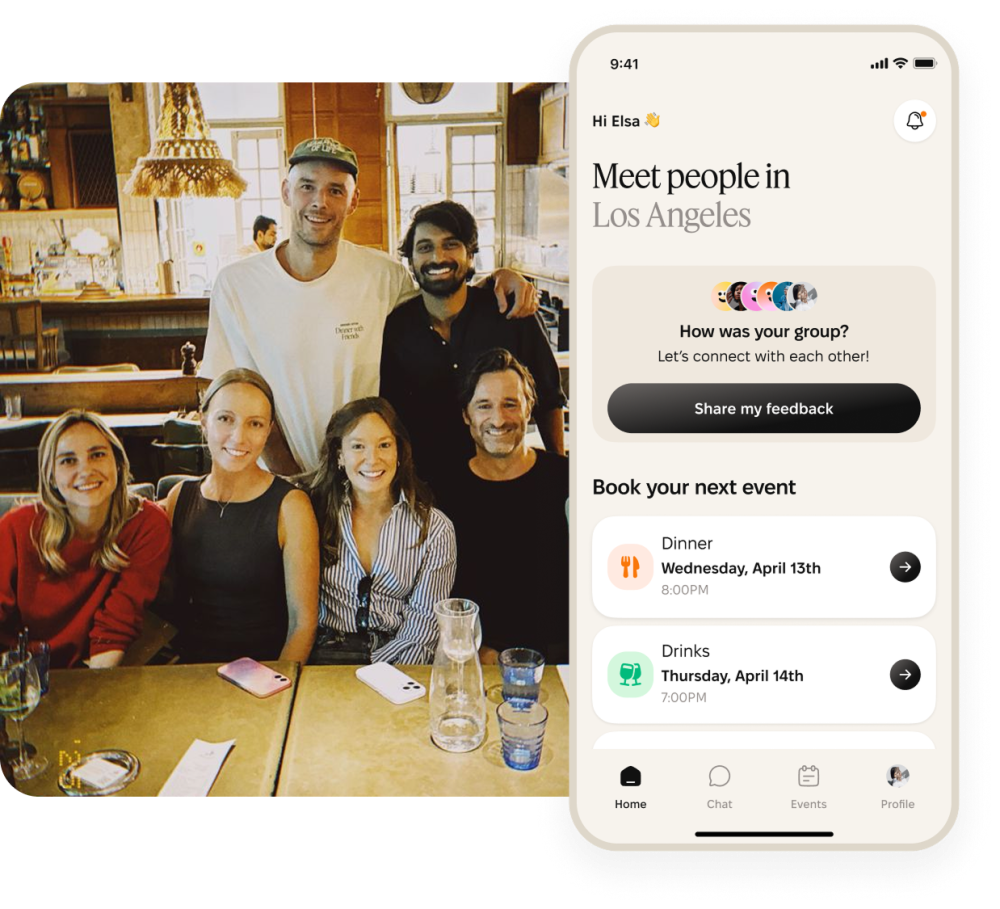
If reading this has clarified anything, it's probably this: the ideas are the easy part, and the labor (the shopping, the RSVPs, the dietary triage, the no-shows) is what stops most supper clubs from ever happening. That's the gap Timeleft was built to close. All the structural choices this article describes (the matching, the seating, the venue, the conversation starters) are already built into the format. You take a short personality quiz, pick a date, and the algorithm matches you with a table of four to six strangers at a pre-booked venue, with conversation starters built into the app and the venue revealed the day before so you can't overthink it. The subscription is $19.99/month in the US, food and drinks are paid at the venue, and you can see how it compares to Meetup or browse every city where Timeleft runs events.
It works more often than not. Here's how one returning member put it:
"I'm surprised how well the guests are matched, and although not every time, I have met a couple of good friends through Timeleft!" - Nicole on Trustpilot
You can also bring a +1 if showing up solo feels like a stretch, and the venue changes week to week across the platform's 20,000+ hand-selected partners, so the room is rarely the same twice. Take the personality quiz and start your subscription
FAQs
What are good supper club themes for first-time hosts?
Start with a one-ingredient theme or a surprise menu, since both need low prep and give guests a built-in conversation thread. Skip anything requiring costumes or homework.
How many people should a supper club have?
Six to eight guests at one round table keeps a single conversation alive. Over-invite by one or two to absorb the no-shows common to any social event.
Should guests be charged to attend a supper club?
Many supper clubs recover costs by asking guests to contribute a flat amount per head depending on the menu and venue. Rotating the host role across a regular group spreads the financial load without any one person paying every time. A simpler option is to ask guests to bring wine, a dessert, or a side, and keep the dinner itself free.
What's the best way to handle awkward silence at a supper club?
Plan one structured moment (a blind taste test, a question round) for the natural lull around minute 40. Silence under two minutes feels longer than it is and usually resolves itself without your help.
What's the ideal length for a supper club evening?
Around three hours works well for most groups. Ending on time makes guests more likely to return than a late-night fade.
Key terms glossary
Supper club: A recurring, ticketed or contribution-based communal dinner, usually with a partially unknown guest list and a host who handles menu and venue.
Surprise menu: A format where guests commit before knowing the menu, which removes decision friction and gives the evening a shared reveal moment.
Venue reveal: Announcing the location the day before the event, which removes overthinking and preserves spontaneity.
Single-pot menu: A meal cooked in one vessel (stew, soup, braise) that scales easily and keeps the host out of the kitchen.
Guest mix: The blend of known and unknown attendees at the table, the single biggest lever on conversation quality.