TL;DR: The main types of supper clubs are underground (word-of-mouth dinners in private homes, venue revealed last minute), private (membership or referral-based clubs with dues and vetting), pop-up (ticketed, chef-led or venue-led one-offs), and app-organised (algorithm-matched tables of strangers booked through a subscription, like Timeleft at $19.99/month). The real variable is how much of the evening you control before you walk in. If you want an unplanned evening without the hunt, app-organised tables are the lowest-friction entry point.
A borrowed space, a stranger's address passed along through a friend, cash at the door, and a conversation nobody saw coming. Nobody planned that night. That was the entire point.
The modern supper club isn't one thing. It's a spectrum that runs from word-of-mouth underground dinners to algorithm-matched app tables, and each point on that spectrum trades a different kind of control for a different kind of surprise. This piece maps the landscape so you can figure out which format matches your appetite for the unplanned.
In this article:
- The mechanics of the modern supper club
- Why unlisted supper clubs defy algorithms
- Breaking routines at private supper clubs
- Pop-up supper clubs
- App-organised dining: algorithmic discovery
- Which type of supper club is right for you?
- FAQs
- Key terms glossary
The mechanics of the modern supper club
If you're asking what are the different kinds of supper clubs, the honest answer is that the label now covers four distinct formats with very little in common beyond strangers and food. Here's how they stack up side by side.
Comparing supper club styles
This table maps the traditional supper club formats side by side and adds a separate row for IRL events apps as a comparison point. They share some mechanics with supper clubs, strangers, food, and algorithmic matching, but operate as a distinct product type rather than a supper club variant. Each format makes a different trade between access difficulty and cost, with the guest list controlled by whoever the format hands that power to.
| Format | Access | Typical cost | Guest selection |
|---|---|---|---|
| Underground | Word of mouth, private lists | Low flat fee, often cash | Host invites, self-selected |
| Private | Membership, referral, application | Dues plus per-event spend | Club vets members |
| Pop-up | Open ticketing, mailing lists | Per-event ticket | Whoever buys a seat |
| IRL events app (e.g. Timeleft) | Open subscription | $19.99/month plus venue spend | Algorithm-matched group |
Two more variables separate the formats, and they apply similarly to IRL events apps for different reasons. Underground supper clubs and platforms like Timeleft reveal the venue late (last minute or the day before), which removes your ability to overthink it. Private clubs and pop-ups vary, some sharing the venue and menu in advance, others holding the address back until close to the event, particularly home-kitchen operations that don't want their location indexed. Social risk follows a similar split. Underground and private formats vet who gets in, while pop-ups and IRL events apps stay open to whoever books, though apps like Timeleft mitigate this through algorithmic matching rather than manual curation.
Mapping the new supper club landscape
The original American supper club was a fixed institution. Midwestern supper clubs became popular during the 1930s as destinations where guests would spend the entire evening, from cocktail hour through a night-club-like atmosphere, and they're still concentrated in Wisconsin, Minnesota, Ohio, Michigan, Illinois, and Iowa, per Wisconsin supper club history. These rooms feature taxidermy, dark wood, romantically remote locations on the edges of lakes or forests, and a cheerful regularity of fish fries on Friday and chicken on Sunday, as Atlas Obscura's supper club history describes.
The modern supper club is a different animal entirely. It's nomadic, stranger-focused, and built around not knowing exactly what you'll get. Demand is moving in that direction. OpenTable's 2026 Dining Trends Report recorded a 46% year-over-year increase in experiential dining, with 48% of Americans saying they're more likely to dine at a restaurant when it's hosting a pop-up, collaboration, or special experience. Younger diners are driving it, with 71% of Gen Z planning to dine out more in 2025.
Why unlisted supper clubs defy algorithms
The underground supper club is the format with the most romance and the most friction. It's also the one most people have heard of and fewest have attended.
How secret supper clubs operate
Underground supper clubs are dinners run out of someone's home, generally outside normal restaurant regulation, with seats moving through word of mouth rather than open ticketing. The dinner's location and menu often aren't revealed until the last minute, a pattern Pique's reporting on underground supper clubs documents in chef-curated home dinners. The friction is the filter. If you found the room, you belong in it.
The lineage is real. In the 1960s, Milton Glaser and Jerome Snyder's Underground Gourmet column grew into a guidebook series that reached San Francisco by 1969, per Restaurant-ing Through History. Paris had its own version. Two young American cooks named Braden and Laura arrived and launched a series of speakeasy-style dinners, calling the project a dinner club to stay outside regulation. Mainstream journalists followed bloggers, and Hidden Kitchen quickly became one of the city's most sought-after reservations, with the location disclosed by email only shortly before each date, according to Budget Travel's Paris underground report.
Accessing unlisted dining experiences
There's no directory, which is the point. The practical routes in:
- Niche newsletters and local food writers: They cover the scene without printing addresses.
- Friends of friends: Personal networks still carry much of the seat distribution.
- Instagram accounts: Many announce dates and menus while holding the location back until you book, though some now share more openly with followers.
- Chefs' own mailing lists: Often the most reliable channel for recurring rooms.
Setting your expectations for the meal
Be honest with yourself about the variance. Amateur chefs host many underground events, charging a relatively low flat fee for several courses and free-flowing wine, as one Civil Eats account of a secret supper club describes. The food may be excellent or uneven. The point is the room, not the menu.
The ideal guest profile
Underground suits you if the search itself is part of the appeal and you're comfortable committing to an evening you can't fully preview. If the search sounds like work rather than fun, another format further down this list will suit you better.
Breaking routines at private supper clubs
A private supper club sits at the opposite end of the access spectrum from a pop-up. These operate more like private social clubs, where members pay dues or require invitations, blending fine dining with a highly personalized and exclusive atmosphere, as Toast's supper club guide explains.
Vetting protocols for private tables
Expect an application and a referral from an existing member at minimum, sometimes a trial dinner before full membership is granted. The barrier isn't snobbery for its own sake, it's how the club protects the room's chemistry.
Entry criteria for private clubs
Expect membership fees before you ever see a menu. Referral requirements are common, and some clubs cap membership deliberately. You're buying a recurring table with familiar faces, not a single evening.
The true cost of private dining
This is the most expensive format by a wide margin. New York's Flyfish Club lists individual membership at a $1,500 initiation fee and $3,500 in annual dues, per Dandelion Chandelier's private clubs coverage, and at the extreme end, Casa Cruz reserves a floor for investor partners paying $250,000 to $500,000 annually, according to Restaurants for Kings' 2026 roundup. Most private clubs sit far below that, but dues plus per-event spend adds up fast.
Signs you will enjoy private dining
You'll thrive here if you want a recurring table with familiar faces and you're prepared to pay for the exclusivity that keeps the room consistent. If what you want is to be surprised by strangers, this format optimises for the opposite.
Pop-up supper clubs
Pop-ups are temporary restaurants operating from private homes, former factories, existing restaurants, or festival spaces. They're the most accessible of the traditional formats, and the scene has grown steadily over the past decade, tracking the broader rise in experiential dining that OpenTable's 2026 data puts at a 46% year-over-year increase.
Chef-led versus venue-focused events
Chef-led pop-ups exist to showcase a specific culinary vision. For many chefs, they're also a low-overhead way to build a following before committing to a permanent space. Venue-focused pop-ups are about the space or the moment instead, a rooftop for one weekend, a dining room during a festival. One follows a person, the other follows a place.
Getting on the guest list
Access is open but competitive. Seats move through mailing lists and ticketing platforms, and popular events sell out on a first-come basis. You don't need to know anyone, but you do need to be paying attention.
Commitment levels in supper clubs
Pop-ups are per-event purchases. There's no subscription, no dues, no recurring obligation. That makes them a low-commitment way to test the format, but it also means no momentum. Every ticket is a fresh decision, and fresh decisions are where good intentions go to stall.
Why choose a pop-up supper club
Choose a pop-up when you're following a specific chef, cuisine, or theme. The surprise is curated rather than genuine, but the access is open, and the food is usually the point.
App-organised dining: algorithmic discovery
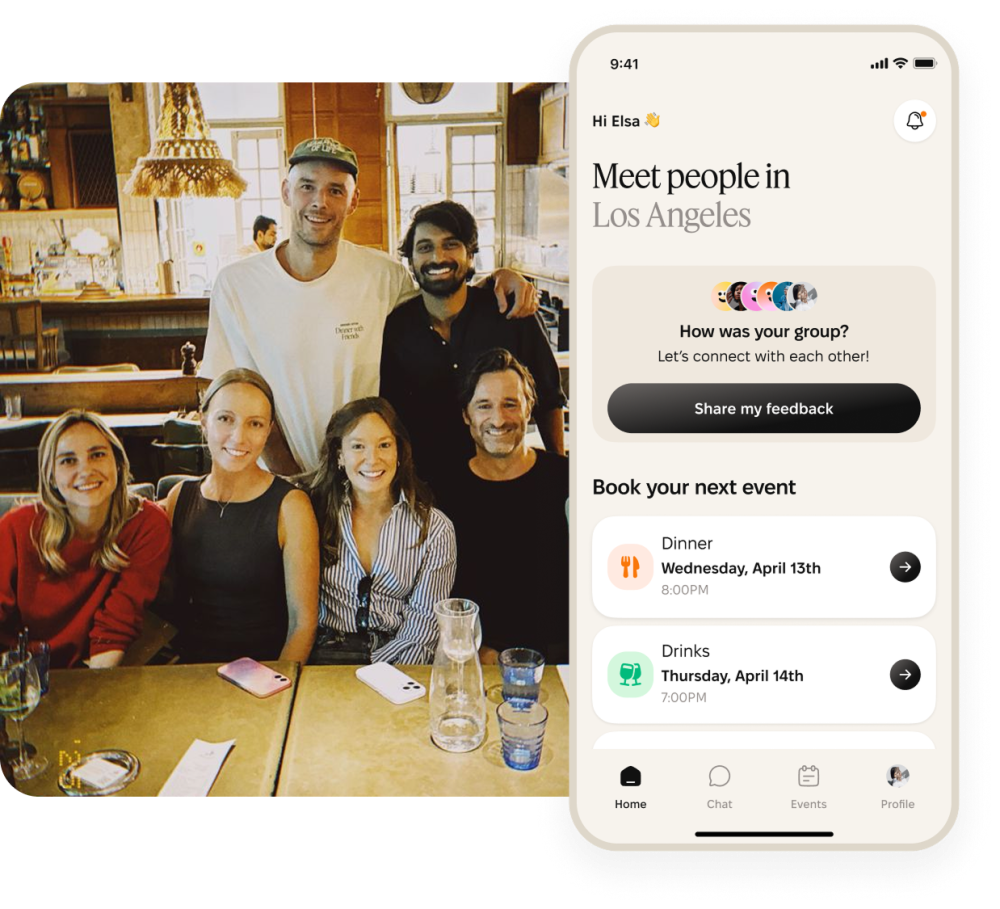
The newest of the types of supper clubs is the app-organised table, and it's the first format to make the unplanned evening repeatable. Apps in this category use matching algorithms to build dinner groups of around six strangers selected for compatibility and conversation potential, as Rigorous Themes' app roundup describes the category. Timeleft is the largest version of it, running across 52 countries and 200+ cities, from long-established markets like Paris and Berlin to newer launches like Brighton's stranger dinners and Timeleft's arrival in Antwerp.
How the algorithm pairs guests
You take a short personality quiz, and the algorithm builds a group across backgrounds, ages, and personality inputs. It's not random and it's not swipe-based. According to Timeleft's own data, 96% of diners report feeling compatible with their matched group. That stands in contrast to the alternatives. Meetup has no matching at all, you simply choose events and meet whoever shows up, while Bumble BFF relies on profile-based swiping with no group compatibility consideration.
Designed for unplanned conversations
There are no profiles to browse beforehand. You show up and see who's there. In-app icebreakers sit ready at every table if the group needs a nudge past the small talk, though plenty of tables get there on their own. The format deliberately removes your ability to pre-screen the room, because pre-screening is exactly the behaviour that turned social discovery into administration.
"I really appreciated the selection of participants at the table: each of us had common points with the others that made conversation easy and enjoyable." - Enza on Trustpilot
How the booking process works
Take the quiz: Personality questions feed the matching, and you can flag dietary preferences and restrictions so the venue fits the table.
Pick a format and date: Dinner is the anchor, with drinks, coffee, runs, and walks among the event types Timeleft offers.
Subscribe: The plan is $19.99/month in the US, and a subscription is required before attending any event. Once subscribed, you can attend as many events as you like that month.
Event access: Once subscribed, you can book up to 13 hours before an event starts. Timeleft reveals the venue the day before, and the app tells you how to find your table on the night. You pay for food and drinks separately at the venue.
The subscription model exists to create momentum. The decision to go is already made, so you're checking your calendar rather than deciding from scratch each week.
The ideal guest profile
App-organised tables suit the person who wants the unplanned evening without the access friction. You don't need to know someone, apply, or hunt through newsletters. You just show up. The difference is this. Do you want the unplanned evening itself, or the months of legwork that used to be required to find one? The kind of evening where you end up arguing about whether cities have a smell with people you'd never have chosen yourself. That's what this format delivers on a recurring basis, without the friend-of-a-friend chain. The format range keeps expanding geographically too, with launches like Toulouse's sociable suppers and Leeds' stranger dinners joining the older markets, and according to Timeleft, the 20,000+ venue network means the room itself is vetted rather than hired at random, with restaurants onboarding through Timeleft's venue partner program.
Which type of supper club is right for you?
By now the pattern should be clear. Every format on this list is a different answer to the same question. How much of the evening do you want to control?
Why choose an underground supper club
Choose underground when the hunt is part of the appeal and you want a story you couldn't have written in advance. Accept that finding a seat is a project, the food is a gamble, and the whole thing may only exist for a season.
Selecting vetted, chef-driven clubs
Choose a private club when you want quality control and a recurring room more than you want surprise. You trade access friction and real money for a table that stays interesting because the membership keeps it that way.
Seeking a specific chef or cuisine
Choose pop-ups when you're following a chef rather than a scene. The evening is knowable in advance, and that's the appeal. You're buying the cooking, with the room as a bonus.
Where to find unscripted conversations
Choose app-organised when what you want is a recurring supply of evenings you couldn't have planned, minus the administration. You don't need to infiltrate a mailing list or chase a referral. The venue comes through the day before, the group is chosen for you, and the only thing left to decide is whether to show up. The available subscription plans run $19.99/month in the US, less than a single main course at most of the restaurants the algorithm will seat you in. The same infrastructure now runs in over 200 cities, whether it's Montpellier's Mediterranean dinners or Nantes' tables along the Loire, and the format stays consistent across all of them.
Take the personality quiz and subscribe. Signing up takes less time than tracking down the underground scene's mailing list.
FAQs
What's the difference between a supper club and a restaurant?
A restaurant sells you a meal at a known location with a known menu. A supper club sells you an evening where the room of people matters as much as the food, and often withholds the venue until close to the event. The food matters, but it's rarely the whole point.
Do I have to know someone to attend an underground supper club?
Usually, yes. Underground seats typically move through word of mouth and personal networks, so one connection is often the entry point. App-organised and pop-up formats require no connection at all.
Are app-organised supper clubs real strangers or is it matchmaking?
They're genuinely strangers matched by algorithm from quiz answers, not profiles you browse or choose. The format deliberately removes pre-screening because that's what turned social discovery into administration.
How much do different types of supper clubs cost?
Underground dinners run a low flat fee, often cash. Pop-ups sell per-event tickets that vary by chef. Private clubs charge dues, with New York examples starting at $1,500 initiation plus $3,500 annually. Timeleft's app-organised format costs $19.99/month in the US, plus what you spend at the venue.
Can I go to a supper club alone?
Yes, and most people do. Underground, pop-up, and app-organised formats are built around solo attendees. Timeleft groups assume everyone arrives alone, which is what makes the conversation start from zero.
Key terms glossary
Supper club: A social dining format where the shared table and the room of people matter as much as the food. Historically a fixed Midwestern venue, now a spectrum of formats.
Underground supper club: A word-of-mouth dinner run out of a private home, often outside normal restaurant regulation, with the location revealed late.
Private supper club: A membership-based dining club with dues, referrals, or applications, selling exclusivity and a recurring room.
Pop-up supper club: A temporary, ticketed dining event, usually chef-led or venue-led, with open access and per-event commitment.
App-organised supper club: A subscription platform that matches a group of strangers algorithmically, books the venue, and reveals it the day before. Timeleft is the largest example.
Venue reveal: The mechanic of revealing the restaurant location only the day before the event, used by underground clubs and app-organised platforms like Timeleft to remove overthinking.
Personality quiz: The short questionnaire app-organised platforms use to match a table across backgrounds, ages, and conversation styles.