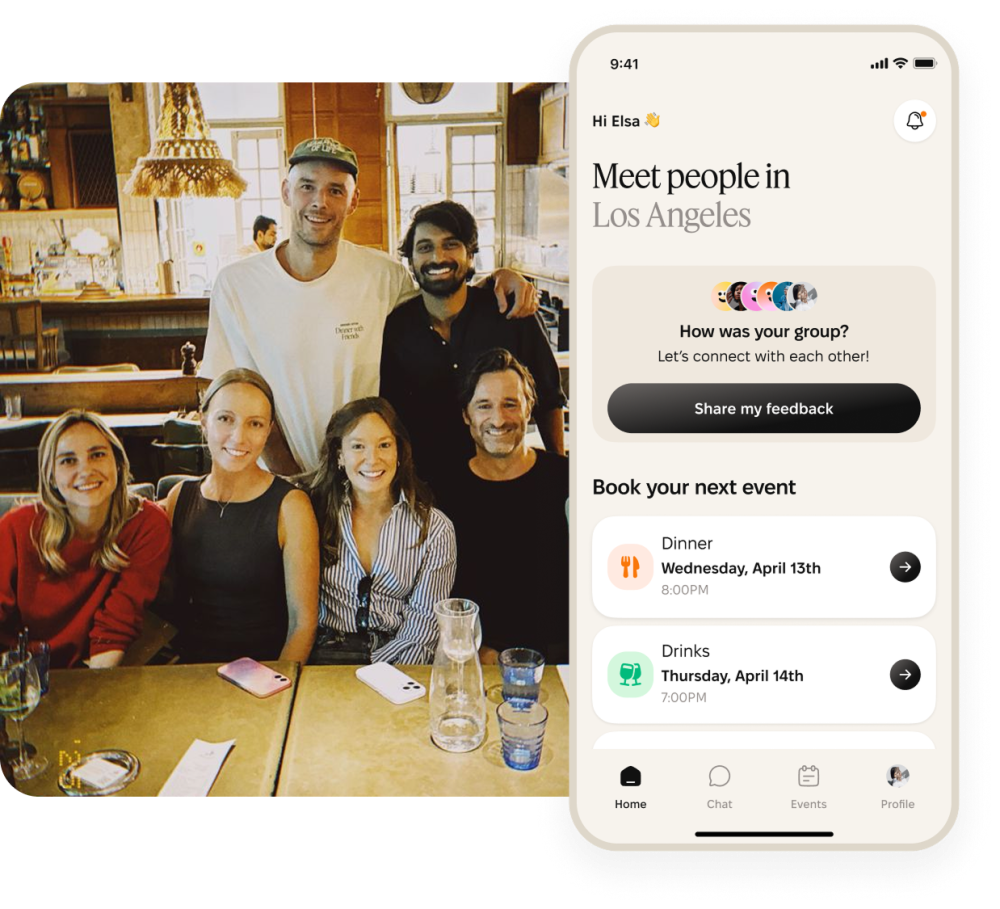
The best speed dating questions are open-ended, slightly unexpected, and designed to surface personality fast - not fill time. Research on self-disclosure and closeness (Sprecher et al., 2013) shows that reciprocal, gradually deepening questions can fast-track connection even in brief encounters. Below are 50+ speed dating questions grouped by vibe - from light openers to deeper conversation starters - from Timeleft, an IRL connections app with 4M+ members in 200+ cities across 52 countries.
You've got five minutes. Maybe less. The person across from you is a complete stranger, and somewhere in the back of your mind a tiny bell is about to ring.
Speed dating is a lot of things - exciting, nerve-wracking, occasionally absurd - but it is never boring. The catch is that what you ask in those opening moments determines almost everything about how the rest of the conversation goes. Ask "so, what do you do?" and watch the energy leave the room. Ask something that invites a real answer, and suddenly five minutes feels like twenty.
This isn't a random list of questions. These are grouped by energy level and depth, so you can match them to where the conversation actually is - not where you wish it was.
What is speed dating, and how does it work?
Speed dating is a structured event where people have a series of short, timed conversations, usually three to five minutes each, with a rotating set of potential matches. When the timer rings, one side of the room moves on and a fresh conversation starts. At the end, everyone privately notes who they'd like to see again, and the organizer shares the mutual matches afterward.
The format is generally credited to Rabbi Yaacov Deyo, who ran the first events in Los Angeles in the late 1990s. The whole appeal is efficiency. Instead of one long date with a single person, you get eight or ten quick ones in an evening, and you find out fast whether there's anything worth pursuing.
A typical event runs 90 minutes to two hours, seats 10 to 20 people, and takes place at a bar or restaurant. The short rounds are the point. They push you past small talk quickly, which is exactly why the questions you choose carry so much weight. The same principle powers a Timeleft dinner, where the timer is replaced by a shared meal, but the job of a good question is identical.
Why the right speed dating questions matter (the science)
It's tempting to think that connection is just chemistry - either it's there or it isn't. But research tells a more interesting story.
First impressions form within milliseconds, often before a single word is spoken. In a timed setting like speed dating, you don't get a slow build. What you ask in those first minutes will largely shape whether the other person wants to see you again.
The difference between a forgettable exchange and one that actually goes somewhere usually comes down to one thing: the quality of the questions.
| What the research says | Source |
|---|---|
| Gradually deepening questions can create closeness between strangers in under 45 minutes | Aron et al., 1997 |
| Reciprocal self-disclosure increases liking and perceived closeness | Sprecher et al., 2013 |
| Rapport builds through mutual attention, positivity, and coordination | Tickle-Degnen & Rosenthal, 1990 |
| Responsiveness - feeling heard and understood - is the core driver of intimacy | Reis & Shaver, 1988 |
| It takes ~50 hours of shared time to move from acquaintance to casual friend | Hall, 2018 |
| Open-ended questions surface deeper responses than closed questions | Nielsen Norman Group |
The takeaway: asking good questions isn't a nice-to-have. It's the single most reliable way to create connection in a short time frame. Open-ended questions that invite a story will always outperform closed questions that get you a yes or a no.
Open-ended vs. closed: a quick example
Closed: "What's your job?"
Open-ended: "What's your idea of a perfect Saturday?"
The first gets you a job title. The second gets you a window into someone's actual life. In five minutes, that difference is everything.
50+ speed dating questions, grouped by vibe
At Timeleft, we've tested thousands of in-app icebreakers across Timeleft dinners in 200+ cities across 52 countries. The questions that consistently spark the best connections aren't the cleverest or the deepest - they're the ones that require a story to answer.
We've grouped our favorites by energy level, so you can start where the room is and go where the conversation wants to take you.
Icebreaker openers (the first 30 seconds)
Think of these as quick-fire warm-ups. They break tension fast, set a playful tone, and help you both get a read on each other's energy before anything heavier lands. They double as speed dating icebreaker questions for any timed round.
Tip: If things feel awkward at first, don't panic. Try acknowledging the awkwardness out loud - it usually leads to shared laughter, which is basically a speed-dating cheat code.
- A random fact you like?
- If your life had a tagline, what would it be?
- A book or series you'd recommend right now?
- Weirdest thing you've ever eaten?
- What are you currently obsessed with?
- What do you do to properly switch off?
- How do you actually spend your free time? (Honest answer.)
- Best trip you've ever taken?
- What's a surprising skill you have?
- Last thing you did for the first time?
These work because they're specific enough to get a real answer but low-stakes enough that nobody freezes. The goal isn't depth yet - it's momentum.
"Get to know you" questions (the middle stretch)
Once the ice is broken, you can afford to be more thoughtful. These questions invite someone to actually reflect, which signals that you're genuinely curious - not just filling a timer.
Whether you ask about a formative memory, a strongly held opinion, or something they'd do differently, you're opening the door to the kind of conversation you'll both remember.
- If your personality was a weather forecast, what would it say today?
- If you could un-invent one thing, what would it be?
- Would you rather explore the world or make roots in one country?
- You have to give a mini TED talk right now - what's it about?
- What's a rule you live by that nobody taught you?
- When do you feel most like yourself?
- What did you spend most of your time doing as a kid?
- Would you rather give up social media or give up eating out?
- What topic would you cover at a conspiracy theory party?
- What's something you'd do every day if you could?
The best speed dating questions in this range have one thing in common: they give the other person permission to be interesting, not just polite.
Deeper questions (when the conversation is ready)
Genuine connection requires a bit of depth. Most people steer clear of anything too personal in the first five minutes - and that's wise. But a well-timed deeper question can take a good conversation somewhere genuinely meaningful without derailing it.
The key word is well-timed. Don't open with these. Let them land naturally after you've built some warmth.
Tip: If you can't remember any specific questions in the moment, think about something you value deeply and phrase a question around that. Authenticity always beats preparation.
- What does a life well-lived look like to you?
- What's something you'd never compromise on?
- A quality in other people that you find magnetic?
- Something you're genuinely curious about right now?
- What's the kindest thing anyone has ever done for you?
- Something you've stopped apologizing for?
- What kind of people make you feel most yourself?
- What's something you're proud of that most people wouldn't guess?
- One piece of advice you'd give your younger self?
- What's one "offline" thing you love doing?
These work because they skip the biographical surface and go straight to values. And when someone shares a value, you instantly know whether there's real compatibility - or just good small talk.
Creative and fun speed dating questions (if you want to stand out)
Sometimes the best conversations start with a question that makes someone laugh, pause, or say "oh, that's a good one." These are the wild cards - the ones that make you memorable.
- If you could live one day from history, what would you pick?
- If you had to delete all your apps except two, what stays?
- If your life was a film, what genre would it be?
- What's the strangest compliment you've ever received?
- What's a smell that immediately takes you somewhere?
- What's a movie or song you're embarrassed to love?
- If you could only listen to one album for the rest of your life, what would it be?
- What's the worst date story you have? (Bonding over shared disasters is underrated.)
- If you had one permission slip for a humble brag, what would it be?
- If I met you five years ago, what would be different?
Fun speed dating questions like these work because they break pattern. When someone expects "where did you grow up?" and gets "what's a smell that immediately takes you somewhere?" - that's when you see the real person show up.
Questions to avoid (save for date two or three)
Not every question belongs in the first five minutes. These aren't bad questions - they're just better once some trust has been built. Think of them as second-date territory.
A reasonable filter: if you wouldn't discuss it in a job interview with someone you just met, keep it in your pocket for when you know each other a bit.
- How much do you earn?
- Do you want kids?
- Why did your last relationship end?
- What's your biggest trauma?
- Do you go to therapy?
- What are your political views?
- What's your religious belief?
- What are you looking for in a partner?
- Are you over your ex?
- Do you own or rent?
There's nothing wrong with caring about these things - they matter. But asking them too early usually shuts conversation down rather than opening it up. Give the relationship room to earn that kind of honesty.
Speed friending questions (when you're there for friends, not a date)
Speed friending is speed dating's platonic cousin: the same timed, rotating format, but everyone in the room is there to make friends, not find a partner. It's grown fast as more people look for an efficient way to meet potential friends as adults, and the mechanics are identical, only the goal changes.
So the questions barely change either. What changes is what you're listening for. You're scanning for shared enthusiasm and an easy rapport, not chemistry, so lean into what someone loves rather than what they want in a partner. These speed friending questions are built for exactly that.
- What could you give a 20-minute talk on with zero prep?
- What's the last thing you did that you'd happily do again next weekend?
- What's a low-stakes hill you'll die on?
- What are you trying to get into lately, even if you're bad at it?
- Ideal Sunday: out with people, or gloriously alone?
- Who's someone you'd love an excuse to see more often?
- What's a small thing that instantly makes you like someone?
- What's a friendship in your life you're grateful for, and why?
These land at a speed friending event, a new-in-town meetup, or a Timeleft dinner, where most people are there to make friends rather than find a date.
Speed dating questions for specific situations
The open-ended principle works everywhere, but the best question shifts a little with the room. Here's how to adjust for the three settings people ask about most.
For students and college events. Younger crowds warm up fastest to low-stakes, funny prompts, so lead with pop culture and shared-experience questions before anything personal.
- What's the most useless class you've secretly loved?
- What's your comfort show for a bad week?
- If your group chat had an official name, what would it be?
For work and team-building events. At a corporate or team speed dating session (sometimes called speed networking), keep it human but keep it professional, and skip anything a colleague might not want on record.
- What part of your job would surprise people who don't do it?
- What's something you learned recently, work or not?
- What did you want to be when you were ten?
For later-in-life and over-50 events. With more life behind everyone, depth lands sooner and shared reference points run deep, so you can move past the surface faster.
- What's a place you've been that has stayed with you?
- What are you more interested in now than you were at 30?
- What does a genuinely good week look like for you these days?
Speed dating tips: how to use these questions in the moment
Having a great list of speed dating questions is one thing. Using them well is another. A few principles that make the difference:
Don't announce it. "I have a question for you!" is the speed-dating equivalent of "let's do an icebreaker!" Just ask. Weave it into the flow.
Follow the 2-question rule. Never ask a question without asking a follow-up. "What's your idea of a perfect Saturday?" followed by "Why that?" is where the real conversation starts. Research on responsiveness (Reis & Shaver, 1988) shows that feeling genuinely heard is the strongest driver of closeness.
Match energy before you escalate depth. If someone gives a playful, surface-level answer, don't immediately go deep. Stay light until the warmth builds. If they open up, follow them there.
Listen more than you talk. The rapport research is clear: mutual attention and positivity create connection faster than clever questions alone. Let them talk. React genuinely. The questions are just the door.
Go with your gut. If a question lights someone up, follow that thread. If it lands flat, move on. The best speed dating conversation starters aren't the ones you planned - they're the ones you noticed were working.
How to prepare for speed dating (and what to expect)
You don't need much to prepare for speed dating, and over-preparing usually backfires. A few practical things help.
What to wear: something you'd wear to a nice-but-casual bar, comfortable enough that you're not fidgeting. Feel like yourself, not a costume version of yourself.
What to bring: a way to jot down names (most events hand you a card or an app) and a couple of go-to questions for when your mind goes blank. That's genuinely it.
What the night feels like: you'll rotate through 8 to 15 short conversations, each a few minutes long. It moves fast and feels a little chaotic, and the first two rounds are always the most awkward. By the third, most people have found their rhythm.
A reframe for nerves: you are not being judged eight times. You're sampling eight conversations. If one falls flat, the timer rescues you both in ninety seconds. That safety net is the underrated best part of the format, and it's the same reason a structured setting like a Timeleft dinner is easier than an open room where you have to start every conversation yourself.
Virtual and online speed dating questions
Virtual speed dating works the same way as in person, timed rounds and rotating matches, but over video, so a few things change. Without body language and a shared room, you have to do a little more with your questions and your energy.
Lean slightly more playful and visual, since video flattens subtlety, and ask one thing the other person can show rather than just tell. It breaks the screen-stare and gives you something real to react to.
- What's one thing within arm's reach that says something about you?
- What's the best thing you've watched or read lately?
- What's a small win you had this week?
Keep your follow-ups quick and your reactions visible. On video, an obvious nod or laugh does the work that a smile across a table would do in person.
Beyond speed dating: where these questions really work
Good questions don't expire after one use. Whether you're at a networking event, a work team icebreaker, a dinner party, or meeting someone for the first time anywhere, the same principle applies: depth beats small talk, every time.
At Timeleft, we've built an entire format around that idea. Instead of five minutes, you get a full evening. Instead of a rotating roster of strangers, you get a table of four to six people personality-matched to you. And instead of awkward silence, you get in-app icebreakers - the same kind of prompts in this article, refined across thousands of Timeleft dinners.
The format works for the same reason good speed dating questions work: it creates the conditions for real conversation to happen, so you don't have to manufacture it from scratch.
Many people who come to Timeleft dinners aren't looking for a date at all - they're looking for connection. And sometimes that connection turns into a friendship. Sometimes it turns into something more. For anyone who does want the romantic angle, Timeleft also runs Singles Events. Either way, it starts with one good question.
"I moved to NY a year ago for a better social life. After a year of no proper friends, I decided to give Timeleft a go. Long story short, I found a bestie... who then became my boyfriend." - Ana B., 5★, US
If you want to put any of these questions into practice somewhere low-pressure, book a Timeleft dinner this week. Four to Six strangers, a good restaurant, and conversation that's already been designed to go somewhere interesting.
FAQ
What is speed dating?
Speed dating is a structured event where people have a series of short, timed conversations, usually three to five minutes each, with a rotating set of potential matches. At the end, everyone notes who they'd like to see again, and the organizer shares the mutual matches. The format is credited to Rabbi Yaacov Deyo, who ran the first events in Los Angeles in the late 1990s.
How does speed dating work?
You arrive, get a number, and rotate through a series of short one-on-one conversations, usually 8 to 15 of them, a few minutes each. When the timer rings, one side of the room moves to the next seat. You privately mark who you'd like to see again, and the organizer emails you any mutual matches afterward. A typical event runs 90 minutes to two hours.
What are good speed dating questions?
Good speed dating questions are open-ended (can't be answered yes/no), slightly unexpected (break conversational autopilot), and easy to answer without overthinking. Research from Aron et al. (1997) - the "36 Questions" study - found that gradually deepening questions can accelerate closeness between strangers in under 45 minutes. Start light ("What are you currently obsessed with?"), then go deeper as the energy builds ("What does a life well-lived look like to you?").
What should I ask at speed dating?
Focus on questions that invite a story rather than a fact. Skip "what do you do?" and try "what's something you could talk about for hours?" or "what's a surprising skill you have?" The best speed dating questions to ask reveal personality quickly without feeling like an interview. Follow up once - "why that?" or "how did that happen?" - to show you're actually listening.
What are fun speed dating questions?
Fun speed dating questions break pattern and make the other person smile or pause. Try: "If your life was a film, what genre would it be?", "What's the strangest compliment you've ever received?", or "If you had to delete all your apps except two, what stays?" These work because they're unexpected - when someone expects "where are you from?" and gets something playful, the real person shows up.
How do I make speed dating less awkward?
Three things help: (1) Acknowledge the format - "This is a bit weird, right?" usually gets a laugh and breaks tension. (2) Don't treat it like an interview - ask one question, follow up genuinely, and let the conversation flow naturally. (3) Match their energy before escalating depth. Research on rapport shows that warmth and positivity matter more than asking the "perfect" question.
What questions should I avoid at speed dating?
Avoid questions that are too personal for a first meeting: salary, exes, trauma, kids, politics, or religion. These topics matter, but asking them before any trust is built usually shuts conversation down. A good filter: if you wouldn't discuss it in a job interview with a stranger, save it for the second or third date.
How many questions should I ask in a speed date?
Quality over quantity. In a five-minute round, two or three well-chosen questions with follow-ups will create a far better connection than racing through ten surface-level ones. The goal isn't to "get through" a list - it's to find the question that starts a real conversation. One great question, followed up well, can carry an entire round.
What questions work for virtual speed dating?
The same open-ended questions work, but lean slightly more visual and playful since video flattens subtlety. Ask something the other person can show, not just tell, like "what's one thing within arm's reach that says something about you?" Keep follow-ups quick and your reactions visible, since an obvious nod or laugh replaces the body language you'd read across a table.
Do speed dating questions work for regular dates too?
Absolutely. The principles behind good speed dating questions - open-ended, slightly unexpected, story-inviting - apply to any first meeting. They work at dinner parties, networking events, dinners with strangers, and casual social gatherings. The only difference is that on a regular date, you have more time to let conversation develop naturally instead of fitting it into a five-minute window.
What makes a conversation memorable in a short time?
Three things, according to the research: (1) asking questions that invite genuine self-disclosure rather than surface facts, (2) showing responsiveness - making the other person feel heard and understood, and (3) gradual escalation of depth. Sprecher et al. (2013) found that reciprocal disclosure - where both people share at increasing depth - is the strongest predictor of feeling close to someone quickly.