There's nothing like the safety of a screen when you're out in public.
That warm and familiar glow, the comfort of watching other people's routines (as predictable as your own, yet somehow more entertaining), and the ability to look busy even when you're not. And, most importantly, this feeling that you're automatically safe from unwanted social interactions.
This concept is what sociologist Erving Goffman calls an "involvement shield", an object that communicates to others that you're unavailable, or need personal space. Traditionally, this included things like newspapers, books, or fans, but today they've largely been replaced by screens.
Whether you're on a bus, alone at a café, strolling in the park, or waiting to catch a flight, that sense of safety goes with you everywhere – protecting you from awkward eye contact, or a conversation with a stranger.
But what if this is exactly the point of being in public? The benefit of third spaces, whether you're there alone or with company, is getting to interact with other people in the myriad of messy, human, and potentially delightful ways that only happen when you let your shield down.
If that sounds like your worst nightmare, it's time to take your social skills back to school.
Like any skill, it gets rusty when you don’t use it
That's especially true for socializing in third spaces, particularly when you're alone. There's an etiquette to it. Not the stuffy "Which fork?" kind, but the more simple stuff, like how we show up when we're sharing space with other people.
Between our phones and a little main character syndrome, we're pretty out of practice these days. That's where this guide comes in – intentional shifts you can make today to improve the way you show up in third spaces, so third spaces can actually do what they're there for.
Wait, what’s a third space?
The idea of a third space was first coined by Ray Oldenburg in his book The Great Good Place, and was used to describe the neutral ground that forms the anchor of community life.
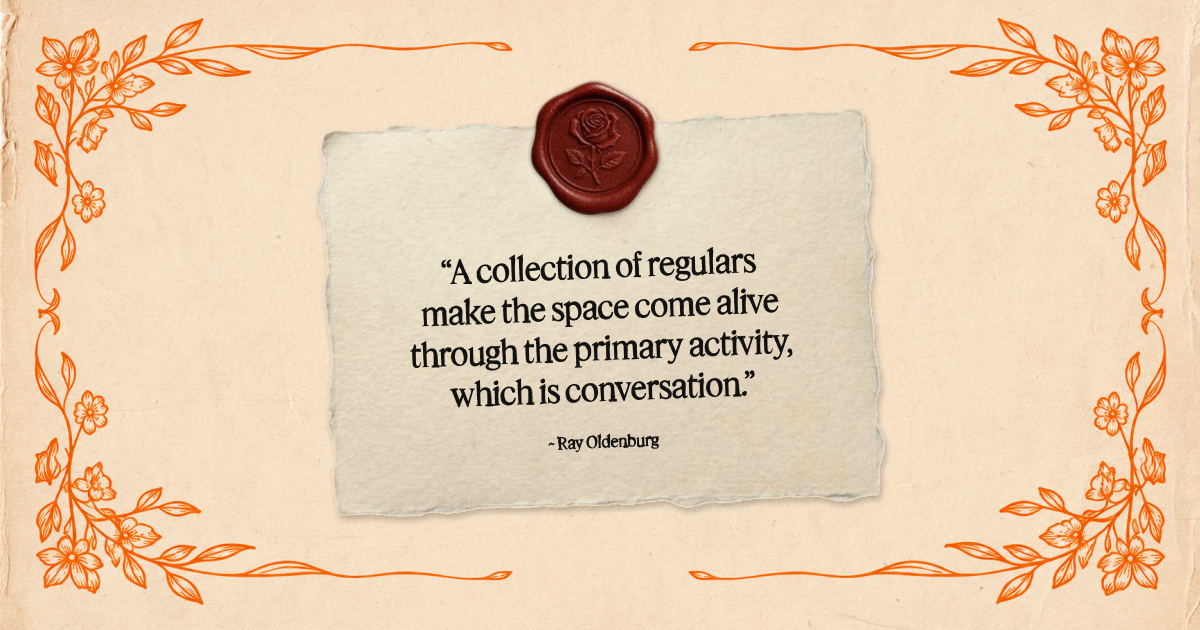
Your first space is your home, your second space is where you go for productivity like work or school, and your third space is where you can just simply be a human in the world – “a generic designation for a great variety of public places that host the regular, voluntary, informal, and happily anticipated gatherings of individuals beyond the realms of home and work.”
This being said, not all third spaces are created equal. Most people would consider places like cafés and airport lounges as a third space, whereas more traditional definitions would only include spaces that have no cost of entry – like a public park or beach.
For the purposes of this essay, we care most about this part of Oldenburg's definition:
Lingering, talking, and being present matters
Showing up with intention does more than make your day better. It's what opens the door to connection, and lets you experience the social benefits third spaces are built for.
It also keeps the lights on. In 2025, London lost pubs faster than anywhere else in England, part of a national trend of roughly one pub closing every single day, according to data from the British Beer and Pub Association. Paris, a city loved and revered for its café culture, lost nearly 400 cafés since 2014 alone, according to Save the Paris Café.
All that is to say that third spaces don't survive on rent and good coffee alone. They survive on people actually using them the way they're meant to be used – lingering, talking, being present. Which means it's on us, the people walking through the door, to keep them alive and worth walking into.
Here’s how we do that.
Timeleft’s etiquette for third spaces
One might argue that a book is the same as a phone, but the sociology of it all says otherwise.
While both are “involvement shields”, books are permeable which means they signal: I'm occupied, but still fundamentally in the room. You can look up from a page, catch someone's eye, and slide into a conversation without missing a beat.
A phone works differently. It pulls your whole attention out of the room rather than just occupying your hands, which is exactly why interrupting someone mid-scroll feels like a bigger ask than interrupting someone mid-page.
One keeps the door to conversation propped open, the other closes it.
WFC (work from café) is glamorous and all, but what if you could spend some of that time laptop-free?
While laptop bans are becoming increasingly popular, especially across the UK, US, and some European cities, we’re not suggesting you abandon WFC altogether – especially since it’s a great way to get out of the house when you don’t have an office to go to.
This is more an invitation to intentionally visit a café, to sit and linger, without your work following you there. After all, that’s what they’re meant for: somewhere to go for a break, and to engage with those around you.
When you do get a conversation going, protect it. Researchers observed 100 conversations between strangers in cafés and found they were rated as noticeably better when no phones were visible, even one just resting face-down on the table. People also reported feeling less empathy toward each other when a phone was present, often without realizing why.
It doesn't need to disappear entirely. As long as your phone is out of eyeline, that’s enough to signal that you’re present.
Sociologist Erving Goffman described "civil inattention" as the unspoken agreement that keeps public life running: a glance at a stranger, then a look away, that says I see you, I mean no harm, I won't intrude. It's a good norm, but it’s also not meant to be permanent.
Third space etiquette means knowing when to break it, on purpose – like a comment on the book someone's reading, or a "Mind if I sit here?". These are small, low-stakes moments where the glance turns into an opening instead of an ending.
There's a version of community that runs on small, unglamorous favors: watching a stranger's bag while they grab a napkin, keeping an eye on someone's dog for two minutes. It barely registers as a favour at all. But we've largely optimized it away, helped along by a culture that's grown more wary of strangers by default: research shows that the share of Americans who say most people can be trusted has dropped from 46% in 1972 to 34% today.
Online, you can mute, block, or leave the second something feels awkward. Third spaces don't have that button. No surprise, then, that small doses of friction like waiting in a queue, sitting near someone you disagree with, or fumbling through small talk, can now feel disproportionately irritating. We're simply out of practice.
The good news: friction tolerance is a muscle too, and it rebuilds fast.
For more on this, read our latest piece on the art of friction-maxxing.
→ Friction-maxxing a dinner with strangers
Imperfect etiquette still counts
Participating in public life is great, screen in hand or not. If a phone is what gets you out the door, or your laptop is the only reason you leave the house at all, that's totally fine.
This is simply an invitation to spend at least some of that time a little more third-space friendly. Look up, put the shield down for a stretch, see what happens. You never know who you'll end up talking to, who you might meet, or what a five-minute conversation could turn into.
Because that's really the whole point of showing up in the first place: you never quite know what's waiting for you on the other side of your shield, until you put it down.
→ If you want to start practicing right now, book a Timeleft dinner.