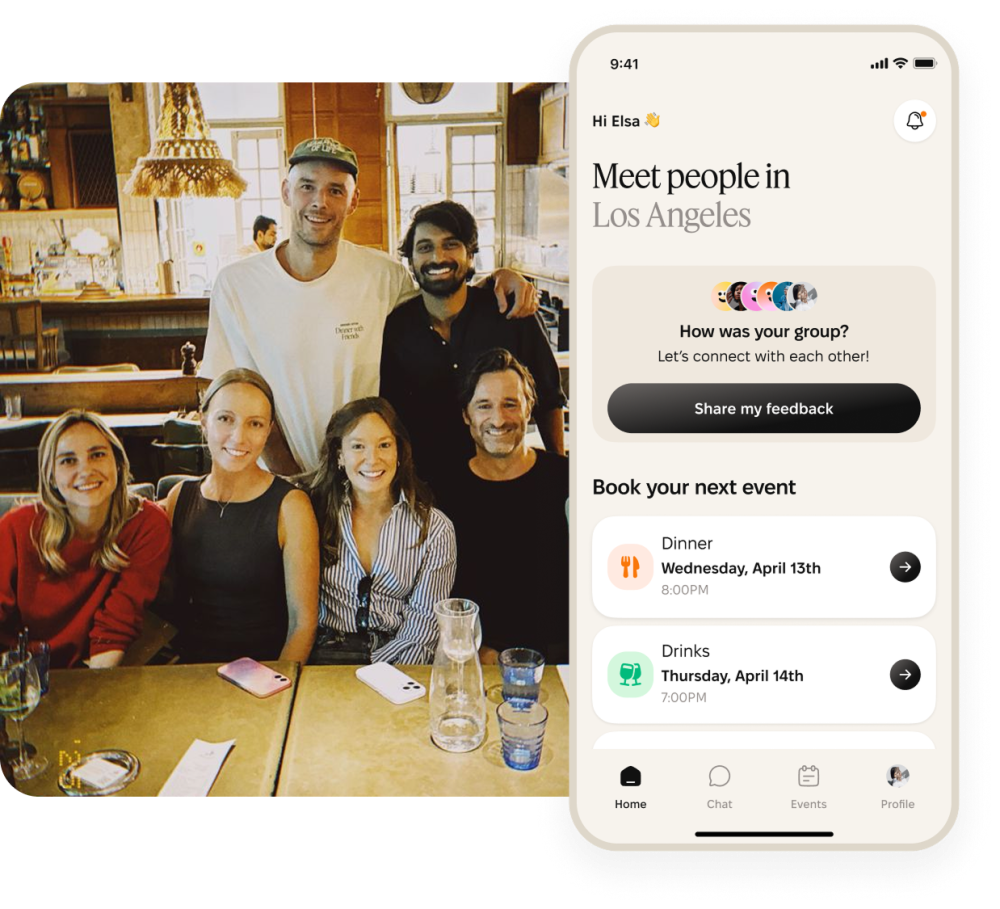
TL;DR: Eventbrite is a free-to-browse marketplace where you find something to do and manage every detail yourself. Timeleft is a subscription service that seats you at a fixed table with four to six matched strangers, handles the venue, and removes the micro-decisions that drain executive function. For a low-stress evening with clear structure and a beginning, middle, and end, Timeleft wins. For niche interests, one-off events, or budget browsing, Eventbrite works.
The hardest part of a social event usually happens before anyone says a word. Where to stand. When to arrive. How to exit without seeming rude. For adults with ADHD, autism, social anxiety, or a limited social battery, open-ended events drain the energy meant for connection. Eventbrite and Timeleft differ on one dimension that matters more than features, and that's which format costs less executive function. Eventbrite lists options and leaves the logistics to you. Timeleft removes the decisions by seating you at a fixed table. The right choice depends on whether you want to manage an event or show up to one.
In this article:
- Why the logistics matter: Timeleft vs Eventbrite
- Why fixed tables outperform open event models
- The science of your matched dinner
- Investment breakdown: what your ticket covers
- Comparing the ideal user for each platform
- Choosing between open events and fixed tables
- FAQs
| Feature | Timeleft | Eventbrite |
|---|---|---|
| Planning required | Take quiz once, pick format and date | Research events, compare options, plan arrival and exit |
| Group size | Four to six for dinners, varies by format | Varies by event, set by the organizer |
| Venue selection | Booked for you, revealed 12 hours before | You choose from listings, confirm address yourself |
| Start and end time | Dinners run about three hours, with a natural close built in | Set by the organizer |
| Exit strategy | The evening winds down as a group, no awkward solo departure | You decide when to leave |
| Cost model | Monthly subscription plus food and drink | Free to browse, per-event ticket prices vary |
Why the logistics matter: Timeleft vs Eventbrite
Eventbrite works like a search engine for things happening near you. You scroll, filter, find a listing, and then the real work begins. You check the address, calculate transit time, try to guess the crowd size from a photo, and wonder whether you'll know anyone there. Once you arrive, you scan the room for a friendly face. If you need to leave early, you plot the exit while pretending to check your phone. That's invisible labor before you say a single word.
Timeleft operates on the opposite principle. The platform books the venue, forms the group, and tells you exactly where to be and when. For dinners, the target group is four to six people, and the venue reveal happens 12 hours before the event. You see a preview of who you'll meet on the day itself, with light context like job industries but no names or photos. The reservation exists. You don't organize anything.
Eventbrite: high effort socializing
Eventbrite gives you control, and control costs energy. The platform allows organizers to publish events of any size at no upfront charge, so the variety is genuine but the structure is inconsistent. One event might have a clear agenda and a host who greets you. Another might be a loose gathering where you walk into a bar and hope you recognize someone. You handle the research, the RSVP, the arrival strategy, and the departure timing.
Reducing decision fatigue with Timeleft
Timeleft removes the planner role. You take a short personality quiz, subscribe, pick a format and neighborhood, and choose a date. That's the end of your logistical responsibilities. The system matches you with others based on your answers. The platform selects from over 20,000 venue partners, and you can cancel up until four hours before the event if your energy crashes.
How clear logistics prevent burnout
Knowing the parameters in advance changes how your nervous system responds. A fixed table means you don't scan the room for belonging. A known duration (dinners run about three hours) means you can mentally budget your energy. When the structure is visible, you can be present instead of vigilant. The beginning, middle, and end are already built.
Why fixed tables outperform open event models
Open event models optimize for variety, not chemistry. Eventbrite excels at connecting you with niche interests, from pottery workshops to tech meetups, but the social format is usually unstructured mingling. You might attend a networking happy hour with 200 people and leave without exchanging a meaningful sentence. The burden of initiation falls entirely on you. For introverts and neurodivergent adults, this is the specific hell they're trying to avoid.
Fixed tables optimize for interaction. When Timeleft seats you with four to six people, the container is small enough that contribution becomes necessary. You cannot hide in a crowd, but you also don't fight for attention. According to Timeleft's internal data, 96% of diners report feeling compatible with their group.
The tradeoff is spontaneity versus reliability. Timeleft requires booking by 13 hours before the event starts, so a same-day whim is off the table. But that constraint is the feature. It prevents the last-minute cancellation spiral when you leave the decision open until your battery is empty.
How Eventbrite's open format works
You browse categories ranging from music and food to business and hobbies, select an event, and purchase a ticket or RSVP for free. The organizer sets the format, which could be a structured workshop or a free-form gathering with no clear host. The platform provides the listing, but the social architecture is the organizer's responsibility. Most focus on content rather than connection dynamics.
Why Timeleft limits social guesswork
Timeleft's format constraints create social safety. The table is reserved. The group is formed. You don't wonder if you're welcome because the reservation confirms you're expected. The system also prevents the "standing around with a drink" scenario that exhausts so many people. You're seated with a defined set of people to engage with.
Managing your first 10 minutes
The opening moments carry the highest anxiety. Timeleft addresses this with in-app Icebreakers, though most groups find the conversation starts naturally. The shared context of "we all booked this specific dinner" gives you an immediate topic.
Knowing how the night ends before it starts
With Eventbrite, each organizer sets the structure and duration. Timeleft removes that ambiguity. The dinner has a shape. You know roughly when it ends. That predictability lets you relax into the conversation instead of managing your departure.
The science of your matched dinner
The preference for small groups is grounded in how human conversation works. Larger groups fragment into side conversations. Smaller groups risk awkward silences if one person doesn't talk much. The four to six range sits in the sweet spot where chemistry happens without chaos.
The personality quiz drives the matching. You answer questions about whether you're an introvert, ambivert, or extrovert, how you want to feel after the evening, and what qualities you value in friends. The system builds a table where personalities complement rather than clash.
Eventbrite handles the guest list differently. Organizers get tools for online registration, guest list management, and real-time tracking, but the platform doesn't match attendees to each other. Timeleft builds the table for you based on quiz answers. You might attend a social mixer and find yourself surrounded by people who all know each other already. The randomness can be fun if you have endless resilience. It's less fun if you have limited social currency to spend.
Matched groups versus open access
Open access means anyone can buy a ticket. That democratic approach works for concerts where the focus is on the stage. It works poorly for connection, where the focus is on each other. When Timeleft restricts the table to people who have answered the same quiz and committed to the same format, it creates a baseline of shared intent. You're all there to talk.
How Timeleft selects from venue partners
The platform selects from over 20,000 venue partners based on neighborhood and format preferences. You pick the area and the type of event, and Timeleft handles the specific restaurant or bar. The venue is revealed 12 hours before the event, giving you time to plan your route without weeks of anticipation anxiety.
When you already know where you'll sit
Anxiety thrives in ambiguity. When you don't know where you'll sit or who you'll face, your brain stays busy scanning for threats. Timeleft removes the spatial guesswork by telling you exactly where your table is. With the "where" question answered, you save processing power for the conversation, which is the fun part.
Investment breakdown: what your ticket covers
Eventbrite operates on a transaction model. You pay per event, or you attend free events and pay nothing. The organizer sets the ticket price and decides whether to absorb Eventbrite’s fees or pass them on to attendees. In the US, every paid ticket carries a 3.7% + $1.79 service fee, plus 2.9% payment processing per order.
Timeleft operates on a subscription model. You pay a monthly fee for access, and then you can attend as many events as you like across all formats and cities. Food and drinks at the venue are always separate. The subscription continues whether you attend or not, creating a different psychological relationship. It becomes infrastructure rather than a treat. The cost works out favorably if you attend two or three events a month.
| Cost Element | Timeleft | Eventbrite |
|---|---|---|
| Platform access | Subscription based | Free to browse |
| Ticket price | Included in subscription | Set by the organizer for each event |
| Service fees | None beyond subscription | 3.7% + $1.79 per paid ticket, plus 2.9% payment processing per order |
| Food and drink | Pay venue directly | Not handled by the platform |
| Commitment | Monthly recurring | Attendees pay per event, and organizers can publish for free, with an optional Pro subscription (from $15 a month, billed annually) for expanded email marketing. |
The hidden costs differ too. Eventbrite's hidden cost is your time and energy spent filtering, deciding, and planning. Your table might be smaller than the target four to six people. However, the cancellation window remains open until four hours before the event.
What your Timeleft payment covers
The subscription covers the matching service, the venue booking, the table reservation, and the app infrastructure. It doesn't cover your meal. You pay the restaurant directly. The value proposition is convenience and structure rather than discounts on food. You're paying to remove the labor of organizing.
Comparing the ideal user for each platform
Eventbrite serves the explorer. If you want to try a new hobby every weekend, if you love the thrill of discovering a secret show, if you have unlimited social energy and enjoy the hunt, Eventbrite is your tool. It also serves the budget-conscious attendee who can only afford free events.
Timeleft serves the person who wants connection without the project management. If you have ADHD and struggle with the executive function required to plan a night out, if you're autistic and find unstructured socializing sensory hell, if you're introverted and need a container that respects your limits, Timeleft fits. The platform is also built with safety features that matter for LGBTQIA+ adults who want to meet people without the romantic pressure of dating apps or the unpredictability of open bars. While dedicated LGBTQIA+ dinners run in Paris on Tuesdays, the standard format emphasizes safety through real-name verification, group settings, and a 99% incident-free track record.
The platforms aren't mutually exclusive. You might use Eventbrite to find a specific concert, and Timeleft to ensure you have dinner with interesting people every week. They solve different problems. But if your primary problem is that socializing costs too much energy to organize, the subscription model aligns better.
When to book via Eventbrite
Use Eventbrite when you want to attend a specific workshop or concert and Timeleft doesn't offer that format. Use it when you're traveling for one night only and cannot commit to a recurring subscription, though Timeleft works across all cities once you subscribe. Use it when you want to bring existing friends to an activity rather than meet new people, and Timeleft when you want a matched group without organizing anyone.
ADHD, autism, and social anxiety considerations
For neurodivergent adults, the open format of Eventbrite can be inaccessible. The sensory load of unknown venues, the social load of unknown group sizes, and the executive load of self-direction create barriers that feel like personal failures but are format failures. Timeleft's constraints are structural supports. The venue reveal 12 hours before allows for planning. The preview of who you'll meet reduces social uncertainty.
LGBTQIA+ social spaces on each platform
Eventbrite hosts LGBTQIA+ events, but they vary in structure and safety depending on the organizer. Timeleft builds safety into the format itself. Everyone uses real names and real photos. The group format prevents isolation. You don't have to scan the room for exits because the table is the territory.
Choosing between open events and fixed tables
The choice between a matched table and open events comes down to what you optimize for. If you optimize for variety and zero financial commitment, Eventbrite wins. If you optimize for energy conservation and social reliability, Timeleft wins. Between small group events and large ones, the real question is cognitive capacity.
| Choose Eventbrite if... | Choose Timeleft if... |
|---|---|
| You want to explore specific hobbies or interests | You want recurring social connection without planning |
| You have unlimited social energy for open mingling | You have a limited social battery and need structure |
| You enjoy researching and organizing your own nights out | You want someone else to handle logistics |
| You prefer free events or paying only when you attend | You value convenience over per-event cost flexibility |
| You like making last-minute plans | You prefer booking ahead and knowing what to expect |
| You enjoy large gatherings and networking | You prefer small groups with matched energy levels |
Consider your last three social attempts. If you spent more time planning the exit than enjoying the conversation, the fixed table will serve you better. If you found the browsing process itself overwhelming, the matched model removes that friction. If you want to test whether you can still enjoy being around strangers without the performance pressure of networking, the structured dinner provides that test in a controlled environment.
Cutting the planning out of socializing
Socializing shouldn't require a project plan. Timeleft treats the logistics as the service. You're paying for the absence of coordination texts, the absence of "where should we go" threads, and the absence of standing alone in a crowded room wondering why you came. You're paying for the table to be ready when you arrive.
Showing up when your battery is low
On nights when your battery is low, Eventbrite asks too much. You have to want something enough to research it, commit to it, and navigate it. Timeleft asks only that you show up. The reservation exists whether you feel ready or not. That external structure can carry you through evenings when your own motivation isn't enough.
What happens when the periphery disappears
The mental load comes from everything around the conversation rather than the conversation itself. Timeleft removes the periphery so you can focus on the center. You don't leave the evening depleted from managing the format. You leave having connected.
Take the personality quiz, subscribe, and show up to your first Timeleft dinner.
FAQs
Can you use both Timeleft and Eventbrite?
Yes. Use Eventbrite for one-off activities like concerts or workshops, and use Timeleft for recurring social connection without planning.
Which platform is better for introverts?
Timeleft offers fixed tables, small groups, and no mingling required, which suits lower social stamina. Eventbrite can work for introverts if you select small, structured workshops, but it requires more energy to navigate.
Does Timeleft work like speed dating or networking?
No. Timeleft isn't a dating app, not a networking app, just real people meeting face-to-face to build real connections. The format is dinner with strangers, not rapid-fire rotations or professional card exchanges.
What if the matched group isn't a good fit?
You can cancel up to four hours before the event if you get a bad feeling, and you never have to see them again after the evening ends. The personality quiz is designed to match compatible energy levels, so mismatches are rare.
Are Eventbrite social events good for meeting people?
They can be, but the burden of initiation falls entirely on you. If you prefer structure, the fixed table format of Timeleft is more conducive to actual conversation.