TL;DR: Timeleft is not a dating app, and it never was. It's a subscription platform ($19.99/month, US) that matches a group of four to six strangers for dinner, books the venue, and sends you the details the day before. There's no swiping and no profile browsing before the event. For LGBTQIA+ diners, the safety is in the format itself, with a fixed seat and a clear end time at a table where your identity isn't the topic. Dedicated LGBTQIA+ dinners run Tuesdays in Paris, with standard events open to everyone in 200+ cities. Timeleft also runs Singles Events for members specifically seeking romantic connection, but that's a separate format, and this article covers standard dinners.
Most "inclusive" social spaces are technically welcoming but structurally exhausting. You spend the evening monitoring how visible you are and whether someone is about to make it weird. If you're an LGBTQIA+ diner who's been researching Timeleft for a while and hasn't booked because you can't quite tell whether it's a dating app wearing a friendship costume, this article is for you. This article walks through what the format actually is, the specific design choices that make the table actually safe rather than just technically welcoming, and what a first dinner looks like from booking to check.
In this article:
- Creating low-friction spaces for LGBTQIA+ diners
- How Timeleft avoids the straight-couple default
- Design choices that make the table actually safe
- Safe social spaces free from romantic pressure
- What to expect at your first LGBTQIA+ friendly Timeleft dinner
- What LGBTQIA+ diners report after their first dinner
- FAQs
- Key terms glossary
Creating low-friction spaces for LGBTQIA+ diners
Three design choices lower the friction LGBTQIA+ diners face at standard social events. Each one removes something unstructured spaces routinely put back on you.
Reducing social monitoring costs
Being LGBTQIA+ in most social rooms comes with a background cost straight people don't pay. You're tracking whether someone's about to assume things about you, and whether the conversation is quietly turning romantic. By the end of the night, you've burned as much energy managing the space as actually being in it.
Timeleft removes that cost by removing the features that create it. No profiles to browse before the event, and no one-on-one messaging until after dinner. As Timeleft's safety guidelines explain, a group chat opens shortly before your event so you can say hello, but profiles and photos stay hidden until afterward.
Building intentional queer social spaces
A matched group of four to six people sits at a pre-booked table with a fixed start and end time, so the focus lands on conversation rather than identity performance. Timeleft runs dedicated LGBTQIA+ dinners in Paris on Tuesdays, per the Paris solo activities guide, and the event types page notes these events are LGBTQIA+ friendly, open to everyone, and available in selected cities as the format expands. Standard Timeleft dinners run in 200+ cities, and nothing at those tables is framed around couples.
Beyond welcoming: designing for safety
"Welcoming" is a sign on the door. A safe format is one where you never have to calculate your exit. The unspoken rules are already visible. Most spaces that call themselves welcoming still put the interpretive work on you. The gap isn't closed by a policy. It's closed by a format where the structure does the work. Fixed seat, fixed time. No performance required. A rainbow flag doesn't fix that gap. A structured table does more.
How Timeleft avoids the straight-couple default
The standard social format assumes everyone's navigating the same unspoken rules. These three design choices change that default.
Why fixed spots ease queer diners
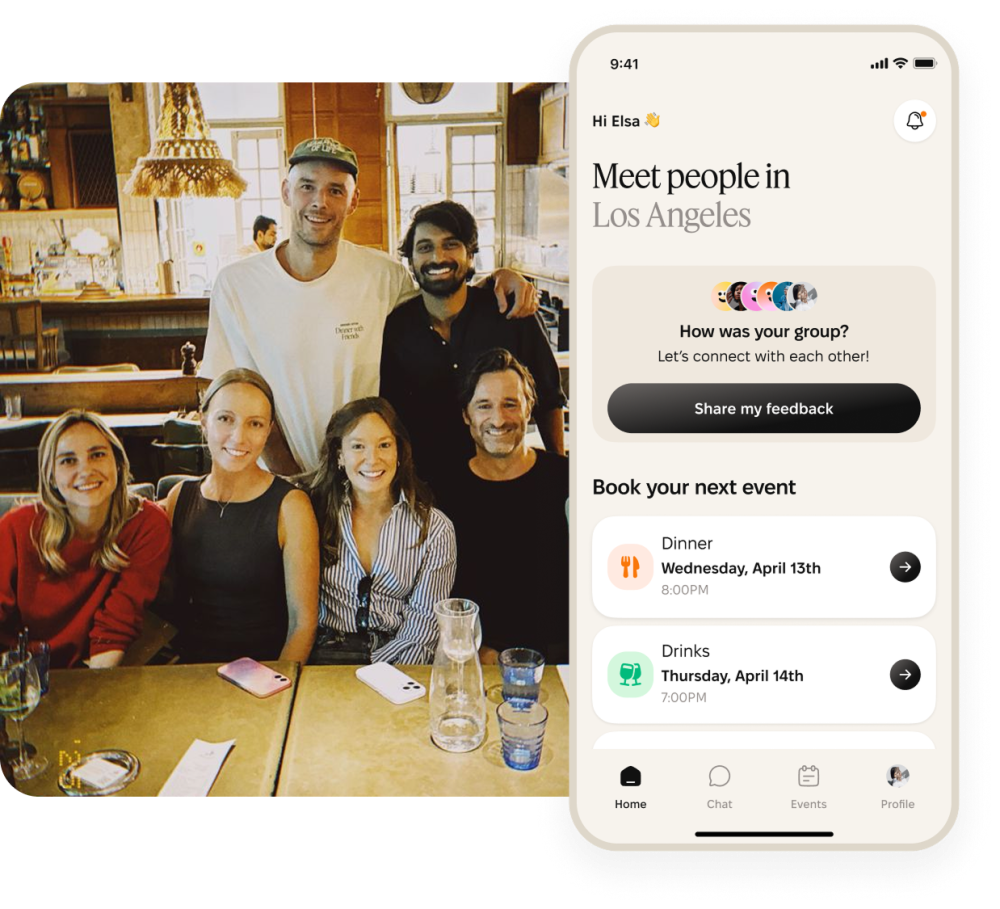
Timeleft matches you with a group. An hour before the event, your table number appears in the app. No standing near the bar deciding where to position yourself, no scanning the room for your people. The format does the interpretive work that unstructured spaces force you to do manually, so your attention stays free for the actual conversation.
Purely social dining for queer adults
Here's the direct answer, because this is the question that keeps people from booking. Timeleft is not a dating app, and independent coverage agrees, with Tasting Table noting the company is clear the platform isn't meant for dating. Timeleft's algorithm explainer puts the positioning in one line: "Not a dating app, not a networking app – just real people meeting face-to-face to build friendships."
The algorithm matches on personality inputs, backgrounds, ages, and interests. The onboarding quiz asks things like how comfortable you are with politically incorrect humor and whether your opinions run on logic or emotion, as The Nod describes, plus logistics like language and dietary preferences, which one first-person account walks through in detail. It does not pair anyone on romantic compatibility at standard events. What a connection becomes after dinner is open-ended – friendship, a travel companion, someone you keep running into. Timeleft does run Singles Events separately for members who want a romantic angle, but that's a different format with a different signal.
Why this format excludes dating
The format is built to make dating functionally impossible at the event level:
- No profile photos to browse before you attend
- No swiping, matching notifications, or attraction-based pairing
- No one-on-one messaging until after the event
- No romantic framing at the standard event level
A verified user review of Timeleft follows the same arc most first-timers describe. Nervous going in. Glad they did afterward:
"I’m surprised how well the guests are matched, and although not every time, I have met a couple of good friends through Timeleft! Love that you can now invite a friend to your dinner too, which makes it a bit less daunting the first time. I was new to the city and it’s been a lovely way to ‘get out’ when feeling alone." - Nicole on Trustpilot
If you've been searching for a gay social dinner app or LGBTQIA+ friendly social events and keep landing on dating products in disguise, this side-by-side view shows the difference in mechanics:
| Feature | Timeleft | Dating apps | Bumble BFF | Meetup |
|---|---|---|---|---|
| Romantic framing | Not at standard events | Yes, explicit | No, but swipe mechanic confuses | No |
| Profile browsing | None before event | Yes, core feature | Yes, core feature | Yes, open discovery |
| Swiping | No | Yes | Yes | No |
| Matching basis | Personality, interests, backgrounds | Attraction, photos | Self-selection, photos | Self-selection, interests |
| Venue | Pre-booked, vetted partner | Self-arranged | Self-arranged | Organizer-dependent |
| Structure | Fixed seat, time, group size | None | Groups feature added in 2025, but core meetup still self-arranged | Varies by organizer |
| Safety screening | Built into the format | Report-based only | Report-based only | Organizer-dependent |
Bumble BFF relaunched as a standalone app in 2025 and added a Groups feature, so there's more structure post-match than there used to be, but you're still swiping on photos and arranging the actual meetup yourself. Meetup leaves filtering and format entirely to organizers. Timeleft handles the matching, the venue, and the booking so the evening doesn't depend on anyone's improvisation.
Design choices that make the table actually safe
Safety here isn't a policy you read. It's a format where the decisions that usually cost you energy are already made.
Fixed venue selection criteria
Every event happens at a pre-vetted partner venue, never a random hired room or someone's basement meetup. The venue partnerships page explains how Timeleft selects and works with restaurants and bars. The venue is already chosen before you leave the house, so there's nothing left to research or second-guess.
No guesswork for LGBTQIA+ social events
The entire booking flow is short, and none of it involves negotiating with strangers:
Personality quiz: Brief questions about how you think and what you value.
Format and date: Dinner, drinks, coffee, or a run, on a day that works.
Subscribe: $19.99/month (US), required before attending any event.
Event access: The group is matched and the venue is revealed the day before.
Show up: Arrive and find your table. The app includes conversation starters to help the table get past the first awkward minutes. No browsing other attendees.
No group chat politics. No "where should we go?" thread that dies after 40 messages. The matching help article walks through how the group comes together.
Predictable endings for easier socializing
Dinner runs about three hours, and you know that before you leave your house. There's no open-ended "let's see where the night goes" pressure and no math about when leaving stops being weird. If the table is flying and you want more, some cities offer an optional Last Drinks stop afterward (availability varies by city, check the app for your location), with zero pressure either way.
Why group limits protect your energy
Tables are capped at four to six people, and that number is deliberate. A small fixed group means fewer people to read and enough airtime for everyone to actually talk. Compare that to a Meetup event where you might walk into a room of 40 strangers with no assigned anything.
Safe social spaces free from romantic pressure
The event itself carries no romantic agenda, and everyone at your table knows it because everyone booked the same product.
Connection without romantic pressure
Timeleft's positioning is plain. It's not a dating app or a networking app. Just real people meeting face-to-face. That shared understanding is what makes queer social dining at Timeleft feel different from a "social" event where half the room is quietly auditioning.
Building recurring LGBTQIA+ social circles
The subscription model is the quiet engine here. Because members can attend as many events as they like each month, a Tuesday dinner stops being a one-off gamble and becomes a recurring ritual. For LGBTQIA+ adults looking for social connection beyond bars, that repetition is the point. A social circle forms from seeing good people more than once, not from one perfect night.
Members can also book events when traveling, since one subscription works across Timeleft's full city footprint, as the multi-city booking article explains. From Paris to Berlin to Brighton, the format stays the same everywhere.
What to expect at your first LGBTQIA+ friendly Timeleft dinner
Timeleft handles the logistics end to end. You find out where you're going the night before and walk in to a seat that's already yours.
Logistics for a stress-free arrival
Once you're subscribed, the evening follows a known shape from booking to check. Here's the full sequence:
| Step | What happens | Who handles it |
|---|---|---|
| Book | Quiz, format, date, subscribe | You |
| Event access | Group matched, venue pre-booked | Timeleft |
| Day before | Venue and group revealed in-app | Timeleft |
| Arrival | Find your table, take your seat | You |
| Dinner | About three hours, conversation starters in-app | The table |
| Check | Pay your own food and drinks | You, at the venue |
The subscription covers the matching, the venue, and the booking. You pay for food and drinks separately at the venue on the day, as the Timeleft vs Meetup breakdown confirms.
The reality of queer social dining
The first ten minutes are awkward. That's normal, and it happens at every table, not just yours. Then someone tells a story and the structure takes over.
Nobody asks you to explain yourself, and nobody assumes a couple default. The table has one job, and it's dinner.
When the check arrives
Two money facts worth knowing before you book. First, the no-show penalty is 35% of the monthly subscription price, and it exists to respect the time of the other diners at the table and Timeleft's venue partners, not as a gotcha fee. Second, you can cancel your subscription any time through your plan settings, effective at the end of your billing period, with one, three, and six month options available.
The exit exists, and knowing the door is unlocked is most of what makes walking through it possible.
What LGBTQIA+ diners report after their first dinner
First-timer feedback from this group follows a consistent pattern. Below is what the reviews actually say, and where the safety numbers land.
No identity performance required
The most common thing first-timers report isn't excitement. It's relief. The format doesn't require identity performance or monitoring how you're being read.
The concept earns consistent praise. Booking confirmation and support responsiveness are where critical feedback shows up most, and that's worth knowing before you arrive expecting a flawless experience. On the safety side, the signal is stronger. Timeleft's safety framework reports that 99% of experiences happen without any safety incident. The community safety page and meetup safety guidance lay out the full approach.
The safest table isn't the one that promises to be welcoming. It's the one where the structure does the welcoming for you, so you can show up hungry and leave present. Take the personality quiz and start your membership.
FAQs
Is Timeleft a dating app for LGBTQIA+ people?
No. Standard Timeleft events have no swiping and no attraction-based matching. What a connection becomes afterward is open-ended, but the mechanics are different. Timeleft does run Singles Events separately for members specifically seeking romantic connection, but that's a different format, and you'd know if you were booking one.
Are there dedicated LGBTQIA+ dinners in my city?
Dedicated LGBTQIA+ dinners are confirmed in Paris on Tuesdays and are piloting in other markets. Standard Timeleft events run in 200+ cities and are open to everyone 18 and over.
How does Timeleft ensure tables are safe spaces?
Safety is built into the format. No pre-event profile browsing, and the seat and time are fixed before you arrive. Members can block or report anyone through the app, and Timeleft's enforcement ladder handles reports from there. Timeleft's safety framework reports that 99% of experiences happen without any safety incident.
What if I'm not out or prefer not to disclose my identity?
No profiles are visible before the event, and the table has no expectation of disclosure.
Can I bring a partner or friend to a Timeleft dinner?
Yes, you can invite a +1 to any event. They'll need to create a free Timeleft account to accept the invitation, which lowers the barrier for first-timers who prefer to attend with someone they know.
How much does a Timeleft dinner cost in total?
The subscription is $19.99/month (US) for unlimited event bookings in one, three, or six month periods, with food and drinks paid separately at the venue.
Key terms glossary
Matched group: A table of four to six strangers, algorithmically matched on personality, backgrounds, ages, and interests. The event carries no romantic framing and no attraction-based pairing.
Venue reveal: The day-before notification in the app that tells you where your event is happening and who's at your table.
Personality quiz: The short onboarding questionnaire that informs group matching. It asks about humor, values, and preferences, not identity.
Subscription: The $19.99/month (US) plan required before attending any event, covering unlimited bookings that month.
Conversation starters: In-app prompts that help the table get past the first awkward minutes.
Last Drinks: An optional bar stop after dinner in select cities, with no pressure to attend.