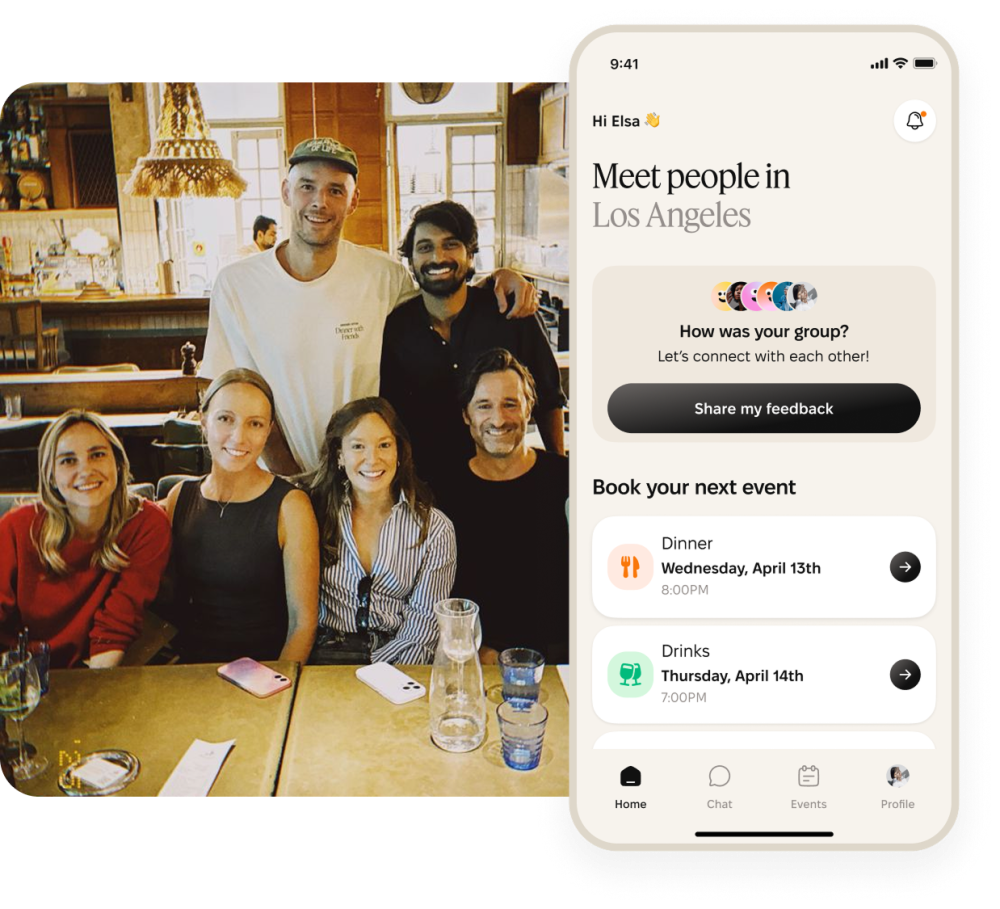
TL;DR: Group dinner events split into two models. Self-organized formats (supper clubs, dinner clubs, private catering) rely on someone to host and build the guest list. App-organized suppers remove the host entirely, matching strangers and booking the venue for them. The real variable is who controls the guest mix, not the food. Timeleft handles the logistics and reveals the venue 12 hours before the event, trading predictability for surprise. Timeleft aims for four to six matched strangers at hand-selected public venues across 200+ cities, though the table can be smaller on the night. A monthly subscription covers unlimited events, with food and drinks paid separately. If you want to choose the people and the place, self-organized formats do that better. If you want a table you could not have assembled yourself, app-organized dinners are the format.
The supper club renaissance has a blind spot. Someone still has to decide who sits at the table. Group dining used to mean one thing. A person organized a table, and everyone else showed up. The category now splits into two models. Food and venue barely factor into it. What actually separates them is who controls the guest mix. App-organized suppers remove the host, the guest list, and the planning, which makes them a different category, not a digital supper club.
In this article:
- Where app-driven events fit your calendar
- The mechanics behind matched stranger tables
- Evaluating group dinner events: apps versus clubs
- Venue logistics: apps versus traditional bookings
- What app-organized dinners do that clubs cannot
- Who app-organized group dinners work for
- FAQs
Where app-driven events fit your calendar
You have a notes app full of restaurants you cannot act on, because eating alone misses the point and the usual crowd rarely has a free night together. The group dining category has expanded to fill different needs, but every option still assumes you have the people to fill the seats. The real distinction is organizational. Self-organized formats require you to assemble the group. App-organized formats assemble it for you.
Peer-reviewed research shows the stakes go beyond logistics. A Nature study on shared meals found statistically significant differences in life evaluations, positive affect, and negative affect between Americans who dine alone and those who share meals.
The table below maps the landscape.
| Format | Who organizes | Guest mix | Planning required | What you know in advance |
|---|---|---|---|---|
| Supper club | Host or chef | Host-selected from network | High (invites, guest list, menu, and venue) | Unknown guests, set menu |
| Dinner club | Rotating members | Fixed or self-selected group | High (member coordination and rotation) | Known people, known venues |
| Restaurant group booking | You or a friend | Your existing circle | High (date wrangling, booking, RSVPs, and chasing) | Known people, chosen venue |
| Private catering | Professional service | Client-selected | Low for guests, high for host | Known people, known venue |
| App-organized dinner | The app | Matched strangers | None for Timeleft (quiz, subscription, neighborhood pick, and show up) | Timeleft (venue revealed 12 hours before, group preview day of) |
Restaurant group seatings
A restaurant reserves a table for a group, often with a set menu or family-style service. The group is pre-existing, whether friends, colleagues, or a club. The restaurant handles the menu, not the people. You still handle the coordination, from choosing the date to confirming who is actually coming. The evening depends on your ability to align schedules and manage expectations.
Modern supper club experiences
A supper club is a ticketed dinner at shared tables with strangers, sitting between a restaurant and a private dinner party, where you arrive at a set time, sit at shared tables, eat a fixed menu, and spend the evening with people you didn't choose. The host assembles the room. For a look at how these operate in practice, the best supper clubs in NYC offer host-led experiences, often with a fixed menu.
Spontaneous social dining with known hosts
Even when the evening feels loose, someone chose the guest list from their existing network. The spontaneity lives in the conversation, not the assembly. Everyone there arrived through the host's network, and the stranger across from you was already chosen. A dinner party with strangers still requires a connector at the center.
Bespoke professional catering events
Commercial, pre-organized, for existing groups. Corporate or private. The opposite of a table of strangers. The catering service manages logistics, but the guest list comes from the client, whether a company or a family.
App-organized group dinners
This is the format that sits outside all the others. There is no host, no pre-existing group, no self-selection, and no coordination required. The app assembles the table, books the venue, and reveals the details late. Timeleft coordinates these dinners in over 200 cities, matching strangers who did not choose each other. You are not attending a dinner party. You are attending a matched group event, and the match is already made before you ever say a word.
The mechanics behind matched stranger tables
Now that the category is mapped, the mechanics matter. App-organized dinners work because they remove the social labor that kills most plans before they start.
Removing the need for prior rapport
The table of strangers is the product. Nobody needs to know anyone beforehand. The shared table gives everyone a reason to be present, the way a class or shared commute once created conversation without effort. You are not networking, and you are not catching up. You are simply there.
Matched guest selection vs self-selection
Contrast with supper clubs and Meetup. In traditional formats, someone chooses the guests. In app-organized dinners, the group is assembled from quiz answers, never at random. Timeleft matches four to six people using a short personality quiz. Members answer questions about social energy (introvert, ambivert, extrovert, or somewhere in between), the qualities they value in a friend, how they want to feel after dinner, and what they are looking for from the experience, alongside practical details like age group, city, and country of origin. 96% of diners report group compatibility.
Consistent structure, different people every time
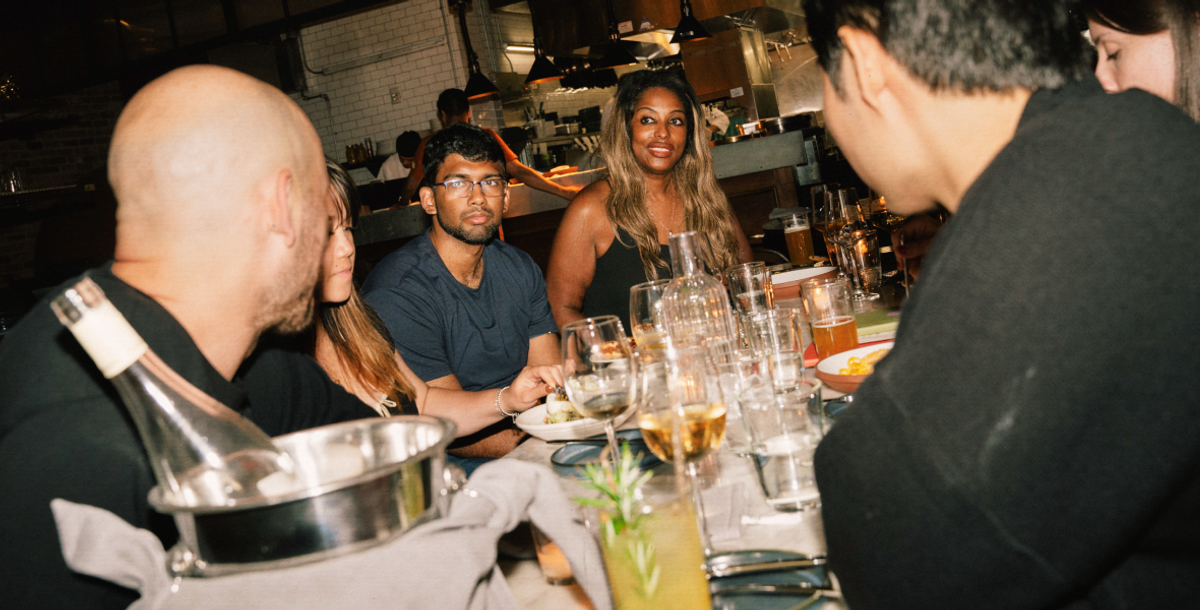
The structure is consistent. Four to six people at a pre-booked venue, with dinner usually running around three hours. Who shows up varies every time. The consistency lowers the barrier, and the variety feeds the appetite for surprise.
Public venues for social dining
Every event happens at a public venue, somewhere you could walk into off the street, never a hired-out room. Timeleft works with a network of hand-selected restaurant partners across 52 countries and 200+ cities. The venue is revealed 12 hours before the event. Dietary preferences are accommodated through venue rotation and suggestions, with specific support for dietary preferences and food restrictions.
Evaluating group dinner events: apps versus clubs
One question cuts through the options. Who controls the guest mix?
Who builds the guest mix
In a club the host controls the guest mix. In an app dinner, the matching does. The host brings intimacy and familiar social cues, while the app removes the coordination tax and assembles rooms your network could never produce. If you want to choose your table, pick a club. If you want a table you could not have assembled yourself, pick an app.
Entry barriers and discovery
Supper and dinner clubs tend to operate through mailing lists, membership, or word-of-mouth, which means discovery depends on already being in the right network. Timeleft requires a monthly subscription and a short personality quiz, with food and drinks paid separately at the venue.
Predicting the group dinner experience
A club gives you a host and a guest list you can see in advance. App-organized dinners withhold both until close to the event, as described above. The experience resists prediction by design.
Venue logistics: apps versus traditional bookings
The logistics are where the models diverge most sharply. Traditional bookings require coordination. App-organized dinners remove it.
Who assembles the guest list
With a traditional booking someone builds the list, sends the invites, and chases the RSVPs. With an app dinner the list is assembled for you. No group chat negotiating dates. And if someone does cancel, the cancellation window closes four hours before the event, so the group is usually settled well before you leave the house.
When the unknown is the point
In a traditional booking the unknown is a risk to manage. In an app dinner the unknown is the point.
Automating the guest list
Timeleft handles matching, venue booking, group assembly, and dietary routing. Members pick a format, date, and neighborhood, then show up. Booking is open up to 13 hours before an event starts, and the matching system handles group size and venue selection without any further planning on your part.
What app-organized dinners do that clubs cannot
The app-organized model sits in a different niche from supper clubs. The logistics are handled and the details arrive late. Overthinking is off the table.
Subscription models versus pay per seat
Money is the clearest line between group dinner formats. A private dinner party is free to attend, though guests often chip in for food. A hosted dinner or supper club has a price attached, either a fixed ticket or a pay-as-you-go bill at the venue. Timeleft runs on a monthly subscription instead of a per-event ticket, so the per-event cost drops the more often you go, and it covers as many events as you want to attend in a month. Food and drinks are always paid separately at the venue. Check the current subscription price before you join, since it varies by market.
| Feature | Dinner party | Hosted dinner | App-organized dinner (Timeleft) |
|---|---|---|---|
| Who chooses the guest list | Host (from existing circle) | Organizer or chef | Matched by quiz answers |
| Who chooses the venue | Host (usually their home) | Organizer (restaurant or rented space) | Timeleft (pre-booked) |
| Private or paid | Private (invitation only) | Paid (varies by organizer) | Paid (subscription) |
| Cost | Guests typically don't pay admission | Varies by organizer and format | Monthly subscription, price varies by market, plus food and drinks at the venue |
| Planning required | High (host does all) | Varies by format and organizer | None (Timeleft handles it) |
| Guest list known in advance | Yes, the host chooses from their existing circle | Depends on the organizer | No, the matched group and venue are both revealed close to the event |
A dinner party host absorbs the cost because they chose to. A hosted dinner organizer absorbs the logistics because it is their job. That shift changes who shows up and why. Platforms like Meetup let you browse interest-based groups for free, and Timeleft removes the browsing step entirely by matching your group and booking the venue. Bumble BFF is completely free and lets you choose exactly who to meet, and Timeleft trades that control for a guaranteed seat at a matched table without the back-and-forth of planning.
A dinner party costs time and effort. A hosted dinner or supper club costs money, either a fixed ticket or a pay-as-you-go bill at the venue.
Selecting the guest experience
The quiz covers personality, values, and social energy, then adds practical details like age group, city, and country of origin. The matching is intentional, not random. The guest experience is selected, not self-selected.
Breaking the cycle of repeat guests
Clubs can become echo chambers full of the same people and conversations. App-organized dinners assemble a new table each time. The format range attracts different crowds, though which formats are running depends on the city. Women-only dinners run Tuesdays in many cities, and where walks or runs are offered, they draw members who want connection without a three-hour commitment. Singles events now run across formats in some cities, for members who want the romantic angle out in the open rather than guessing.
Who app-organized group dinners work for
App-organized dinners suit a specific appetite. If you want to choose the people and control the room, a club or a group booking does that better. If you want a table you could not have assembled yourself, this is the format.
Finding novelty in group dining
For anyone whose life is good but predictable. The unplanned evening is the value.
"I have met wonderful people through Timeleft from all walks of life that I wouldn't have met ordinarily. I have really enjoyed going to these dinners. In addition I have been introduced to several areas in my neighborhood that I wouldn't have thought of going to. I plan to continue going to Timeleft dinners for the foreseeable future." - Carolina on Trustpilot
Where foodies find hidden tables
That notes app full of restaurants is not going to act on itself. The venue reveal means the decision is already made, the spot chosen before there is time to second-guess it. You end up somewhere you kept meaning to try, with a table of people you did not choose and could not have assembled yourself. The subscription removes the mental overhead of working out whether a restaurant is worth organizing a group around.
Why veterans seek unscripted dinners
Someone who has spent a decade in the same scene knows exactly what to expect from a Saturday night. The faces are familiar, and the conversations stopped surprising them years ago. An app-organized dinner puts them in a room they did not build, with people who have no idea what they usually talk about.
"It was my first time trying this out. They matched me with a great group of people! I had a great night with good conversation and made some new connections as well! I'm looking forward to joining another dinner in the near future" - Stephanie on Trustpilot
Where spontaneity meets social dining
No host, no agenda. The evening goes where it goes.
The first 10 minutes are usually the most awkward. After that, the conversation tends to find its own direction.
Take the personality quiz and subscribe. Pick a format and neighborhood. Your first table of strangers is already being assembled.
FAQs
Are app-organized dinners the same as supper clubs?
No. Supper clubs are host-led with a self-selected guest list. App-organized dinners have no host, and the guests are matched by quiz answers, not chosen by anyone at the table.
Is prior connection required to join an app dinner?
No. The table is four to six strangers. Nobody needs prior rapport or a reason to break the ice. The format does that.
How is this different from booking a table with friends?
Booking with friends means you choose the people and venue. App-organized dinners assemble both for you, revealing details late.
Are app dinners a one-off or a recurring option?
A Timeleft subscription covers as many events as you like. The format is designed as a recurring ritual, not a one-off.
How much does an app-organized dinner cost?
Pricing varies by organizer and format. Some hosted dinners and supper clubs charge a fixed ticket per event, others use a subscription. Timeleft works on a monthly subscription, with pricing that varies by market, and you pay for your own food and drinks at the venue separately.