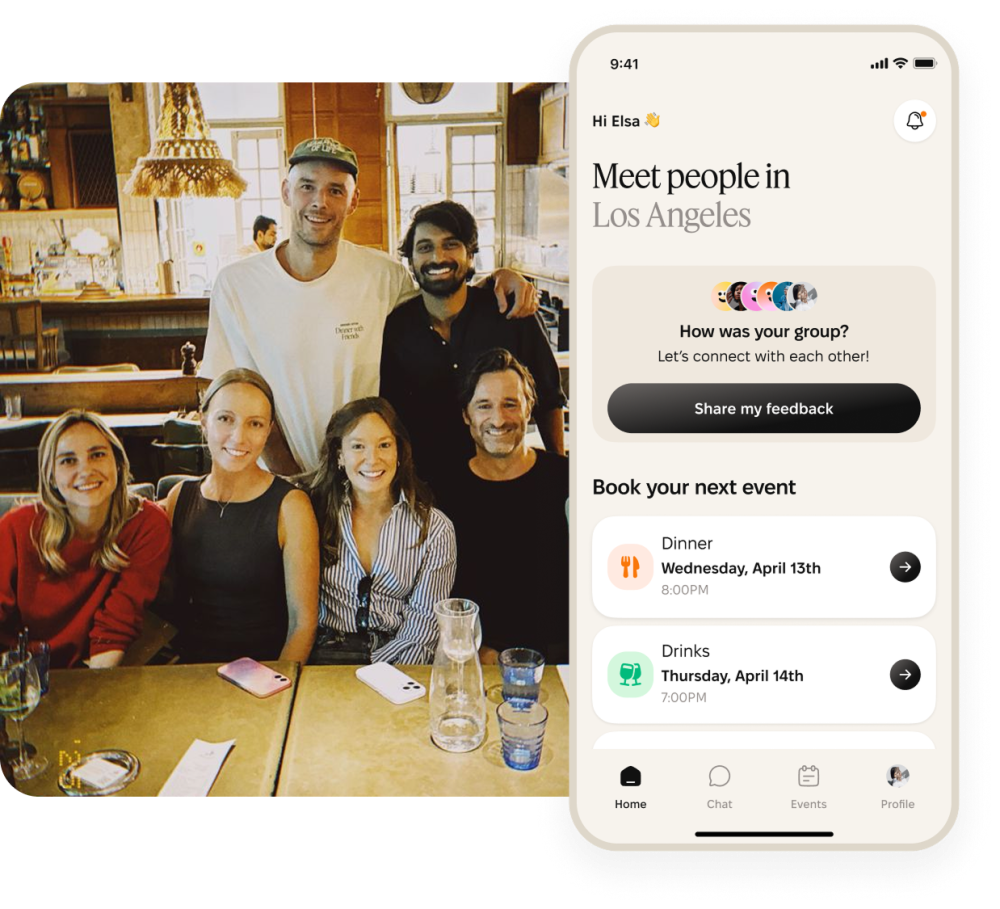
TL;DR: When the format itself is the problem, the logistics of a social event can cost more energy than the connection gives. A pre-booked venue, reserved table, matched group of four to six, and a known end time of about three hours mean the decisions that drain executive function are already made before you leave the house. Groups aren't matched by neurotype. A subscription covers every event; food and drinks are paid separately at the venue. Booking and rescheduling close 13 hours before the event, and cancellation stays open until four hours before, so there's room to decide on the day. Coffee, walks, runs, and Bring a +1 suit lower-battery days.
You've been told to "just relax and be yourself" at parties where the format itself is the problem. When every social event requires you to improvise the structure (where to stand, how to read the room), the cognitive cost of attendance often exceeds the connection gained. For adults with ADHD or autism, that math rarely works out.
Timeleft works the other way round. The structure comes built in. Timeleft handles the logistics before you arrive. You show up, sit down, talk, and leave. The decisions that would otherwise cost you the evening are already made.
In this article
- Beyond small talk: why spontaneity isn't sustainable
- Why pre-set logistics save your energy
- How groups are matched, and how Timeleft compares
- Socializing with ADHD: showing up without the cancellation spiral
- Socializing with autism: what's already decided for you
- Managing social battery with smaller formats
- The logistics of your first dinner
- FAQs
Beyond small talk: why spontaneity isn't sustainable
Unstructured socializing comes with a hidden tax, and for many neurodivergent adults it's a steep one. Arrivals, transitions, exit planning, and the small decisions between them all take executive function. At a party, those decisions multiply. Where to put your coat, how to enter a conversation, when to get a drink, how to leave without offense.
Each micro-decision takes a little energy. By the time you've navigated the first 30 minutes of an unstructured event, you may have already spent the resources you needed for actual conversation.
Where the friction comes from
The constant background processing required to navigate the room is where the friction lives. The processing happens across space, timing, unspoken hierarchy, and the sensory texture of the room, and the costs compound the longer an event runs.
- Space: where to stand, where to sit, how to enter a conversation, and when it is acceptable to move away
- Timing: when to arrive and when to leave
- Social hierarchy: who is in charge, what the unspoken rules are, how to exit without offense, and whether you are taking up too much or too little space in the conversation
- Sensory load: how loud the room is, how bright the lights are, where to position yourself to reduce input, and whether the smell or temperature of the space is manageable
Timeleft settles the space and timing questions before you arrive.
Why your brain needs predictability
Uncertainty is cognitively expensive. When you don't know how long an event will last or what the expectations are, your brain stays on alert, scanning for cues about when you can leave and what you should do next. A fixed end time removes that background calculation. Knowing a dinner has a scheduled conclusion means your nervous system can settle into the experience rather than managing the exit. A friction point that happens to be especially costly if executive function is already stretched.
Why masking drains your battery
For autistic adults, socializing often involves sustained, conscious monitoring of social signals, internal scripting, suppressing natural behaviors like stimming or avoiding eye contact, and managing the gap between how you feel and what the room expects you to show. Hull et al. (2017), writing in the Journal of Autism and Developmental Disorders, described this as social camouflaging. This masking requires running a mental social checklist throughout the event. When the structure is explicit (arrive, sit, talk, leave), the demand for constant interpretive labor drops.
Why pre-set logistics save your energy
Timeleft picks the place and the table, so there is less to decide on the night. The big decisions are already made before you leave the house.
Predictable timing for easier planning
You can book up to 13 hours before an event starts, in every city. The venue is revealed 12 hours before the event, and your table number or name arrives one hour before. Because of that late reveal, there is less time to overthink it, and still enough notice to plan your route and sensory prep.
Skip the stress of arrival logistics
Think of it as a reservation someone else made, for a group you didn't have to organize. You arrive at the stated time, find your reserved table, and sit down with a small matched group you haven't met yet. There is no wandering around a bar looking for the group, no texting "I'm here, where are you," no negotiating whether to sit inside or outside, and no deciding when the evening is finally over.
A reserved table: the social map is already drawn
Groups are four to six people. This range is small enough to keep track of who's speaking, and big enough that you're rarely stuck in one long one-on-one. In a group of six, the conversation can split into smaller exchanges without leaving anyone isolated.
"It was a great time. I got to meet people that are intentional about making friends and building strong relationships. The restaurant was very nice and the people were amazing" – Alejandra on Trustpilot
How groups are matched, and how Timeleft compares
Timeleft is not a neurodivergent-specific platform. Groups are matched across backgrounds, ages, and personalities, not by neurotype. Before subscribing, you take a short personality quiz that takes about two minutes. It covers the basics (age group, city, industry, relationship status), what you're looking for from the evening, and how you'd describe your personality. That includes whether you're an introvert, ambivert, or extrovert, whether you lean toward logic or feelings, and the qualities you value in other people.
You also pick your interests from a list of 21, choose how you'd describe your ideal group dynamic, and say how you'd like to feel when the evening ends. Those answers shape who you sit with. The quiz does not guarantee chemistry, but it means no one at the table is a random draw.
| Feature | Timeleft | Meetup | Bumble BFF | 222 Place |
|---|---|---|---|---|
| Structure | Dinners about three hours, plus drinks, coffee, runs, and walks | Event-dependent, set by organizer | Self-arranged after match | Pre-planned experiences, waitlist-dependent |
| Group size | Four to six, matched by Timeleft | Varies widely, self-selected | One-on-one matching plus interest-based Groups | Small groups |
| Logistics | Venue pre-booked, revealed 12 hours before the event | Organizer chooses, listed on the event page | You arrange everything | Experience pre-planned, price varies by event |
| Predictability | Known end time for dinners, reserved table | Varies by organizer and event type | Entirely self-managed | Weekly text with opt-in, no guaranteed selection |
Meetup offers hobby breadth across interests, and Timeleft offers a predictable weekly seat with a matched group so you never walk into a room where the format is unclear. Bumble BFF lets you choose exactly who you meet, and Timeleft removes the legwork of arranging the meetup entirely. 222 Place delivers mystery-driven variety, and Timeleft delivers a recurring format with an event almost always available.
Socializing with ADHD: showing up without the cancellation spiral
For people with ADHD, the fear of being "the person who cancels" often comes down to the executive-function cost of day-of decisions. A 2005 meta-analysis by Boonstra and colleagues found that adults with ADHD show executive-function difficulties, and research links inattention-related traits to procrastination (Niermann and Scheres, 2014). Waking up and deciding whether to go means asking your brain to start a complex sequence of tasks, like showering, dressing, eating, and getting there, at the moment it's least equipped to. Timeleft shrinks it to one decision, whether to show up, because the booking and the table are already sorted.
How executive function shapes attendance
Decision fatigue is cumulative. From the moment your day begins, you are making choices. When to get up, what to wear, what to eat, how to structure your time, and each one takes something. By evening, the idea of adding "negotiate social logistics" to that list is often enough to trigger cancellation.
How booking ahead removes day-of decisions
You are more likely to show up when you have already paid than when you are deciding from scratch each week. It's the same logic as a gym membership, and the subscription works the same way. Because you booked on Tuesday for Wednesday, the decision is already made.
Why a dinner with an end helps
A dinner that runs about three hours has a clear beginning, middle, and end. This finite container prevents the slow attrition of an open-ended party where you must constantly decide whether to stay or go.
"As someone who tends to alternate between being invisible and dominating the conversion, Timeleft has been a good way to socially adjust to group situations, particularly post-pandemic." – Evie on Trustpilot
Socializing with autism: what's already decided for you
The group chat opens shortly before the event, and a preview of who you'll meet arrives on the day.
Fewer unspoken rules to decode
When the table and the end time are already set, there are fewer unspoken rules left to decode. The structure is the script.
A table where the rules are visible
In-app Icebreakers help with the opening minutes. Most tables don't end up needing them, but they make the first few minutes easier. After the event, the Impressions feature lets you see what people appreciated about you, providing concrete feedback about what landed well.
What the late reveal means for sensory planning
You can't choose the venue, but the reveal 12 hours before the event gives you time to check it. For those with sensory sensitivities, here is what to look for.
| Factor | What to check |
|---|---|
| Noise | Restaurant review sites often mention noise levels, and you can call ahead to ask how loud it gets |
| Lighting | Look for photos of the interior to gauge brightness |
| Seating | Seating depends on the venue. Arrive early if you need a specific position. Facing the room or sitting away from the kitchen tends to work well for noise and visual management |
| Exit route | Note where the restrooms and exits are when you arrive. Having a clear route out lowers background anxiety without requiring you to use it |
Managing social battery with smaller formats
The subscription flexes with your capacity. You can attend as many events as you like per month, across any format, so you can match the commitment to your current battery level.
| Format | Best for |
|---|---|
| Dinners | Full social engagement, building deeper connections (about three hours) |
| Drinks | Casual conversation, lower commitment than dinner |
| Coffee | Quick meetups, testing the waters, tight schedules |
| Walks | Side-by-side conversation, lower eye-contact pressure |
| Runs | No pace, no pressure. Parallel activity, conversation alongside movement |
Low-intensity coffee and walks
Coffees are casual, quick, and easy to fit into even the busiest schedules. Walks, often scheduled for Sundays, remove the pressure of sustained eye contact and allow for side-by-side conversation, which can feel less demanding than face-to-face intensity.
Parallel play for neurodivergent adults
Runs give the conversation something to happen alongside, a pattern sometimes called parallel play. There is no pressure to maintain constant verbal output or sustained eye contact. The shared activity creates the connection while your body is occupied with movement. This side-by-side engagement can be more sustainable than the face-to-face intensity of a seated dinner.
Bringing a plus-one to reduce anxiety
Bring a +1 allows you to bring someone from your existing circle, met through Timeleft or not, to any event. This helps people who aren't ready to go solo take the first step, so you have someone you already know at the table while you settle in.
The logistics of your first dinner
Your first Timeleft dinner follows a predictable arc from booking to departure. Knowing the sequence reduces the uncertainty that triggers pre-event anxiety.
Booking: choosing your evening in advance
Your first booking follows four steps.
1. Take the personality quiz.
2. Subscribe. A subscription covers unlimited event bookings across all formats. Food and drinks are paid separately at the venue.
3. Pick your format, date, and neighborhood. Choose from dinners, drinks, coffee, runs, or walks. Book up to 13 hours before the event starts.
4. Event access. The table is reserved for your matched group, and you show up.
Reducing pre-event social anxiety
Use the time between the reveal and the event to prepare rather than overthink. A sensory checklist covering noise, lighting, seating, and exit routes is in the autism-friendly section above.
How the dinner structure protects energy
Arrive at the stated time. The table is reserved and fills as people arrive. There is no pressure to stay for Last Drinks afterward, an optional bar stop in select cities for those who want to extend the evening.
Preserving your battery until departure
Consider leaving time for recovery after the event. A 2020 study by Sointu Leikas published in Heliyon found that sociable behavior lifts mood in the moment but is followed by tiredness two to three hours later. The post-event crash is real, and protecting that time helps the evening cost less than it gives.
Take the personality quiz and subscribe. See which formats are available in your city.
FAQs
What if you need to leave early due to overwhelm?
There's no penalty for leaving early, and no penalty for not attending. If something comes up, cancellation stays open until four hours before the event. A brief note to the table, an early start the next morning, a commitment afterward, is enough. No policy requires an explanation. Because the dinner runs about three hours with a known end time, leaving toward the end of that window rarely needs any explanation at all.
How do you know the group will be neurodivergent-friendly?
Several features here happen to reduce friction that's especially costly if you're neurodivergent, but the group itself is matched across backgrounds and personalities. There's no guarantee of neurotype.
Is this a dating or networking event?
Timeleft is the IRL connections app, not a dating app or networking app. What a connection becomes is open-ended: friendships, travel companions, business partners, and sometimes romance through Singles Events.