TL;DR: Timeleft is not a dating app. It's an IRL social platform that matches people into groups for dinners, drinks, coffee, runs, and walks. There's no swiping, no bios, no profile browsing, and no one-on-one messaging before the event. Timeleft pre-books the venue. A subscription is required to attend. Food and drinks are paid separately at the venue. Community Guidelines ban continued romantic pursuit after rejection. If you do want romance, Singles Events run across formats in around 30 cities.
Standard dinners aren't set up as dates, but Singles Events are, in the cities where they run. Check which one you're booking so you know what everyone's there for.
Most social formats assume unlimited executive function. You arrive somewhere open-ended, figure out where to stand, read the unspoken rules, keep the conversation going, and then calculate when you can leave. For a lot of people, all of that adds up to just... not going.
Timeleft is built differently, and the difference is structural. It's an IRL social platform where you take a personality quiz, subscribe, pick a format and neighborhood, and show up. The group format, the pre-booked venue, the set end time, and a preview of who you'll meet before you arrive remove the real-time judgment calls that make so many evenings cost more than they give.
In this article
- Defining Timeleft: a platform, not a dating app
- What happens from booking to the table
- How Timeleft differs from typical dating platforms
- How Timeleft's design keeps dating pressure off the table
- Why knowing what it is makes it easier to go
- FAQs
Defining Timeleft: a platform, not a dating app
The platform is designed around one core idea. Bring strangers together in person, at a table, for a set amount of time, with no planning required. For dinners, Timeleft aims for a group of four to six, though the number on the night can be smaller. The connection that comes out of that can become a friendship, a travel companion, a business partner, or even romance. But the format isn't built around any one of those outcomes.
What brings the group together
Timeleft matches people based on personality, not photos. The onboarding quiz asks about your age, location, and what kind of group you'd like, alongside personality questions like whether you lean introverted, extroverted, or somewhere in between, and how you form your opinions. Groups are matched across backgrounds, ages, and personality answers to build balanced tables.
How the format removes dating pressure
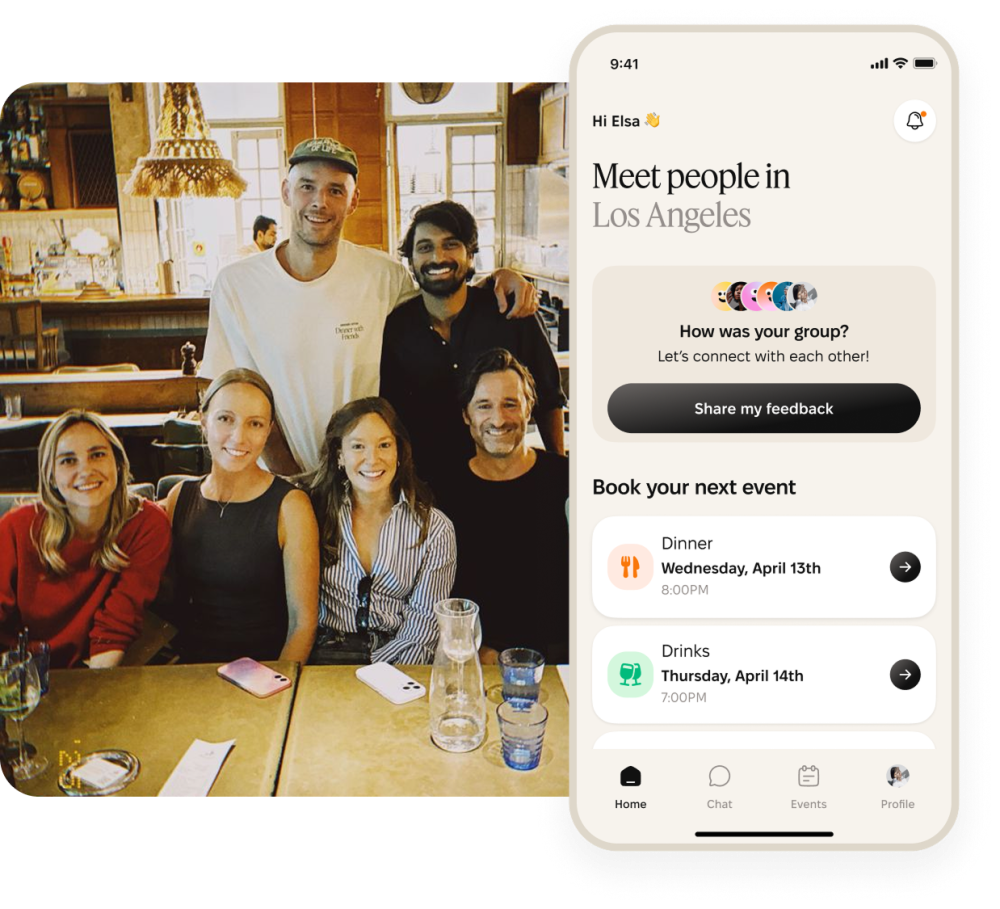
For every event, Timeleft matches a group of four to six people for dinners. A preview of who you'll meet is revealed on the day of the event. You show up and sit down with the group.
That structure removes the negotiation and the ambiguity that make dating apps exhausting. There's no "what does this person want from me?" question hanging over the table.
Clearing up the dating app confusion
The confusion makes sense. The concept involves meeting strangers. And yes, some people who meet at Timeleft dinners end up dating, and a few have gotten engaged. Romance happens. It isn't what the table is set up for.
Dating apps vet first and meet second, and you're the one doing the vetting. At Timeleft, you meet first, and the connection becomes whatever it becomes from there.
What happens from booking to the table
Here's the full sequence, from booking to conclusion.
1. Take the personality quiz: A short set of questions about your personality and what kind of group you're after. Timeleft uses your answers to build a balanced table.
2. Start your subscription: A subscription is required before attending any event. Subscribers can attend as many events as they like per month.
3. Book up to 13 hours before the event: Choose a format and a neighborhood, then a date. That's the full decision.
4. Venue revealed 12 hours before the event: You'll find out where you're going shortly before the event. No researching restaurants, no second-guessing.
5. Preview on event day: A look at who you'll be meeting arrives on the day itself.
6. Group chat opens shortly before the event: A brief window to say hello before you arrive.
7. Arrive and dine for about three hours: You pay for your own food and drinks at the venue. Most people feel a little nervous at first. The awkward part usually doesn't last long.
8. Optional Last Drinks in select cities: A bar stop after dinner, no pressure to attend.
How Timeleft differs from typical dating platforms
Dating apps and Timeleft both start with strangers. Everything after that works differently.
| Feature | Timeleft | Dating apps (Tinder, Bumble, Hinge) |
|---|---|---|
| Matching method | Personality quiz, group compatibility | Profile-based matching, mutual interest |
| Group size | Four to six people for dinners | Mostly one-on-one |
| Pre-event messaging | Group chat only, shortly before the event | Post-match direct messaging; no structured event to arrive at |
| Profile visibility | Preview on the day, full profiles only if you opt in to connect after | Visible before matching |
| Venue selection | Pre-booked, revealed 12 hours before the event | User-planned |
| Event duration | About three hours for dinner. No set duration for other formats | Open-ended |
| Primary purpose | IRL connection, group format | Dating |
Dating apps put the work upfront. You build a profile, wait for a match, message back and forth, then negotiate a meetup that may never happen. Timeleft skips the back-and-forth.
How Timeleft's design keeps dating pressure off the table
A few things sit behind the safety approach. Events take place at pre-booked public venues. There's no private contact before you meet. And if you report someone, you're never matched with them again.
Why group size matters
A one-on-one meetup has a different energy. Two people, one table. That setup invites interpretation. Is this a date? Do I stay if the vibe is off?
Timeleft aims for a group of four to six at dinner, though the number on the night can be smaller. Either way, the conversation moves around the table. No one's keeping score, and no single person's impression of you determines how the evening goes.
How a set end time takes the edge off
A defined end time means there's a clear exit. You don't have to calculate when to leave or worry about overstaying. Dinner runs about three hours. After that, there's an optional Last Drinks stop in select cities, with no pressure to attend. It's looser than the table. People from other tables turn up too, so it works more like a regular night out at a bar.
For people who find unstructured social events exhausting, a set end time makes it easier to commit in the first place. Coffee and walks are shorter if a three-hour dinner feels like too much to start with.
Why knowing what it is makes it easier to go
When a platform is vague about its purpose, you have to do the interpretive work. Is this a dating thing or a friendship thing? That's exhausting to walk into, especially if you're neurodivergent, socially anxious, introverted, or part of a community where "inclusive" spaces often default to a straight-couple or dating norm.
Timeleft tells you exactly what it is, so you don't have to figure it out at the door.
How enforcement backs up the policy
Timeleft enforces this. The Community Guidelines explicitly ban continued romantic pursuit after rejection. Most cases follow a staged process, but serious violations can result in an immediate ban. The standard process is:
1. Educational warning
2. Formal warning
3. Permanent ban
The Community Guidelines are direct about this. "Expressing interest in someone isn't a violation, but continuing after they've made clear they're not interested is."
Why the structure matters for LGBTQIA+ diners
For LGBTQIA+ adults, a space marketed as safe doesn't always feel safe once you arrive. Knowing the rules before you go helps. Standard dinners aren't framed as dating, and the ban on continued romantic pursuit applies at every table.
Dedicated LGBTQIA+ dinners run on Tuesdays in Paris and are piloting in other cities. They use the same group format and rules.
No one is hosting. No one is "your date." After the event, you can use the Connect feature to stay in touch with people you clicked with. Nobody gets your details unless you both opt in, and that choice only comes once you've met in person.
Take the personality quiz and subscribe. See which formats are available in your city.
FAQs
Is Timeleft a dating app?
No. It's an IRL social platform built around groups, not one-on-one profiles. For dinners, Timeleft aims for four to six people. If romance is what you're after, Singles Events are the one format built around it, and even then, you're at a table with others first.
Can you bring a friend to Timeleft?
Yes. Once you've booked an event, you can invite existing Timeleft connections directly in the app, or share a link with someone outside Timeleft. See the help centre for full steps on sending and managing invitations.
Are LGBTQIA+ dinners separate from regular dinners?
Both. Dedicated LGBTQIA+ dinners run on Tuesdays in Paris, and you can book any standard dinner too.
What if someone at the table treats it like a date?
The Community Guidelines ban continued romantic pursuit after rejection. If someone violates this, you can report them in the app, and enforcement follows a three-stage ladder from educational warning to permanent ban.
How is Timeleft different from a dating app?
Dating apps usually match two people on profiles and leave the planning to them. For dinners, Timeleft aims for a group of four to six and books the venue. What happens after that is up to the table. If you do want romance, Singles Events run across formats in around 30 cities and are the only events built around it.