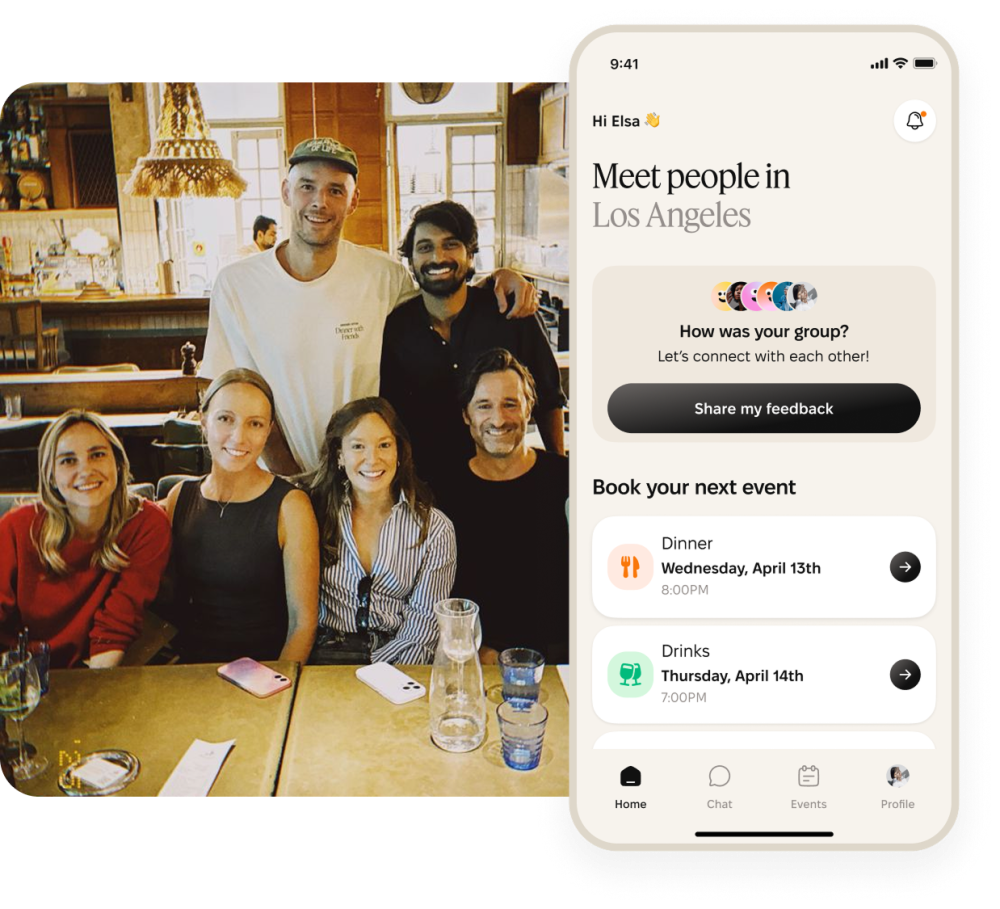
TL;DR: Yes, and the reason is structural rather than cosmetic. Every event happens at a pre-vetted venue with a group of typically four to six people, a fixed start and end time, and no one-on-one pressure. Timeleft requires verified identity details before you can book, and reporting runs through an in-app flow reviewed by human moderators, with enforcement that can end in a permanent ban. Timeleft doesn't publish full details of its screening process, and the matching criteria aren't fully public. What the format does is remove the conditions where harm usually happens.
Most dinner-with-strangers apps treat safety as a reporting problem. Something goes wrong, and the expectation is that a report fixes it. Timeleft treats safety as a design problem, and the difference matters more than any badge or background check.
The safest thing about a Timeleft dinner isn't the report button. It's that you know exactly when the evening ends, that you're seated with a group rather than alone with one stranger, and that the whole thing happens in a working venue with other people around. This article covers the whole system. It walks through what Timeleft verifies before you book, what happens at the table, exactly how Timeleft reporting works, what enforcement looks like, and where the honest limits are.
In this article:
- Why Timeleft's structure increases safety
- Verifiable safety steps for every attendee
- How Timeleft approaches physical safety
- Reporting misconduct: the exact steps to follow
- How violations lead to account removal
- Why the Timeleft format minimizes social risk
- The limits of Timeleft safety protocols
- FAQs
- Key terms glossary
Why Timeleft's structure increases safety
The combination of layers matters more than any single one, and each is worth understanding on its own.
Structure as a safety feature
Timeleft safety rests on design choices that each remove a condition where harm typically happens, rather than on moderation tools bolted on afterward.
| Design choice | What it means | Why this helps |
|---|---|---|
| Pre-vetted venues | Every event happens at a venue Timeleft has selected in advance | A working business, other people around |
| Group format | Typically four to six people per table | No isolated one-on-one dynamic |
| Day-before reveal | Venue and group details arrive the day before | Nothing to overthink, nothing shared far in advance |
| Fixed boundaries | Fixed start time, fixed seat, freedom to leave | You know when it starts and can leave when you want |
Behind those choices sits a broader classification system. As the safety framework explains, Timeleft has built a structured classification with nine distinct categories of harm, so moderation isn't guessing case by case. When people ask "is Timeleft safe," the honest answer starts with that structure, not with any single tool.
Where surveillance fails to protect
By the time a report is filed, the bad evening has already happened. As Timeleft's safety framework puts it, 99% of experiences happen without any safety incident at all, but the occasional issue does come up, and after-the-fact review can't undo it. Prevention has to come from the structure of the gathering, which is why Timeleft starts with venue choice, group size, and a defined end point rather than after-the-fact review.
How clear boundaries protect your energy
A fixed format does more than lower risk. It lowers how much mental effort it takes to show up, which matters if unstructured social events genuinely exhaust you. As Timeleft explains in its guide to dinner with strangers, that structure tends to work better for quieter personalities than open, free-floating events.
If you're still weighing whether that format fits you, Timeleft's self-assessment guide walks through the logistics honestly before you commit to anything.
Verifiable safety steps for every attendee
Here's the checklist version before the detail. Each layer is explained in full in the sections below.
| Safety layer | What happens | When |
|---|---|---|
| Phone verification | Required at signup | Before any booking |
| Real-name, real-photo policy | Profile uses your legal name and a clear photo | At signup |
| Age requirement | 18+ (21+ in the United Arab Emirates) | At signup |
| Venue vetting | Pre-vetted venues only | Before events are listed |
| Day-before reveal | Venue and group visible the day before | Day before your event |
| In-app reporting | Long-press any message, tap Report | Any time |
| Enforcement | Warnings through permanent ban | After review |
How phone verification secures your seat
Every member verifies a phone number before they can book anything. Signup requires your legal name, a phone number, and a clear, unfiltered photo, and Timeleft may ask for ID verification on top of that, per its community guidelines. Your phone number isn't visible to other members. Timeleft's community guidelines explicitly prohibit impersonation, fake profiles, and duplicate accounts, so there's a real policy behind it.
What Timeleft verification covers and what it doesn't
Profiles use legal names and real photos, and the age floor is 18+ everywhere, 21+ in the United Arab Emirates. Timeleft doesn't publish the matching criteria, and its public documentation doesn't give a stated reason for that, which means you're trusting the system without seeing exactly how it works, and you can read how group matching works in the help center.
Safety protocols for new users
Between signup and your first event, you answer a few questions about yourself, pick your city, format, and a date that works, and subscribe. The subscription is $19.99/month in the US, it's required before attending any event, and food and drinks are paid separately at the venue. Then the day-before reveal kicks in. The restaurant and your group become visible in the app the day before your event, so the evening only becomes concrete the night before. Booking stays open until 13 hours before an event starts, so last-minute decisions are possible.
Security gaps in the matching process
The matching process is built around compatibility, not risk assessment. It's why the structural layers (vetted venues, group format, fixed times) carry so much of the weight in dinner with strangers safety.
How Timeleft approaches physical safety
Venue selection, what happens at the table, and what the format means for neurodivergent diners are each covered below.
Safety criteria for selected venues
Every event happens at a pre-vetted partner venue across 52 countries and 200+ cities, a footprint that independent press coverage corroborates at roughly 6,500 dinners each week. You can browse the full footprint on the locations page. One nuance worth stating plainly. Timeleft's terms define a venue as a restaurant, bar, café, or similar location, so the network is built around working hospitality businesses rather than hired private rooms. Restaurants and bars interested in joining the network apply through the venue partnership process, which is how the selection stays deliberate as Timeleft grows.
Staff protocols for guest safety
Worth being precise here. Timeleft is not present at dinner, and each group is responsible for its own bill, as Timeleft's restaurant guide explains. That host-free model is deliberate. A restaurant table, a small group, and the natural structure of a meal provide the scaffolding without Timeleft needing to place staff at every event. What you do have in the room is the venue's own staff, since every event happens in a working restaurant or bar, plus Timeleft's reporting flow in the app. Venues with concerns can reach Timeleft directly through the venue partner complaint process, which keeps accountability running in both directions.
Safety for neurodivergent diners
If your version of dinner with strangers safety is less about physical risk and more about whether the format will cost more than it gives, there are a few specifics worth knowing. You know the venue the day before, so you can look up the menu and the layout in advance. You know the group size and the start time. There's no unspoken social script to interpret when you arrive, no calculation about when leaving stops being weird, and conversation starters are on the table if the group needs them. The dinner follows a clear format. Some cities also offer Last Drinks, an optional bar stop after the meal, but it's opt-in and there's no pressure to stay past the dinner itself.
For practical prep, Timeleft's guide to staying safe at meetups covers what to expect on the day.
Reporting misconduct: the exact steps to follow
If something feels wrong, here's what to do and what happens after you report.
How to send a private safety report
Timeleft reporting runs through the app. You can report any user or message at any time, and you can block someone so they can't contact you again. For the full walkthrough, the help center article on how to report a safety incident covers the current steps. You can also reach the team directly through support.
Specific evidence used for safety logs
Both human moderators and automated systems review violations, and Timeleft's community safety page explains how those reviews work.
How long review takes
After you file, the team checks the report against what's on file for everyone involved. No committed response time is published, though Timeleft has noted that AI-assisted review can process reports in under a minute, with human moderators following up on cases that need it.
Reporting safety concerns confidentially
The reported user doesn't learn who reported them, per Timeleft's safety guidelines, which also advise sharing contact details only with people you trust after an event. You can also block any user at any time directly through the app.
How violations lead to account removal
There's a clear order to enforcement, though some violations skip straight to a permanent ban.
How the enforcement ladder works
Violations follow a three-stage ladder. Severe violations skip the ladder entirely and result in an immediate permanent ban.
| Stage | What happens |
|---|---|
| Educational warning | The rule broken is explained to the user |
| Formal warning | It goes on your account, and counts if there's a next time |
| Permanent ban | Account banned from Timeleft |
Violations that go straight to a permanent ban include physical violence, drink tampering, theft, direct threats, non-consensual image sharing, fraud, minor exploitation, and ban evasion.
What happens when Timeleft removes you
When an account is suspended or banned, Timeleft notifies the user by email and offers an appeal process, as detailed in the section below.
How you're notified
Per Timeleft's terms and conditions, users can appeal the decision by contacting Timeleft within seven days of notification, or contest a sanction they believe was applied in error within 30 days.
Can someone just make a new account?
Timeleft's community guidelines explicitly prohibit creating multiple accounts following a suspension or ban. Phone verification and the real-name, real-photo requirement make it harder, but no platform in this category can promise it never happens.
Why the Timeleft format minimizes social risk
Format design does most of the safety work here, and the reasoning behind each choice is worth spelling out.
Why a fixed end time builds safety
Dinners wind down naturally, and no one is waiting for permission to leave. You never have to invent a reason to go, or stay longer than you want to because leaving feels awkward.
Why fixed group sizes ensure safety
Tables typically run four to six people. There's no one-on-one situation at any point. Every event happens with a group, in a public venue, under Timeleft's active moderation, which is what the safety record rests on.
No post-dinner contact pressure
After the event, the Connect feature lets you choose who you stay in contact with through the app.
For members who want an additional layer of comfort, Timeleft also runs women-only dinners on Tuesdays in 50+ cities, which you can read about in Timeleft's women-only dinner overview.
The limits of Timeleft safety protocols
No verification or format design removes every variable. These are the specific gaps worth understanding before you book.
What verification doesn't cover
Timeleft confirms a phone number, a legal name, a photo, and an age. Timeleft's public documentation doesn't describe criminal record screening or employment history checks.
Managing contact after the event
Once the event ends, contact continues only if both people choose it through Connect. If someone contacts you in a way you didn't invite, report through the app and block them if needed.
Assessing restaurant safety standards
Every venue goes through Timeleft's selection process. If a venue feels off on the night, speak up and report afterward so Timeleft can review the partner. For a broader look at how the format fits different personalities before you book, the essays on Timeleft's blog cover the experience from angles this article doesn't, including starting over socially in a new city. Take the personality quiz and start your subscription.
FAQs
Is Timeleft safe for solo diners?
Yes. The format assumes people arrive on their own, and you'll have a pre-booked table, a group of typically four to six, and a fixed end time at a working venue. You can also bring a +1 to any event if you'd rather not go alone the first time.
Can I leave a Timeleft dinner early if I feel unsafe?
Yes, at any point, with no explanation required. Tell the venue staff if you need immediate help, then report through the app afterward so moderation can follow up.
Does Timeleft verify identities before matching?
Partially. Timeleft requires phone verification, your legal name, a real photo, and age confirmation (18+, or 21+ in the UAE), with possible ID checks. Timeleft's public documentation doesn't describe background checks or criminal record screening.
What happens if I report someone at a Timeleft dinner?
Your report goes to human moderators supported by automated systems, and the reported user never learns who filed it. Outcomes range from an educational warning to a permanent ban depending on severity.
Are Timeleft venues vetted for safety?
Yes. Every event takes place at a pre-vetted partner venue across 52 countries and 200+ cities, and the address is revealed only the day before your event. If something feels off at the venue on the night, report it through the app so Timeleft can review the partner.
How much does Timeleft cost, and is there a no-show fee?
The subscription is $19.99/month in the US, required before attending any event, with food and drinks paid separately at the venue. A no-show carries a penalty of 35% of the monthly subscription price.
Key terms glossary
Structural safety: How Timeleft reduces risk through the format itself (vetted venues, group sizes, fixed times) rather than relying on after-the-fact reporting.
Day-before reveal: The venue and group details appear in the app the day before your event, so the evening only becomes concrete the night before.
Enforcement: Violations follow a three-stage ladder: educational warning, formal warning, then permanent ban. Certain serious violations, including physical violence, threats, and ban evasion, skip the ladder and result in an immediate permanent ban.
Connect: The post-event feature that lets you choose who to keep in contact with through the app.
Venue vetting: Timeleft's process of selecting restaurants and bars for events across 52 countries and 200+ cities.