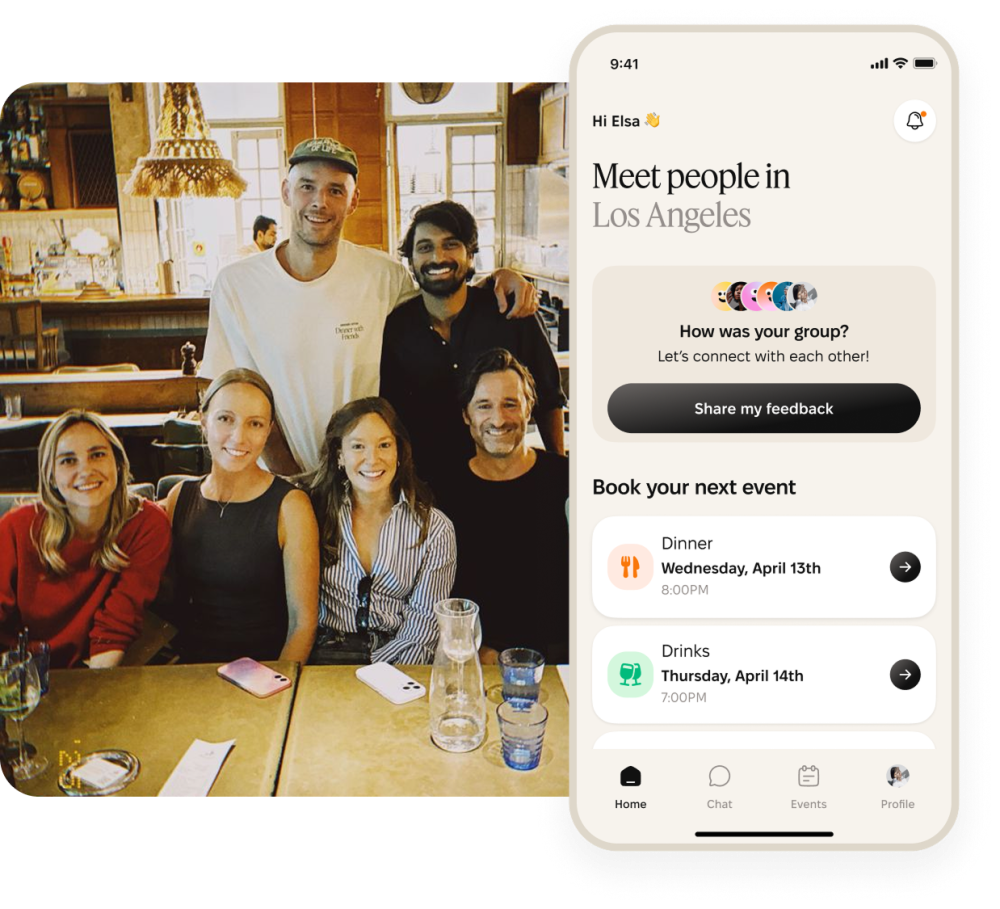
TL;DR: If you want a direct Eventbrite alternative for finding local events, Meetup is the closest match and most events are free to attend, though the choosing and the walking in cold still sit with you. If the real goal is meeting people rather than attending things, that's a separate problem from event ticketing, and it's the one Timeleft is built for. It removes the two moments that usually drain you. Choosing what to do and figuring out who you'll talk to when you get there. For adults who want a predictable room and a group that's already matched before they arrive, Timeleft is the easiest place to start.
You don't open Eventbrite because you have run out of things to do. The letdown usually comes later, when a night that looked fine on the listing page doesn't quite hold up in real life. The room is full of people who already know each other, and there's no obvious way into a conversation without forcing it. Eventbrite is built to sell attendance, not to make sure you talk to anyone once you arrive.
That difference matters most if you're neurodivergent, introverted, socially anxious, or done spending 20 minutes before every event deciding how to get out of it. The right platform isn't the one with the biggest calendar. It's the one that lowers decision load before the night starts, and that's where Timeleft stands apart from the usual Eventbrite alternatives for meeting people.
In this article:
- Why Eventbrite alternatives exist for structured socializing
- Seven proven platforms for predictable group gatherings
- Find your ideal match based on event style
- Exactly how these platforms handle your arrival
- FAQs
Why Eventbrite alternatives exist for structured socializing
Eventbrite does what it is designed to do well. Its organizer tools are built around ticketing, promotion, and event management, not matching strangers into a group that will talk to each other. Eventbrite is widely described as a platform to create, promote, and sell tickets for events of all sizes, and its attendee side is still oriented around discovery and purchase rather than conversation. That's useful if you want a concert. It's much less useful if you want dinner with people and a table that already exists when you arrive.
The mismatch shows up in the parts of the night Eventbrite doesn't control. You still pick the event, read the room, find your way in, decide who to approach, and figure out when to leave. Those are real costs for anyone whose energy is limited, and a room full of people isn't automatically a usable room.
Why unstructured events drain energy
Unstructured events ask you to keep making micro-decisions while you're already spending energy on social interpretation. Where do you stand, and who looks open to talking. How do you join without interrupting, and when can you leave without making it weird. That stack gets expensive quickly if you have ADHD, autism, social anxiety, or a short social battery, and it's why so many people who like other people still bail on open-ended plans.
The useful question isn't "Is this event inclusive?" It's "Does this event remove enough decisions that I can stay present?" A week-long intervention with strangers found that repeated conversations made people less fearful of rejection and more confident in conversation, but the key word is repeated. You don't get repetition from a format that burns you out before the second attempt.
Criteria for low-stimulation events
A lower-friction social format usually has a few things in common. The start time is fixed, the group isn't open-ended, the venue is chosen in advance, and the host isn't improvising the room in front of you. You should also know before you arrive whether you're expected to mingle, sit, move, or simply show up and follow the evening as it unfolds.
That's the standard this article uses for each platform below. If an app gives you a calendar, you still do the work. If it gives you a matched table, a set booking window, and a known venue reveal, it carries more of the load for you.
| Platform | Typical social unit | Matching mechanics | Decision load on the night |
|---|---|---|---|
| Timeleft | Small group, usually four to six for dinner | Matched by Timeleft from quiz answers and preferences | Low |
| Meetup | Any size | Self-selection by interest and RSVP | Medium to high |
| We3 | Small group | Questionnaire-based trios | Varies by group |
| Bumble For Friends | 1:1 or groups | Profile browsing and mutual opt-in | Medium |
| Peanut | 1:1 or small groups | Interest and proximity discovery | Varies by connection |
| Nextdoor | Neighborhood threads and events | None | Varies by event |
| Friended | Post-based chats | Post and prompt-based connection | Varies |
Seven proven platforms for predictable group gatherings
Each platform below is ranked by how much of the night it handles for you. Timeleft comes first because it removes the most decisions before you walk in.
1. Timeleft: structured dinners without the awkward start
If you landed here searching for an Eventbrite alternative, the honest answer is that Eventbrite and Timeleft do different jobs. Eventbrite is a ticketing platform, and its job ends at the door. Timeleft is built for what happens after that door, putting you in a room where the social work has already been reduced. You take a short personality quiz, subscribe, and choose when and where you want to go. For dinners, the target group is four to six people, with other formats varying by city.
That structure removes the first round of decisions before the night even starts. There's no group chat to coordinate and no venue research spiral waiting for you. Timeleft also gives you In-app Icebreakers for the first few minutes and Impressions after the event, which helps the evening feel less like a test and more like a social format with a shape to it. If you want the simplest on-ramp, Bring a +1 to your first event and make the room smaller in your head.
Every decision that would normally sit with you is settled before the night starts, so the evening arrives with a clear shape instead of an open question.
2. Meetup: pre-planned group outings with a lot of browsing
Meetup is still useful if you want a hobby-led room and you're willing to do the filtering yourself. The platform is built around groups and RSVPs rather than matching, which means you can usually find something, but you still have to choose the event, assess the organizer, and walk into whatever format that organizer has set up.
Meetup works best when you have the energy to browse and self-select. The free-to-attend model keeps the barrier low, and if you know what kind of group you're looking for, you can usually find it. Just know that the choosing is yours to do.
3. We3: matched trios with a narrow focus
We3 is built around matching people into small groups rather than dropping them into a big open event. That makes it more structured than Meetup and closer to Timeleft on the "fewer strangers at once" axis. The tradeoff is that the format is narrower, and the product is still more about forming a trio than giving you a broad set of social formats across cities.
If you want a small group and only a small group, We3 can make sense. The format is deliberately narrow, and the product doesn't extend much beyond the trio itself, so if your social life needs more than one repeatable format, you'll likely outgrow it.
4. Bumble For Friends: guided matching, but still on you to organize
Bumble's September 2025 relaunch moved the product toward group-based connection, with a new Groups tab, chat rooms, and hangout planning. That's a real improvement over pure one-on-one swiping, and it makes Bumble For Friends more social than it used to be. The free model and selfie verification are also genuine strengths, and it's fair to say the app now tries harder to get people from matching to meeting.
Even with the relaunch, the burden still lands on the members to turn a match or group into an actual plan. Timeleft is the better fit when you want the plan to exist before you have to make it.
5. Peanut: low-pressure, but mostly one-on-one
Peanut is designed for mothers and people in similar life stages who want to meet others nearby and start conversations. It's warmer and more specific than a general-purpose social app.
Still, Peanut is built around discovery and connection rather than pre-booked, pre-matched events. The planning and follow-through still sit with you once a connection is made.
6. Localized events via Nextdoor
Nextdoor is useful when you want local information and the occasional community event. It's not designed as a social matching product, and the event experience is usually loose enough that you still have to read the room and create your own opening. If you want a night that already has a social container around it, Nextdoor will still leave too much up to you.
7. Friended: avoiding social exhaustion by starting online
Friended starts from posts and conversation prompts rather than events. That can be gentler than walking into a venue cold, because the first interaction happens in writing and the pace is easier to control. The downside is that it doesn't solve the in-person part. If the real issue is the transition from wanting connection to being in a room with people, Friended keeps you online longer than Timeleft does.
Find your ideal match based on event style
The right choice depends on the kind of night you can sustain. Use the sections below to match each platform to the format that costs you the least energy.
For matched small-group dinners
Choose Timeleft if you want the closest thing to a table that's already waiting for you. It's the best fit if you want the venue to be handled, and the social group to be matched before you walk in.
Structured meetups for shared hobbies
Meetup is still the obvious place to look if your social life works best when there's a shared activity in the middle of the room. The catch is that the quality of the night depends heavily on the organizer, so it rewards patience and filtering. If you want hobby breadth, it can work. If you want lower effort, Timeleft is easier to repeat.
Apps for private, low-pressure meetings
Bumble For Friends, Peanut, and We3 are better if you want a narrower starting point than a big public event. They each create some kind of pre-selection before you meet. They don't remove as much of the planning burden as Timeleft does.
Apps that minimize decision load
If decision load is the main issue, the ranking gets simple. Timeleft first, then We3, then Bumble For Friends, then the rest. The whole problem here is too many live choices, and Timeleft is the one on this list built around that exact problem.
Exactly how these platforms handle your arrival
The part most people worry about is the arrival itself. For most platforms on this list, Meetup, Bumble For Friends, Peanut, Nextdoor, Friended, the honest answer is that you're on your own once you walk through the door. No reserved table. No matched group waiting. No sequence of steps telling you what happens next. You find an opening. You figure out who looks approachable. You hope the timing's right. That's fine if you've got the energy. But it's the exact gap Timeleft is built to close, so the rest of this section focuses there.
Step by step: booking your seat
The booking flow matters because the harder the setup, the more likely the night never happens. On Timeleft, the path is simple. Take the quiz, subscribe, choose the format, date, and neighborhood, and wait for the reveal. Booking and rescheduling close 13 hours before the event, while cancelling stays open until four hours before, which gives you a little breathing room if your energy drops late in the day.
The logistics of your first event
A first Timeleft dinner is intentionally light on unknowns. The venue is revealed 12 hours before the event, and a group preview appears on the day. You don't see profiles to browse before you meet. The table is reserved for your group, but seats are not assigned, which keeps the evening structured without turning it stiff.
The dinner itself usually runs about three hours, though that's not a rigid end time and shouldn't be treated like one. Food and drinks are paid separately at the venue, which keeps the subscription separate from the meal. That separation is useful if you're trying to estimate cost before you commit.
Predictable steps to calm pre-event nerves
What actually calms pre-event nerves is the sequence. You know when you can book, when you can cancel, when the venue lands, and roughly what kind of group you're walking into, and that lowers the amount of social guessing you have to do before the first hello. For anyone who's spent years arriving at events already tired, that sequence is what makes the difference.
Take the personality quiz, subscribe, and show up to your first event.
FAQs
What's the best alternative to Eventbrite for meeting people?
Eventbrite is a global self-service ticketing and event discovery platform, while Timeleft is a social app that matches you into a small group and books the venue, so the two aren't direct alternatives. If your goal is meeting people rather than buying a ticket, Timeleft removes more of the social work, and Meetup is better for hobby browsing.
Do these apps work for introverts or people with social anxiety?
Yes, but they work differently. Timeleft is the easiest fit for introverts and people with social anxiety because the venue, group, and booking window are handled before you arrive, which lowers the amount of live improvisation you have to carry.
Which platforms require the least planning on the night?
Timeleft requires the least planning on the night because the group is matched and the venue is pre-booked before you arrive. We3 is the next closest, while Meetup and Bumble For Friends still leave more coordination to you.
Are there LGBTQIA+-friendly alternatives to Eventbrite?
Yes, and the right one depends on whether you want identity-first matching or simply a safe table where you don't have to explain yourself. Timeleft runs dedicated LGBTQIA+ dinners in Paris, with other cities piloting the format, and standard events everywhere else.
How much do these apps cost compared to Eventbrite?
Eventbrite itself is mostly a ticketing marketplace, while the apps above use different models. Timeleft starts from $27.99 a month for new members in the US, prices vary by market, and that covers event access only. Food and drinks are paid separately at the venue. Meetup, Bumble For Friends, Peanut, Nextdoor, and Friended all have free tiers or free core use, so the real comparison isn't price but how much planning each one leaves on you.