TL;DR: The best dinner with strangers event for you depends on how much structure you need. Timeleft runs a $19.99/month subscription with algorithmic group matching, a pre-booked venue, a day-before reveal, and a fixed table of typically four to six people, so the only thing left to do on the night is show up. EatWith offers chef-led intimacy but asks you to browse and book each experience yourself. Meetup is free to browse but depends entirely on organizer quality. If unstructured social formats cost you more energy than they give back, fixed-structure apps win.
Most comparisons of dinner apps lead with price or city count. Neither of those is the thing that decides whether you actually show up. What decides it is whether you know, before you commit, when the evening ends, where you are going, and how many people will be there. For a lot of people, not knowing any one of those is enough to cancel.
This article compares Timeleft against the main dinner-with-strangers alternatives on the dimensions that actually matter if open-ended socializing exhausts you: structure, fixed end times, group size, safety infrastructure, and whether the format leans social or romantic. You will get a side-by-side comparison table and honest notes on where competitors do things differently. This is a dinner party app comparison built around one practical question: which format costs you less on the night?
In this article:
- What makes dinner with strangers apps different from each other
- Evaluating app mechanics for low stress dining
- Best dinner with strangers app alternatives to Timeleft
- Dinner app features: a side-by-side review
- Where Timeleft excels for low-stimulation dining
- How other dinner apps handle the logistics
- How to select a low-friction dinner app
- FAQs
- Key terms glossary
What makes dinner with strangers apps different from each other
Most "dinner with strangers" apps look identical from the outside. Strangers, a table, a meal. Underneath, they split on one axis that matters more than price or city count. How much of the evening does the app decide for you, and how much does it leave to you?
Managing expectations through fixed formats
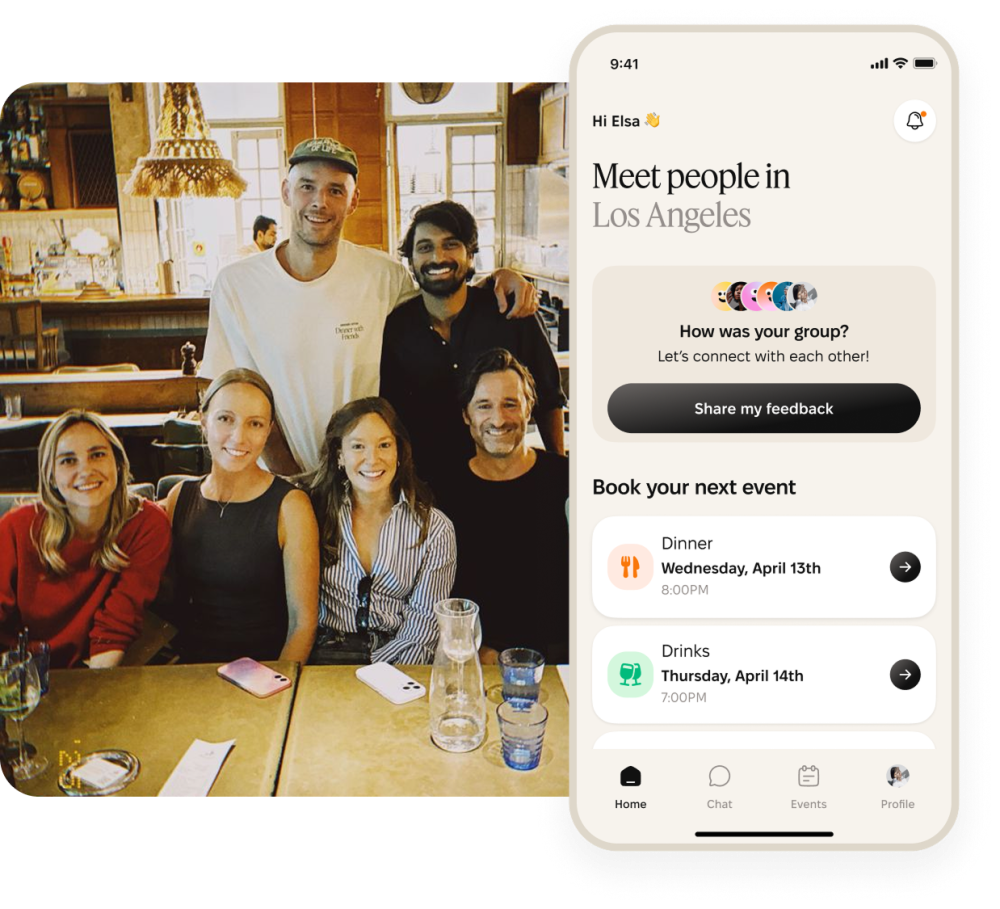
One end of the spectrum hands you a matched group at a pre-booked venue and tells you when to show up. The other hands you a browse page and leaves the rest to you. A fixed format means the start time, the venue, the group size, and the end of the evening are all settled before you leave the house. You take a short personality quiz and pick a city and a date. Timeleft builds the group and books the venue.
Defining purpose in stranger dinners
Not every dinner app is trying to do the same thing. One category sells a culinary experience. Another is built around social connection. A third category functions as a dating pool, whether or not it admits it. Knowing which one you are booking matters, especially if you want a social evening rather than a romantic one. Timeleft's standard dinners are social by default. For members who want a romantic context, Singles Events run across dinner and drinks formats explicitly.
Fixed group sizes and logistics
A table of four to six is small enough to hear everyone and big enough that no single person carries the conversation, which is why Timeleft keeps tables at that size. Marketplace-style platforms leave group size to the host, so the headcount varies event by event and you cannot count on a known configuration.
Evaluating app mechanics for low stress dining
If you are weighing Timeleft vs alternatives, the useful lens is not features so much as fatigue. Every unmade decision in an evening is a small withdrawal from a limited budget, and apps differ wildly in how many withdrawals they demand.
Defined schedules and seat assignments
A defined schedule means you know when the evening starts and roughly when it ends before you commit. Timeleft dinners run about three hours at a pre-booked restaurant. Meetup leaves timing entirely to whoever is running the group that night, and that person is paying at least $29.99/month to do it, which tells you something about the consistency you can expect.
Predictable seating and group size
Predictability is the difference between walking into a known configuration and scanning a room wondering where to stand. With algorithmic matching, your table exists before you arrive. Bumble BFF uses a self-selection model where you browse and swipe to match, then plan the meeting yourself.
Reviewing safety for neurodivergent users
For neurodivergent diners, safety is partly about behavior and partly about sensory and social predictability. The features that matter most here are structural ones. You know the venue before you go, and nobody can message you individually before the evening starts. The group size is fixed. Timeleft's terms and safety rules are built into the format rather than bolted on afterward.
How structured dinners reduce fatigue
Research on friendship formation supports the structure argument. Hall's 2018 study found it takes roughly 50 hours together to move from acquaintance to casual friend, which means repeatable, low-cost social occasions matter more than any single brilliant night out. A format you can sustain beats a format you survive.
Best dinner with strangers app alternatives to Timeleft
Here is the honest lay of the land, with each competitor's real strength named and paired with what Timeleft offers for the same need.
Refined alternatives to Timeleft
The main alternatives split broadly by how much they hand back to you. EatWith is a chef-led marketplace where you browse and book each experience individually. Meetup is organizer-led, and Bumble BFF puts the planning entirely on you after the match. Newer entrants like 222 Place run fixed-format social dining on a hybrid model, per-event or monthly subscription, currently available in fewer cities.
EatWith: chef-led dining with browse-and-book structure
EatWith is built around culinary authenticity, with locals hosting everything from home-cooked dinners to food tours, per this EatWith platform analysis. For a reader who wants the food to be the point, that intimacy is real. The trade-off is that you browse hosts and book each experience individually, which is exactly the decision work Timeleft removes with a matched group and a venue chosen for you.
How alternative apps manage logistics
Meetup's strength is sheer scale and free browsing across every interest category imaginable. Its weakness is that everything depends on the organizer. Everything from the format to how the group behaves is down to whoever is running the event that night. Meetup organizer pricing starts at $29.99/month, which means the person running your evening is a volunteer paying for the privilege. Timeleft pairs that breadth of choice with standardized logistics that do not depend on one person's energy.
Fixed-schedule dinner apps compared
Among fixed-schedule options, the differences narrow to matching method and footprint. 222 Place runs the same fixed-format social dining with a hybrid per-event or monthly model, and Timeleft answers with algorithmic matching across 52 countries and 200+ cities, so one subscription travels with you. Swipe-based apps like Bumble BFF give you profile control before committing, which some readers genuinely prefer, and Timeleft trades that control for blind matching so there is nothing to browse or second-guess.
Cost models across dinner apps
| App | Subscription fee | Per-event fee | Meal cost |
|---|---|---|---|
| Timeleft | $19.99/month (unlimited events) | None | Paid at venue |
| EatWith | None | Per-experience pricing, 30% service fee added | Included in event fee |
| Meetup | Free to browse | Free to attend or ticketed, set by the organizer | Varies by event |
| Bumble BFF | Free or paid Premium tier | None | You arrange and pay |
Dinner app features: a side-by-side review
Here is the core comparison. The last row is the one worth looking at first.
| Feature | Timeleft | EatWith | Meetup | Bumble BFF |
|---|---|---|---|---|
| Group size | Fixed, typically 4-6 per table | Host-determined, variable | Organizer-set, often 20 to 200 | 1-on-1, plus group chats |
| Matching method | Algorithmic, blind | Self-select host/experience | Self-select interest groups | Swipe-based 1:1 matching |
| Cost model | $19.99/month + own meal | Per-event, variable pricing | Free to browse; organizer fees | Free or Premium |
| Planning effort | Very low, almost nothing to decide | Medium, you pick and book each time | High, you plan everything | High, you message and arrange |
The table above reflects documented mechanics from help centers and booking flows, cross-referenced against user reviews cited in this article. Look at the last row before anything else. Platforms where you browse hosts or message potential matches individually leave all that work with you. Fixed-format apps take it off your plate before you leave the house.
Comparing predictability across apps
Predictability adds up. When everything about the evening is pre-decided, the only variable left is the conversation itself. When any one of those is open, your brain holds it open all evening.
Predictable start and end times
EatWith and Meetup both leave the end time to whoever is running the evening. If you have ever done the mental math of "can I leave yet," a stated end point is not a small feature.
Ideal group sizes for low stress
Four to six people is enough that the conversation distributes itself, and few enough that nobody disappears into the background. Timeleft's matching algorithm builds balanced tables across backgrounds and personalities, and 96% of diners report feeling compatible with their group.
Standardized vetting and safety protocols
| Safety feature | Timeleft | EatWith | Meetup |
|---|---|---|---|
| Age requirement | 18+ | 18+ platform-wide | Typically 18+ |
| Pre-event privacy | Profiles hidden until after | Host profiles public | Member profiles visible |
| Reporting | In-app, anonymous | Platform support | Community flagging |
| Guest protection | Group-only chat pre-event. Individual messaging after via Connect | Host vetting, insurance | Organizer discretion |
The case for platonic dinners
This needs saying early. These apps are for socializing, not dating, and that question comes up more than any other. Timeleft runs separate Singles Events for members explicitly seeking romance, which keeps the standard dinner table unambiguous. One reviewer described the standard format this way:
"Very good experience. Second dinner with Timeleft and every time I spent a very nice evening with like-minded people. A great opportunity to meet up new people, be it for just one evening or for longer friendship" - Celine on Trustpilot
Where Timeleft excels for low-stimulation dining
Of all the dinner with strangers apps compared here, Timeleft is the one that treats the planning overhead as its problem rather than yours. That shows up in four concrete ways.
Fixed seat, fixed time, no decisions on arrival
You take a short personality quiz, pick a date, and the subscription handles the rest. The algorithm matches your group and books the venue. The details land the day before, by which point there is nothing left to arrange and nothing left to dread. For a lot of people, that absence of dread turns out to be the thing they didn't know they needed.
Know exactly when the evening concludes
The dinner runs about three hours. Reviewers keep coming back to how well the matching holds up in practice:
"My experience exceeded my expectations by far. I spent a wonderful dinner with bright and open-minded strangers. The event was well-organised and most likely the algorithms were working well too, to have created this combination of participants. 5 stars" - Regina on Trustpilot
Designed for platonic social connection
The standard dinner table is social by design, with conversation starters built into the app so the opening stretch of the evening has somewhere to go. What a connection becomes afterward is entirely open-ended. Some become friends. Others become travel companions or something harder to put a name to. The format itself never asks you to perform romance.
Standardized logistics for every city
One subscription works across the full footprint, and you can book events in another city when you travel. The range of event formats covers dinner, drinks, coffee, and runs in most markets, all on the same matching and booking system. You can check whether your city is covered before subscribing.
One thing worth knowing before you book. No-shows are a real part of the format globally, and Timeleft charges a no-show penalty specifically to protect the group experience and the time of the other diners at the table.
How other dinner apps handle the logistics
Each alternative covered above solves the same core problem differently. Where they diverge is in how much of the evening they hand back to you.
In-home intimacy vs. zero planning
EatWith puts you in someone's home with a host cooking for you, and that intimacy is its genuine strength. Timeleft answers the same need for a warm room with vetted restaurant partners, so the setting is a proper restaurant rather than somebody's kitchen. Bumble BFF sits at the other extreme. You get full profile control, and everything after the match is on you.
Personalization: group size and social identity
Marketplace platforms let you pick experiences by headcount, which gives you control at the cost of research. Algorithmic matching removes the choice entirely, and for readers who find choices expensive, removal is the feature. For LGBTQ+ diners, the question is whether a room is structurally safe, not just technically welcoming. Timeleft's standard dinners run on real-name, real-photo profiles and group-only chat, and a small number of markets pilot dedicated LGBTQIA+ dinners and drinks (confirm availability in your city before counting on one). Women-Only Dinners run on Tuesdays across 50+ cities on the same infrastructure.
How to select a low-friction dinner app
Run any app you are considering through these three checks before you pay for anything.
Fixed timing: Does the app tell you when the event ends before you book? If the answer is vague, the format will cost you more than the ticket price, and fixed timing is the single strongest predictor of whether you will actually attend instead of cancelling at 6pm.
Group size and venue model: Confirm group size (six or fewer for most people who find big rooms draining) and venue type. In-home formats can be lovely, but verify who else is coming and how the evening closes. A chef's dinner party with no stated end time is still an unstructured social event wearing a nicer outfit.
Structural safety signals: Look for identity requirements, group-only communication, an explicit non-romantic default for standard events, and anonymous reporting. A space marketed as safe should be able to show you the machinery, the way Timeleft's venue partnership standards and safety pages do.
The broader context supports picking something and sticking with it. The U.S. Surgeon General's 2023 advisory found that roughly half of U.S. adults experience measurable loneliness, with serious documented health consequences including increased risk of heart disease and premature mortality. Pew Research found 61% of U.S. adults rank close friendships as essential to a fulfilling life, more than double the share who said the same about marriage. The cost of a format you can sustain is lower than the cost of waiting for one that feels effortless.
The right app is not the one with the most users or the fanciest venues. It is the one where you know exactly when the evening ends before you commit to going. Take the personality quiz and subscribe.
FAQs
What is the best app to meet strangers for dinner?
Timeleft is the strongest option for readers who need structure. A $19.99/month subscription covers unlimited events. The group is algorithmically matched and the venue pre-booked. Tables run typically four to six people. EatWith suits diners who prioritize chef-led experiences over logistics simplicity.
How does Timeleft compare to other dinner with strangers apps?
Timeleft is the only major option that combines blind algorithmic matching with a day-before venue reveal across 52 countries and 200+ cities, with dinners running a fixed ~3 hours. Competitors either leave planning to you (EatWith), to a volunteer organizer (Meetup), or to a swipe-and-message pipeline (Bumble BFF).
Are dinner with strangers apps safe?
Safety varies by platform. The side-by-side breakdown of age requirements, pre-event privacy, reporting, and guest protection is in the comparison table above. For Timeleft specifically, 94% of group chats are never flagged and 99% of experiences occur without a safety incident.
Do dinner party apps have fixed end times?
Timeleft dinners run approximately three hours with a defined start, and some cities add an optional Last Drink afterward. Marketplace and organizer-led apps like EatWith and Meetup leave timing to the host or organizer, so end times vary event by event.
Are these apps for dating or just socializing?
The standard formats on Timeleft, EatWith, and Meetup are social, not romantic. Timeleft runs separate Singles Events for members explicitly seeking romance, keeping the regular dinner table free of dating pressure.
Key terms glossary
Algorithmic matching: Group assignment by a system using personality quiz inputs, rather than self-selection or swiping. Timeleft reports 96% group compatibility from this method.
Day-before reveal: The practice of releasing venue name, address, and meeting time 24 hours before the event, which removes pre-event overthinking.
Planning effort: The mental overhead of making small choices before and during an evening out, things like where to go, when to leave, and what to say. Structured formats reduce this by deciding most of it before you arrive.
Fixed format: An event structure where the venue, group size, start time, and approximate end time are all set before the guest commits.
No-show penalty: A fee for skipping a booked event without cancelling. Timeleft charges 35% of the monthly subscription price to protect group experience and venue commitments.
Group-only chat: A safety design where attendees can only message the whole table before and during the event. After the evening, the Connect feature lets you message individuals directly, make plans, and keep the conversation going.