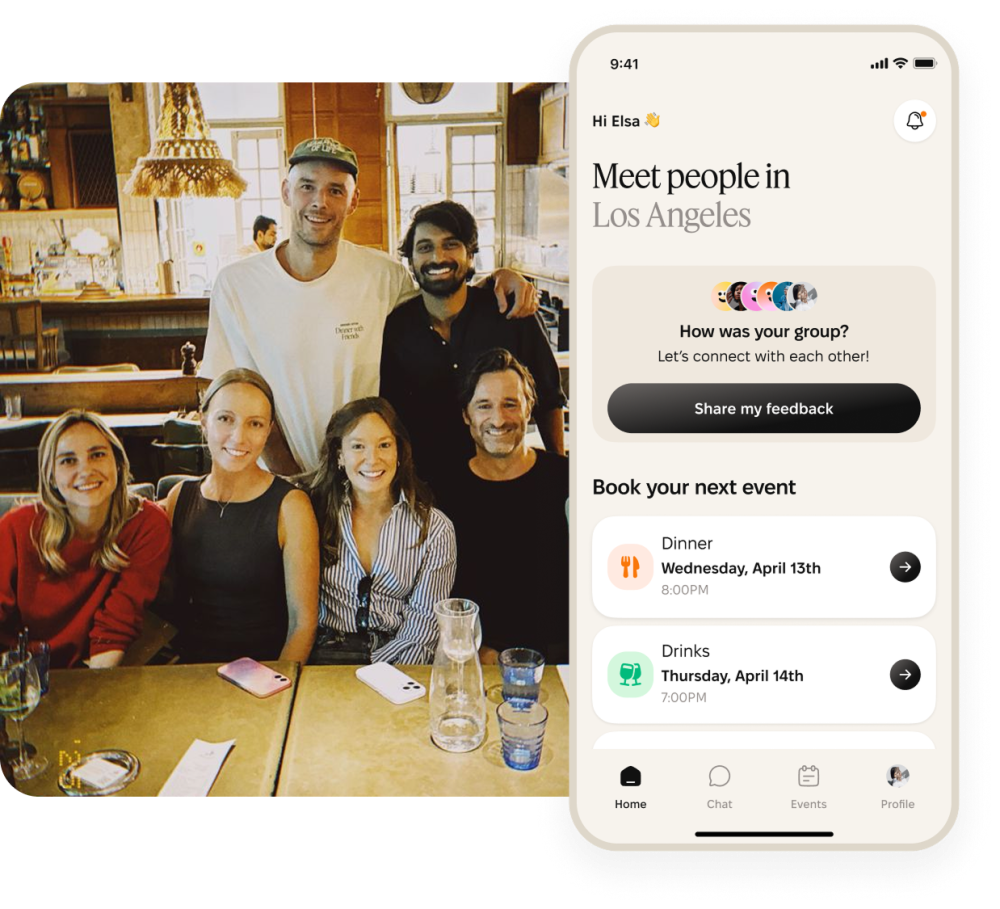
TL;DR: Every platform has events. The one that works for introverts is the one that removes the most decisions. Timeleft tops this list because it replaces browsing and planning with a fixed structure, a short personality quiz, a matched group, and a pre-booked venue, with cancellation available close to the event. Meetup is free but unstructured. Bumble BFF gives control but leaves planning to you. 222 Place is boutique but unpredictable. If you want low stimulation social events where the format does the interpretive work, start with the one that removes decisions instead of adding them.
Eventbrite solves the wrong problem for introverts. The events are fine. The issue is that every unstructured social format asks you to make decisions the moment you walk in.
It lists events but leaves every logistical decision to you. The best alternative has fewer listings but removes more decisions from your evening. Below are five platforms ranked by how many judgment calls they take off your plate. The winner removes venue choice, group composition, timing ambiguity, and exit strategy before you leave the house.
In this article:
- The design flaws blocking neurodivergent access
- The science of low stimulation gatherings
- Where to find a better Eventbrite alternative: five platforms ranked
- How Timeleft removes format barriers for neurodivergent adults
- Reducing decision fatigue in event planning
- Autism-friendly social events: what to look for
- How to choose your first structured social event
- FAQs
The design flaws blocking neurodivergent access
Most event platforms assume unlimited executive function. They list events. You do the rest. For many introverts and neurodivergent adults, the rest is the part that costs the most.
Why undefined formats drain your battery
Social exhaustion happens when the sensory and interpretive demands of a room become overwhelming, and it often hits neurodivergent adults hardest in unstructured settings. Research on executive function and social functioning in autism suggests that people on the spectrum perform worse on open-ended tasks than on structured ones, because the invisible work of reading unspoken rules, interpreting facial expressions, judging conversational timing, and managing sensory input runs in the background the whole time. The most-cited work here focuses on children and adolescents, and the finding comes from the literature it reviews rather than its own primary data, but the pattern maps consistently to what adult neurodivergent people report. The battery drains from managing the format, not from the people.
The hidden cost of social decisions
Every unstructured event forces real-time judgment calls others barely notice. Where to stand when you arrive. Who to approach. How long to stay before leaving feels acceptable. Each micro-decision draws from the same pool of executive function, and that pool runs dry faster in open-ended settings. Planned events with a clear beginning, middle, and end give your brain a script to follow, while unplanned events force improvisation.
The science of low stimulation gatherings
Structure isn't a preference. For many people, it's the difference between attending and canceling.
Defined boundaries for easier social flow
Hans Eysenck’s arousal theory links extraversion-introversion to individual differences in cortical arousability, probably mediated by the ascending reticular activating system. Introverts tend toward higher baseline cortical arousal than extroverts, which helps explain why a fixed start time and a predictable format, with fewer unknowns to process, can make walking into a room feel less daunting. You know what to expect, so your nervous system doesn’t burn energy scanning for it.
Calm spaces for easier connection
Sensory load compounds the problem. Environments with lower noise, seated arrangements, and smaller groups allow introverts and neurodivergent adults to stay closer to their optimal arousal zone, which leaves more capacity for conversation.
Why fewer choices mean more comfort
Decision fatigue is a documented cognitive phenomenon, and it compounds social fatigue. Reducing the number of choices a social event demands preserves the mental energy you need for the interaction itself. The fewer decisions the format requires, the more of you is available for connection.
Eliminate pre-event decision fatigue
Browsing listings, comparing options, imagining worst-case scenarios, and planning exit routes all happen before leaving the house. A format that handles the venue, the group, and the timing removes that entire category of drain.
Where to find a better Eventbrite alternative: five platforms ranked
Not every platform is built the same way. Below are five options ranked by how many decisions they remove from your evening, with honest trade-offs for each.
| Platform | Structure level | What's handled for you | Best for |
|---|---|---|---|
| Timeleft | High | Venue, group, timing, exit window | Showing up without managing the format |
| Meetup | Low | None beyond RSVP | Free, broad interest communities |
| Bumble BFF | Low | Initial connection only | One-on-one control over who you meet |
| 222 Place | Varies by experience | Venue and activity | Mystery-driven nights out |
| Running clubs | Varies by club | Activity and location | Parallel socializing with shared movement |
1. Timeleft: low-stress, structured dining
Timeleft is the IRL connections app built around a simple sequence. You take a short personality quiz, subscribe, pick a format, date, and neighborhood, and show up. Timeleft matches the group, books the venue, and handles every logistical step in between. For dinners, groups target four to six people, though the actual number on the night can be smaller.
Knowing you can cancel close to the event lowers the activation cost of booking in the first place.
Timeleft runs across 52 countries and 200+ cities. Lower-intensity formats like coffee and walks run in select cities and are shorter and lighter than a full dinner. 96% of diners report feeling compatible with their matched group, which means the table usually works without you needing to manage it.
As an introvert in a new city, I’ve been looking for ways to meet new people — a daunting and nerve-racking task. A friend recommended Timeleft, and although I was very apprehensive and even considered backing out on the day of, I’m so glad I went! I ended up having a great meal with four wonderful people — all repeat diners — who made me feel incredibly welcome. Some of us connected after dinner and plan to meet again. I’ve already scheduled my next dinner! - Jeff on Trustpilot
2. Meetup: reducing social decision fatigue
Meetup is free to browse, and its user base is enormous. The trade-off is that Meetup is an open platform where organizers host and anyone RSVPs. There's no matching, no pre-booked venue chosen for your group, and no guarantee of format. Walking into a Meetup event means walking into a room where the organizer is a stranger and the agenda may or may not be clear. That works well for hobby-specific communities. It works less well if the room itself is the hard part.
3. Bumble For Friends: best for one-on-one control
Bumble BFF relaunched as BFF in September 2025 and lets you browse profiles, send waves, and connect one-on-one. Every match passes selfie verification, and the basic tier is free. The trade-off is that after the match, everything is on you. You message, you suggest a place, you negotiate a time, and you hope it isn't awkward. Many matches never become meetings.
BFF's strength is control over who you connect with. Timeleft's answer is removing the planning gap entirely, so the connection happens in person at a pre-booked table instead of stalling in a chat thread.
4. 222 Place: best for mystery-driven nights out
222 Place vets every guest and matches small groups around boutique experiences like pottery classes, matcha ceremonies, and themed dinners. The quiz goes deeper than most platforms. But selection isn't guaranteed, and waitlists are common.
5. Local running clubs: best for parallel socializing
Running clubs offer a shared activity that takes pressure off direct conversation. You run side by side, and the talking happens alongside the movement. The trade-off is that most clubs keep the format loose, often with no matching and no pre-set plan beyond a route and a start time, though this varies by club. You show up and figure out the social dynamics on your own.
How Timeleft removes format barriers for neurodivergent adults
The platform's design choices map directly to the friction points that make unstructured events costly.
Eliminate pre-event social anxiety
There are no profiles to browse before you meet. No swiping, no bios, no comparing yourself to strangers in advance. Timeleft reveals the venue 12 hours before the event, and a preview of who you'll meet (light context like job industries, not names or photos) appears on the day. The decision is already made, which removes the pre-event spiral of imagining worst-case scenarios. Booking your first dinner takes minutes and requires no social decisions at all.
Defined start and end times
Dinners run about three hours. That's a defined window, not a fixed end time, but it gives the evening a shape. You know roughly when it starts and roughly when it winds down. Compare that to a networking mixer or a Meetup event with no stated end point, and the difference is significant.
Lighter options for low energy days
Not every week has three hours of social energy in it. Coffee and walk formats are shorter and lighter than a full dinner, and formats vary by city. The Bring a +1 feature lets you bring someone from your existing circle, which helps if going solo feels like too much on a given week.
LGBTQIA+ dinners without dating pressure
Timeleft runs LGBTQIA+ dinners in Paris on Tuesdays, with the format piloting in additional cities. The framing is belonging and safety, not identity or matchmaking. These are group dinners at public venues with the same matched structure as every other Timeleft event, designed as a space where you don't have to explain yourself. If you're looking for romance specifically, Singles Events run across formats in around 30 cities, but the LGBTQIA+ dinners are built for connection without a romantic agenda.
Reducing decision fatigue in event planning
The decisions that happen before an event often cost more than the event itself.
Pre-commitment reduces cancellation guilt
Booking ahead means the decision is already made. A Timeleft subscription works the same way. You've paid, the event is booked, and the only remaining step is walking through the door. Booking closes 13 hours before the event, which means the commitment is locked in before the day-of anxiety peaks.
Why venue updates arrive 12 hours early
Timeleft reveals the venue 12 hours before the event, not days in advance and not the day of. That timing is deliberate. Close enough that you can't spend days imagining scenarios, and early enough that you can plan your route. The decision is made, so there's nothing left to dread. If you can't see your event details in the app, the help center walks through the timeline.
Remove the burden of event coordination
Organizing a group dinner with friends can mean a long back-and-forth message thread, last-minute dropouts, and a venue that was nobody's first choice. Timeleft skips all of it. The group is matched, the venue is booked, and confirmation arrives without a single negotiation. For socializing with ADHD, this matters because the coordination phase is where executive function drains fastest, and it's the phase most likely to produce a cancellation.
Autism-friendly social events: what to look for
Not every event labeled "inclusive" is structurally safe. Here's a checklist for evaluating whether a format accommodates rather than merely welcomes.
Clear logistics for stress-free events
Concrete logistics are the trust signal. Fixed start time, a venue you can look up, a group size you can prepare for, and a cancellation window that lets you back out without penalty. The Timeleft help center covers venue accessibility questions, and all events happen at public venues you could walk into off the street.
How to spot low stimulation events
Use this checklist before booking any social event:
- Fixed start and end times. Open-ended events force you to calculate your own exit.
- A set table. Standing-only formats add sensory and spatial load.
- Clear agenda or format. "Networking mixer" tells you nothing. "Dinner for four to six" tells you everything.
- Small group size. Groups above eight to 10 increase the interpretation load.
- Calm environment. Loud bars and crowded rooms stack sensory input on top of social processing.
- A cancellation policy that respects uncertainty. If you can't cancel without losing money, the barrier to booking rises.
Socializing without the hidden exhaustion
The goal is leaving present rather than depleted. Success means the evening cost less than expected. That happens when the format handles the logistics so you can handle the conversation.
How to choose your first structured social event
Not every format suits every energy level. The right first event is the one that removes the most decisions, not the one that sounds most ambitious. Here's how to find it.
Prioritize low stimulation social events
Start with the format that matches your current energy, not the one that sounds most impressive. If a three-hour dinner feels like too much for a first outing, coffee or a walk offers a shorter window with the same matched structure. Formats vary by city, so check what's available near you before setting expectations.
Reduce social friction with a plus one
Bring a +1 is available for any event. You can bring a Timeleft friend or someone from your existing circle, which lowers the solo-entry barrier without changing the group dynamic. This is especially useful for a first event, where the walk from the door to the table is the hardest part.
Plan your exit to protect your battery
Cancellation stays open until four hours before the event. Knowing you can cancel lowers the barrier to booking in the first place, and it means you're never trapped in a commitment made on a higher-energy day. There's no pressure to stay for Last Drinks afterward, and no penalty for leaving when the dinner winds down. The safety guidelines cover block, report, and connection tools, and the community guidelines outline a three-stage enforcement process, so Timeleft manages the room even when you're not managing it.
Take the personality quiz, subscribe, and show up to your first Timeleft dinner.
FAQs
What's the best Eventbrite alternative for introverts who cancel a lot?
Timeleft, because cancellation stays open until four hours before the event. That window lowers the barrier to booking in the first place, which matters more than any motivational framing.
Are there autism-friendly social events that don't feel like therapy groups?
Yes. Timeleft dinners are matched groups of four to six at pre-booked public venues, with no wellness or self-help framing. The structure is built into the format, not layered on top as an accommodation.
How do you socialize with ADHD without burning out?
Choose formats with fixed structure and fewer on-the-night decisions. Timeleft removes venue, timing, and group composition from your plate, so you can be present instead of managing the room.
What are low stimulation social events and where do I find them?
Low stimulation events have fixed start times, small groups, seated arrangements, and calm environments. Timeleft's coffee and walk formats are lighter options, available in select cities.
Is Timeleft safe for LGBTQIA+ people, or is it performative?
Timeleft runs LGBTQIA+ dinners in Paris on Tuesdays, framed around belonging and safety, never dating. Public venues and vetted members are standard across all events.
How much does Timeleft cost?
From $27.99 a month for new members in the US, prices vary by market. Food and drinks are always paid separately at the venue.